

More news on this day
Emirates has suspended all scheduled flights until at least March 7 as widening conflict and sweeping airspace closures across West Asia trigger one of the most severe disruptions to global aviation in years.
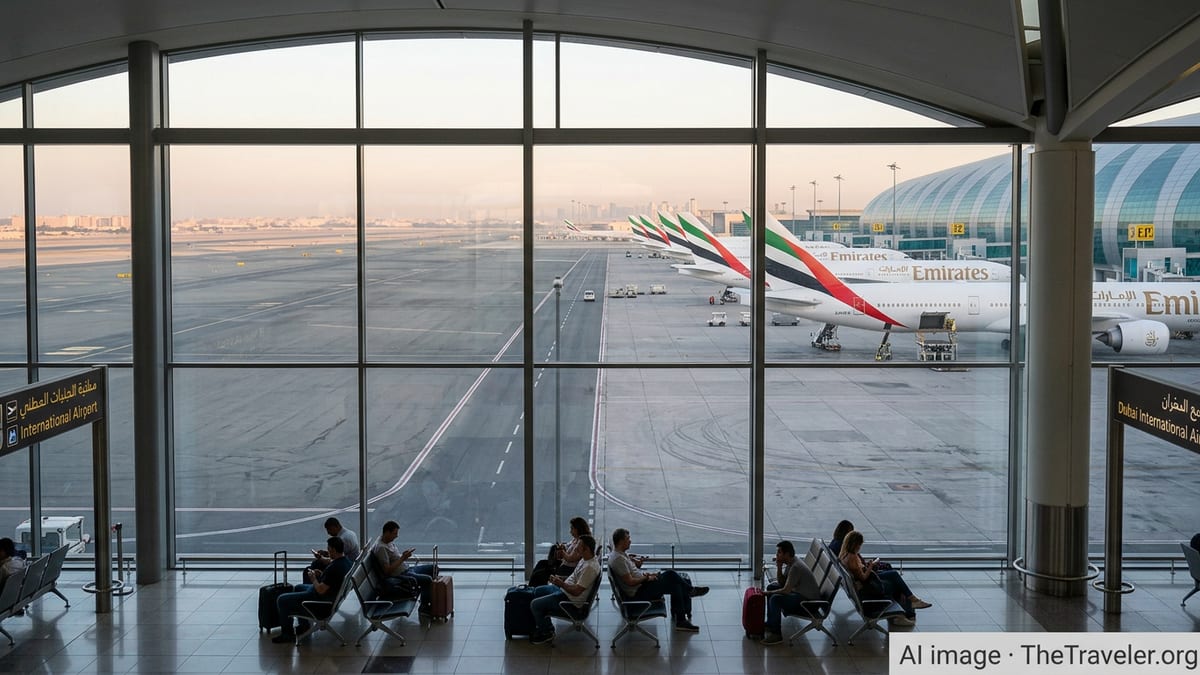
Major Gulf Hub Grinds to a Near Halt
Dubai-based Emirates confirmed on Friday that it has frozen all scheduled passenger services through March 7, citing widespread regional airspace closures and evolving security risks. The move comes after days of rolling cancellations and diversions following US and Israeli strikes on Iran and retaliatory attacks that have rippled across the Gulf and Levant.
The shutdown effectively throttles capacity at Dubai International, the world’s busiest airport for international traffic, and sharply curtails one of the most important east–west transit corridors for long-haul travelers. Limited evacuation and special services are operating, but normal commercial schedules remain largely paused, with passengers urged not to go to the airport unless they hold a confirmed, operating booking.
Etihad Airways in Abu Dhabi and Qatar Airways in Doha have also slashed operations, running only a small number of carefully routed flights, if any, through heavily controlled airspace. Aviation analysts describe the shock to Gulf hubs as the most acute test of the industry’s resilience since the early phases of the COVID-19 pandemic.
Authorities in the United Arab Emirates say recent airspace restrictions were introduced as temporary, exceptional measures to protect civilian passengers and crews. Regulators are now allowing a gradual, highly controlled resumption of traffic, but warn that any further escalation of hostilities could lead to renewed blanket closures with little notice.
Global Carriers Join Regional Airlines in Freezing Routes
Emirates’ decision follows a wave of suspensions by regional and international airlines that have progressively redrawn the global route map over the last week. Etihad, Qatar Airways, flydubai and Air Arabia have halted or sharply reduced services to multiple destinations across the Middle East, with many carriers canceling flights outright rather than attempting complex and fuel-intensive detours around conflict zones.
International airlines including KLM, Air France, ITA Airways, Delta Air Lines and Air Canada have likewise suspended flights to key cities in the United Arab Emirates, Qatar, Saudi Arabia, Iran and Lebanon, among others. Several European and Asian carriers have also withdrawn from routes touching the broader West Asia region, citing airspace closures over Iran, Iraq, Israel, Qatar, Bahrain, Kuwait and Syria, and partial restrictions affecting parts of the Gulf.
The cascading suspensions have effectively severed many of the usual links between Europe and Asia that rely on Gulf hubs for transit. Flight tracking services report thousands of cancellations across Dubai, Abu Dhabi and Doha in recent days, with aircraft diverted to alternative airports in Turkey, Egypt and further afield where possible. Some carriers, including major European groups, have extended suspensions into next week as they await clarity on when critical air corridors can safely reopen.
Industry experts note that the current pattern mirrors past conflict-related disruptions in the region but on a far broader scale, with simultaneous closures across multiple flight information regions. Airlines must now weigh not only direct security risks but also the operational complexity and cost of rerouting around large no-fly areas in already congested skies.
Cross-Border Strikes and Airspace Closures Redraw the Map
The aviation shutdown is rooted in an escalating conflict centered on Iran and Israel that has spilled across borders and drawn in Gulf states. Intensified Israeli strikes on Tehran and Beirut, US attacks on Iranian assets and subsequent retaliatory actions have prompted multiple governments to close or heavily restrict national airspace, effectively erecting a moving barrier across West Asia.
Flight information regions over Iran, Iraq, Israel, Qatar, Bahrain, Kuwait and Syria have seen prolonged shutdowns or severe curbs on civilian overflights. Parts of the UAE and eastern Saudi Arabia have remained only partially open, with authorities imposing altitude, routing and timing constraints that sharply limit available capacity. Military activity, including missile launches and drone operations, has heightened the risk profile for civil aviation, particularly at cruising altitudes traditionally considered safe.
The result is a fragmented patchwork of accessible routes that leaves airlines with few viable options for connecting Europe, Africa and the Americas to South and East Asia. Long-haul flights that would typically transit the Gulf now face lengthy detours via the Caucasus, Central Asia or the Red Sea, if they operate at all. Many carriers have concluded that suspending operations is safer and more economical than attempting to stitch together ad hoc routings through an unstable airspace picture.
Regional regulators, including the UAE’s General Civil Aviation Authority, have issued repeated safety alerts highlighting the elevated operational risks, from potential misidentification of civilian aircraft to navigation disruptions caused by jamming and spoofing. Airlines are being advised to conduct continuous risk assessments and to remain prepared for sudden changes to approved flight paths.
Travelers Stranded Worldwide as Limited Flights Prioritize Evacuation
The immediate human impact is being felt by hundreds of thousands of travelers stranded at airports around the Middle East and at far-flung hubs that rely on Gulf connections. Tourists, business travelers, migrant workers and religious pilgrims have found themselves stuck in transit cities with limited accommodation, scarce onward options and little clarity on when regular services will resume.
In recent days, a small number of evacuation and special relief flights have operated from the UAE and other Gulf states, largely coordinated by foreign governments seeking to extract citizens from high-risk areas. These flights are prioritized over commercial demand, leaving many ticketed passengers on paused itineraries waiting for rebooking or refunds while airlines triage capacity.
Travel advisories issued by Western and regional governments now urge citizens in several countries, including the UAE, Saudi Arabia, Lebanon, Jordan and Egypt, to depart as soon as they can secure safe transport, underscoring the seriousness of the situation. However, with much of the surrounding airspace still restricted, viable exit routes remain limited and subject to abrupt change.
Airlines are broadly offering rebooking waivers and, in some cases, refunds for affected passengers, but policies vary widely by carrier and route. Travelers are being told to monitor official airline channels and airport notices closely and to avoid heading to terminals unless they hold written confirmation that their flight is operating.
Industry Faces Mounting Operational and Financial Pressure
For the aviation industry, the crisis presents a dual challenge of safety and solvency. Gulf carriers such as Emirates and Etihad, whose business models are built on high-frequency, long-haul connections through their hubs, are seeing core networks suddenly paralyzed. Each additional day of near-total suspension represents significant lost revenue, sunk operating costs and complex crew and fleet repositioning exercises.
International airlines with thinner margins and smaller regional footprints face their own pressures, from compensating stranded passengers to absorbing the higher fuel and staffing costs associated with lengthy detours. Airline shares in Europe and Asia have already come under selling pressure as investors price in prolonged disruption along one of the world’s busiest long-haul corridors.
Aviation insurers and regulators will also be closely watching the evolving risk environment. War risk premiums and coverage exclusions could rise if hostilities widen or if any civil aircraft are threatened, further increasing the cost of operating in or near the region. Airport operators in Dubai, Abu Dhabi and Doha, meanwhile, must contend with dramatically reduced traffic volumes while maintaining readiness to scale up quickly when restrictions eventually ease.
While authorities stress that current airspace controls are temporary, few in the industry expect a swift return to pre-crisis normality. Even if active hostilities abate, airlines are likely to restore schedules cautiously, with a phased reintroduction of routes and continued avoidance of certain airspace until regulators and security agencies provide firm reassurances about long-term safety.