

More news on this day
Emirates is sharply scaling back its Airbus A380 footprint in the United States, consolidating the superjumbo on a smaller number of high-demand routes as shifting regional conditions and a new generation of long-haul jets begin to reshape the carrier’s strategy.
Get the latest news straight to your inbox!
A Leaner A380 Footprint in the United States
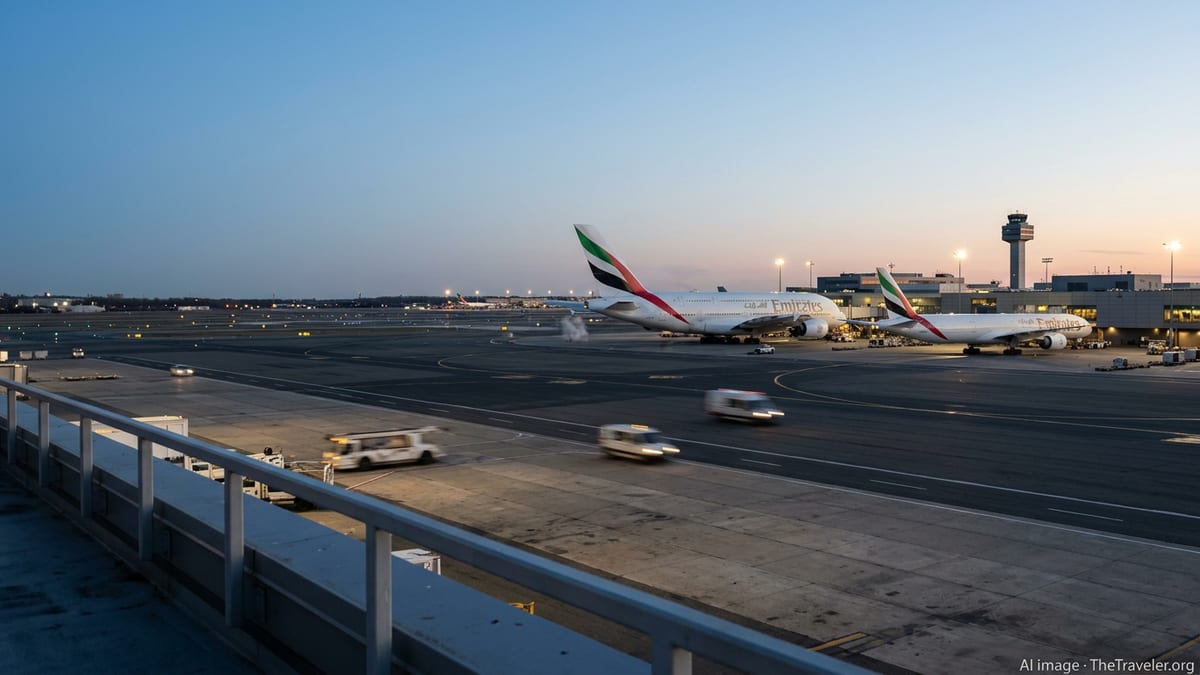
Publicly available schedule data and specialist aviation analysis indicate that Emirates has reduced its US Airbus A380 network to roughly half of the destinations it served at its peak, concentrating the double decker on a handful of core gateways such as New York, Los Angeles and Washington. Earlier experiments with A380 services to other US cities have been rolled back over the past several years, with many flights reverting to Boeing 777s as the airline rebalances capacity.
Industry coverage of Emirates’ network shows that the airline once routinely deployed the A380 to additional US airports including Boston, Dallas Fort Worth, Chicago O’Hare and Orlando, often on a seasonal or trial basis. As of 2025 and into early 2026, these airports are no longer part of the regular A380 roster, marking a notable retrenchment from the broader superjumbo push seen before the pandemic.
Analysts note that the pivot does not signal an abandonment of the A380, which remains central to Emirates’ long-haul model, but rather a more selective deployment. The carrier appears to be focusing the aircraft on routes where consistently strong premium and leisure demand, plus suitable airport infrastructure, can justify the A380’s high seat count and operating costs.
Regional Tensions and Airspace Disruptions
The reduction in US A380 services coincides with a period of heightened geopolitical tension across parts of the Middle East, which has led to intermittent airspace closures and routing changes. Operational updates published by Emirates in early March 2026 describe rolling adjustments and day by day changes to some schedules as the airline works around restricted corridors and congestion.
While these disruptions affect a broad cross section of Emirates’ network rather than exclusively A380 routes, they add complexity to planning long haul capacity, including to North America. Longer flight times on certain routings can tighten aircraft and crew availability, prompting airlines to prioritize flexibility by leaning more heavily on twin engine widebodies such as the Boeing 777 and Airbus A350.
Regional uncertainty also interacts with demand patterns. Travel advisories, shifting corporate travel policies and fluctuating tourism flows can all influence how much capacity an airline is willing to commit on its largest aircraft. In this environment, trimming superjumbo flying on marginal US routes and redeploying lift to more resilient markets can be seen as a risk management measure as much as a cost decision.
Fleet Renewal and the Rise of Next Generation Twins
At the same time, Emirates is deep into a sweeping fleet renewal that is gradually changing the balance between its A380s and newer, more versatile aircraft. Company disclosures and independent fleet databases show that the airline continues to operate well over one hundred A380s, but has also begun inducting Airbus A350 900s and has placed additional large orders for Boeing 777 9s, with deliveries scheduled through the late 2020s.
These next generation widebodies offer significantly lower fuel burn per seat and greater flexibility in matching capacity to demand on long haul routes. Aviation analysts observe that where Emirates once viewed the A380 as its default option on thick intercontinental city pairs, the carrier now has more tools to tailor capacity, particularly on routes where daily demand does not reliably fill more than 400 or 500 seats.
Schedule filings for 2026 highlight a broader pattern of A380 redeployment worldwide, not only in the US. On some high profile routes in Asia and Australia, A380s are being swapped for 777s or A350s during off peak periods, while selected destinations see seasonal upgauges to the superjumbo during holidays or summer peaks. This pattern suggests Emirates is treating the A380 as a premium, high density asset to be used surgically, rather than as a blanket solution for long haul growth.
Premium Economy and Changing Passenger Demand
A further driver behind the reshaping of Emirates’ US A380 network is the carrier’s aggressive rollout of premium economy, supported by what it describes as one of the largest cabin retrofit programs in commercial aviation. Publicly released plans outline billions of dollars in investment to refresh more than 200 aircraft, including many A380s and 777s, and to double annual premium economy seat capacity by 2026.
By mid decade, Emirates is targeting millions of premium economy seats per year across its network, including on selected US routes. Aviation trade coverage indicates that retrofitted A380s and 777s are being deployed first on markets where there is a strong mix of affluent leisure travelers and cost conscious business passengers who are willing to pay a surcharge for extra comfort without moving all the way up to business class.
In practice, this strategy can lead to a rethink of which aircraft best fits each US city. On some routes, a smaller widebody with a high share of premium economy and business seats may generate stronger returns than a very large A380 with more emphasis on sheer volume. The result is a patchwork of capacity decisions where the A380 remains the flagship on a few marquee US corridors while other cities see upgraded cabins on smaller jets instead.
End of an Era or Strategic Evolution?
Emirates’ decision to halve its US A380 routes invites the question of whether the superjumbo’s heyday in North America is ending. Aviation data shows a clear contraction from pre pandemic ambitions, and with no new A380s entering production, the long term direction of travel is toward more efficient twin engine jets.
However, executives at Emirates and coverage from financial and aviation outlets point out that the airline intends to keep its A380 fleet active into the 2030s, supported by ongoing cabin upgrades and product enhancements. The focus appears to be on squeezing maximum value out of the aircraft on a smaller set of trunk routes, especially those feeding the carrier’s Dubai hub with high yield connecting traffic between North America, Europe, Africa and Asia.
For US travelers, the changes translate into a more concentrated but still visible A380 presence. The superjumbo is increasingly marketed as a special experience on select gateways, while a new generation of quieter, more fuel efficient twins takes over the job of stitching secondary US cities into Emirates’ global network. Rather than a sudden end of an era, the halving of US A380 routes reflects a gradual evolution in how the world’s largest A380 operator deploys its signature aircraft in a more volatile and competitive landscape.