

More news on this day
Emirates has joined a growing list of global airlines slashing or freezing flights to the United Arab Emirates, Qatar, Saudi Arabia, Iran, Lebanon and other West Asian destinations, as sweeping airspace closures and cross-border strikes linked to the Iran war ripple through one of the world’s most vital aviation corridors.
Regional Airspace Shuts Down After Iran Strikes
The latest wave of disruption began on February 28, 2026, when coordinated United States and Israeli strikes on Iran were followed by Iranian retaliatory attacks across the Gulf, prompting rapid airspace closures in multiple countries. Aviation authorities in Bahrain, Iraq, Israel, Kuwait, Qatar, Syria and the United Arab Emirates moved to shut or severely restrict their skies, forcing airlines to cancel, divert or ground aircraft with little warning.
Key hubs in Dubai, Abu Dhabi and Doha, normally among the busiest crossroads for traffic between Europe, Africa and Asia, saw scheduled passenger operations brought to a near standstill over the subsequent days. Flight tracking maps showed swathes of empty sky over large parts of the Gulf, while long-haul routes that usually thread through West Asia were abruptly rerouted north over Turkey or south over the Arabian Sea, adding hours of flying time and substantial extra fuel costs.
Authorities and airport operators stressed that the closures were driven by security concerns as missile and drone strikes targeted infrastructure and population centers across the region. For travelers, however, the impact was immediate and chaotic, with hundreds of thousands stranded on the wrong side of now-closed borders and limited clarity on when normal schedules might resume.
By early March, leading Gulf carriers were acknowledging that a return to regular operations was unlikely before at least the end of the first week of the month, underscoring the scale of the disruption and the continuing volatility of the security situation.
Emirates and Gulf Carriers Suspend Most Operations
Dubai-based Emirates, one of the world’s largest long-haul airlines, confirmed that all scheduled flights to and from Dubai remain suspended until late on March 7, citing ongoing airspace closures and operational constraints. The carrier, which normally operates hundreds of daily departures through Dubai International Airport, said only a limited number of services were being mounted to support essential travel and repatriation.
Etihad Airways in Abu Dhabi has likewise suspended most scheduled flights, with earlier notices halting all operations to and from the UAE capital for extended periods while regional skies remain restricted. Low-cost operators flydubai and Air Arabia have also cut the bulk of their networks in and out of the Emirates, operating only a handful of special services as conditions allow.
Qatar Airways, whose Doha hub relies heavily on transcontinental transfer traffic, temporarily halted flights to and from Doha when Qatari airspace was closed, affecting both passenger and cargo operations. Oman Air and Kuwait Airways have issued similar notices cancelling or curtailing flights to a broad list of destinations across the Gulf, Iran, Iraq, Jordan, Lebanon and Syria.
Together, the suspensions by Emirates, Etihad, Qatar Airways and their regional peers have effectively frozen much of the commercial traffic into and out of the UAE, Qatar and eastern Saudi Arabia, turning what are usually some of the world’s most connected cities into isolated islands of limited and tightly controlled air access.
Global Airlines Join Widespread Flight Freezes
The shock to the region’s aviation network has quickly spread worldwide as non-Gulf airlines react to the deteriorating security picture and the closure of key air corridors. European heavyweights Air France, KLM and ITA Airways have suspended flights to multiple West Asian destinations, including the UAE and Saudi Arabia, while rerouting surviving services to bypass airspace over Iran, Iraq, Qatar, Kuwait, Bahrain and large sections of eastern Saudi Arabia.
North American carriers have adopted similar precautions. Air Canada has halted flights to the Gulf and wider conflict zone, focusing instead on rebooking stranded passengers onto limited repatriation services or alternative routings via Europe. Delta Air Lines and other US-based carriers have suspended their relatively small direct presence in the region while avoiding affected skies on long-haul routes to India and Southeast Asia.
Asian and European leisure airlines, including major charter and holiday operators, have also scaled back or frozen operations, especially to Dubai, Abu Dhabi, Doha and Red Sea gateways in Saudi Arabia. Some, such as Lufthansa Group carriers and selected Asian airlines, have publicly confirmed that they will not use UAE or neighboring airspace at least through the first week of March, pending new security assessments.
The result is a patchwork of suspensions and diversions that extends far beyond the immediate warzone. Travelers flying between Europe and India, or between North America and Southeast Asia, are seeing their flights cancelled, significantly rerouted, or shifted to secondary hubs that remain outside the radius of missile and drone activity.
Travelers Face Chaos, Skyrocketing Costs and Patchy Repatriation
For passengers caught mid-journey, the cascading cancellations have translated into long queues, impromptu hotel stays and mounting uncertainty. Large numbers of travelers remain stranded in Dubai, Abu Dhabi, Doha and other Gulf cities, waiting for scarce seats on evacuation or limited commercial flights as airlines rebuild skeleton schedules around closed and partially open airspace.
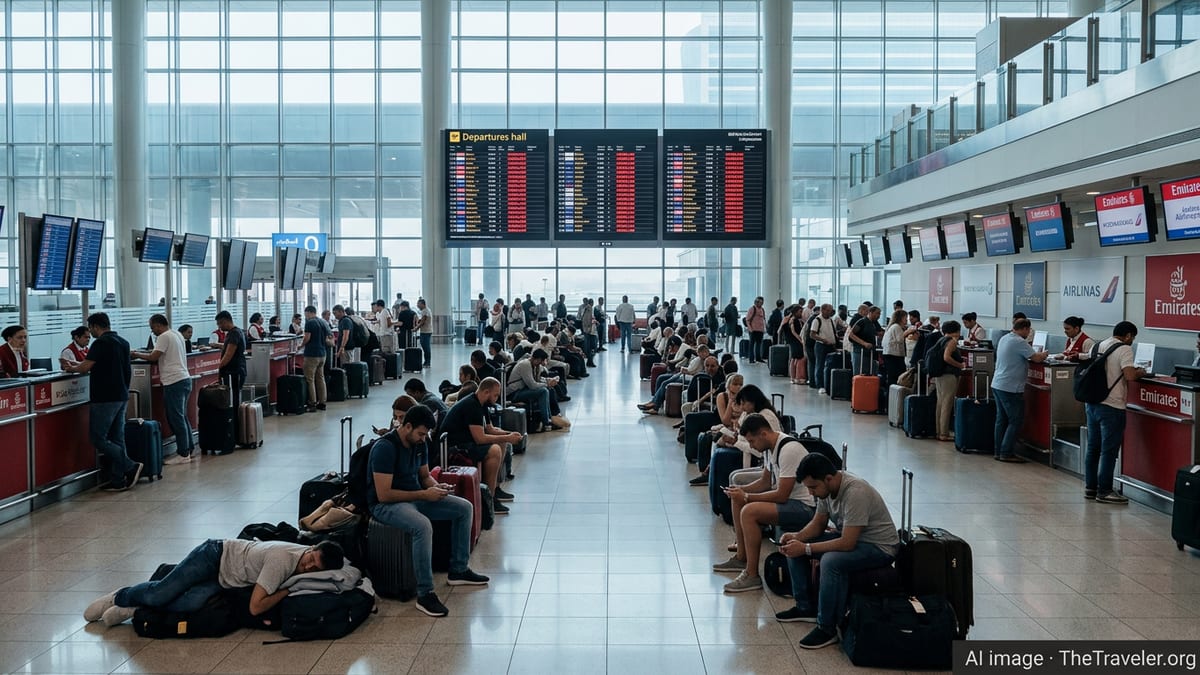
Reports from regional airports describe departure halls filled with passengers sleeping on floors, as hotels near major hubs quickly sold out in the first days after the airspace shutdown. Governments have begun organizing repatriation flights, with Indian carriers, among others, operating special services to bring home tourists and migrant workers who had used Gulf hubs as transit points.
The disruption is hitting budgets as well as itineraries. With capacity sharply reduced, fares on remaining routes have spiked, particularly on indirect routings that detour far from the Gulf. Some travelers have turned to private jets or ad hoc charter flights routed through safer airports in Oman, Jordan or Cyprus, paying eye-watering sums to escape the gridlock.
Travel insurance has become a critical lifeline for some, though many policies treat war and political unrest as exclusions, leaving passengers to negotiate directly with airlines for refunds or future travel credits. In the meantime, foreign ministries including the United States, Canada and several European states are continuing to urge citizens in affected countries such as the UAE, Qatar, Saudi Arabia, Iran and Lebanon to leave while commercial options remain available.
Uncertain Timeline for Recovery in a Key Aviation Corridor
Industry analysts warn that even if airspace restrictions begin to ease after March 7, restoring normal connectivity across West Asia will likely be a gradual process. Airlines will need to reposition aircraft and crew, coordinate new routings that reflect any lingering no-fly zones and rebuild complex hub banks that allow for smooth connections between continents.
The Gulf’s major airports, especially Dubai International and the new Zayed International Airport in Abu Dhabi, are central to global aviation, funnelling millions of passengers each month between Europe, Africa and Asia. Prolonged disruption threatens not only tourism, but also business travel, cargo flows and the broader economies of states that have invested heavily in becoming global transit hubs.
Carriers are walking a tightrope between maintaining a minimal presence for essential travel and protecting staff and passengers from the evolving security risks. Until a durable cease-fire takes hold and regional airspace authorities issue clear, consistent guidance, airlines are expected to err on the side of caution, keeping many routes suspended and detours in place.
For now, prospective travelers are being urged to avoid booking new trips through the Gulf or wider conflict zone, monitor airline travel advisories closely and remain prepared for last-minute changes. With Emirates, Etihad, Air Canada, KLM, Air France, ITA, Delta and many others still effectively frozen out of large parts of West Asian airspace, the world’s most important east west aviation bridge remains fractured, with no quick fix in sight.