

More news on this day
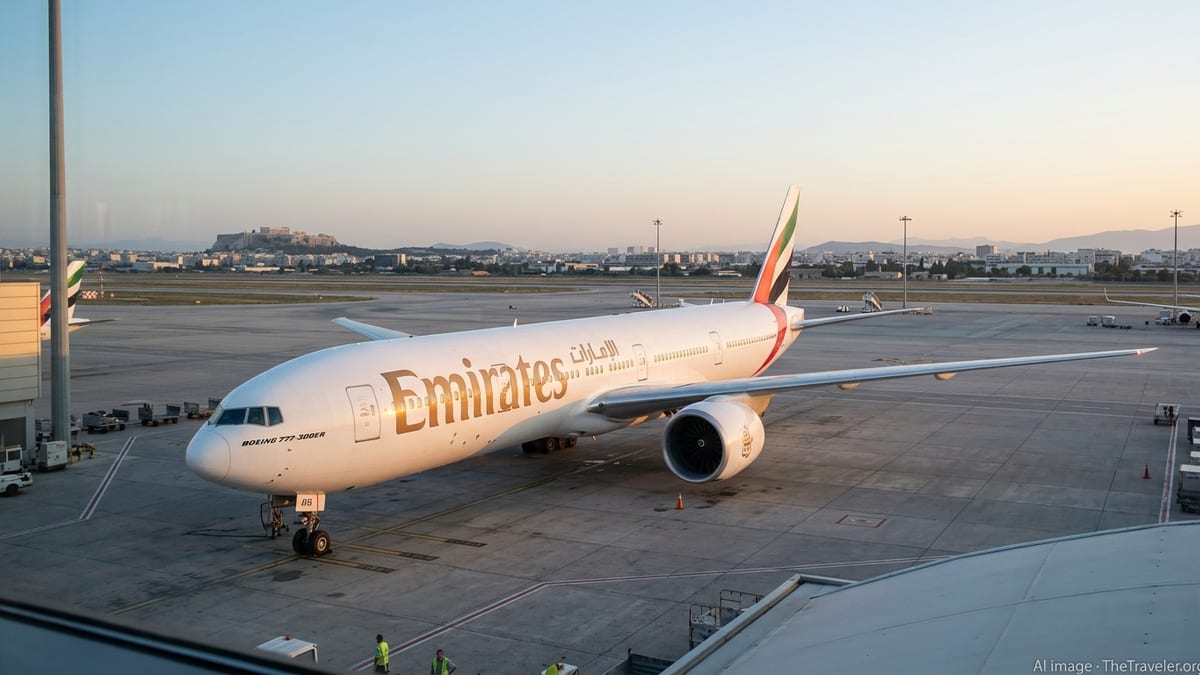
Athens is edging back onto major long-haul maps as Emirates begins operating limited services to the Greek capital following recent airspace disruptions, underscoring the city’s enduring pull for global travelers and its strategic role between Europe, the Middle East and North America.
Get the latest news straight to your inbox!
Measured Restart After Regional Airspace Disruptions
Publicly available information indicates that Emirates is operating a reduced schedule across its network following late‑February airspace closures affecting Dubai International Airport and surrounding corridors, with Athens among the destinations seeing a cautious reintroduction of services. Operational updates referenced by regional aviation coverage describe a gradual return of selected routes as conditions allow, rather than an immediate restoration of pre‑disruption capacity.
Reports from aviation trackers and travel industry outlets show Emirates flights reappearing on the Dubai to Athens route on select days in early March, often as part of limited or special operations. These movements follow several days in which scheduled services to and from Dubai were widely suspended, leaving aircraft and crews out of regular rotation and forcing airlines to prioritize key connections as they rebuilt their timetables.
While full schedule normalization remains in progress, the presence of Emirates services between Dubai and Athens, even at a reduced frequency, is seen within the sector as a vote of confidence in the market. Analysts note that when capacity is scarce, long‑haul carriers tend to focus first on routes where demand is consistently strong and yields are resilient, placing Athens high on the list for an early comeback.
Athens as a Strategic Hub Between Continents
Long before the latest disruption, Emirates had identified Athens as a strategic bridge linking Europe, the Middle East and North America. Company archives show that the airline has served the Greek capital since 1996 and, in 2017, extended one of its Dubai–Athens services onward to Newark, effectively turning Athens into a transatlantic hop between the Gulf and the United States. That decision was widely viewed as a reflection of both local demand and the city’s geographic advantage.
Industry briefings published in Greece highlight how the Dubai–Athens–New York configuration gave travelers in the wider region an additional one‑stop option for reaching North America, while also channeling visitors from the United States into Greece year‑round. Even as schedules evolved over time, that period cemented Athens’ reputation within Emirates’ network as more than a seasonal beach gateway, but as a viable hub with connecting potential in its own right.
More recently, Greek aviation news outlets have pointed to product upgrades on the Athens leg of Emirates services, including the deployment of enhanced Boeing 777 aircraft with four‑class cabins on the Athens–New York route in 2025. These investments signaled long‑term confidence in premium and connecting traffic via the Greek capital, suggesting that any current limitations in service are operationally driven rather than a reflection of weaker demand.
Resilient Demand Underscores Greece’s Travel Appeal
The decision to bring Athens back into a limited operational pattern aligns with wider evidence of strong and resilient demand for Greece. Inbound tourism to the country has rebounded sharply in recent seasons, with successive summers seeing high hotel occupancies across Attica and the islands, even amid broader global uncertainty. Travel sections of major European and Middle Eastern outlets routinely place Athens among top city‑break choices, noting its combination of heritage, food culture and relatively competitive pricing compared with other Western European capitals.
Greek tourism authorities have previously reported record or near‑record international arrivals, driven not only by traditional markets such as Germany, the United Kingdom and Italy, but also by long‑haul visitors from the Gulf and North America. Airline seat capacity into Athens has accordingly expanded over the past few years, both through flag carrier growth and increased services by foreign airlines targeting summer leisure travelers and year‑round business and conference traffic.
Within this context, Emirates’ willingness to allocate scarce long‑haul capacity back to Athens during a phased restart is being interpreted in the industry as recognition that Greece remains a priority leisure and connectivity market. Tour operators focusing on multi‑destination itineraries, combining Athens with islands such as Santorini, Mykonos and Crete, are expected to benefit from the restoration of at least some long‑haul links as peak booking season approaches.
Operational Constraints Shape a Limited Schedule
Despite the positive symbolism of Athens reappearing on Emirates’ map, the current service framework remains constrained. Public updates from airports and airline communications suggest that the carrier is still contending with lingering airspace restrictions, displaced aircraft, and crew‑duty limitations, which together prevent an immediate return to the full Dubai–Athens schedule that existed before the latest regional disruption.
Air traffic data and flight status services show that certain Athens rotations have operated as one‑off or irregular flights, sometimes with different flight numbers than the standard schedule. In parallel, ground handling resources and slot availability at both Dubai and Athens are being reassessed as airlines across the region attempt to re‑time services to fit narrow operational windows. This has led to a patchwork of departures that travelers and agents must monitor closely.
Travel industry advisories urge passengers to check their individual bookings frequently and remain flexible about routings and dates. With many carriers still in recovery mode, itinerary changes remain common, and the limited Emirates service to Athens is being treated as a first phase in a broader normalization process rather than a definitive end state for the route.
What the Athens Resumption Signals for Summer 2026
Looking ahead to the core summer travel period of 2026, aviation analysts are watching Athens as a bellwether for how quickly long‑haul capacity into Southern Europe can be rebuilt. Historical patterns suggest that airlines prioritize Mediterranean destinations ahead of peak travel months, leveraging strong holiday demand to restore revenue and rebuild customer confidence after periods of disruption.
If airspace conditions continue to stabilize and long‑haul aircraft are progressively repositioned, observers expect Emirates and other Gulf carriers to target higher frequencies into Athens, restoring daily or near‑daily operations from Dubai and potentially ramping up onward connectivity to North America and Asia. Such a shift would reinforce Greece’s status as a resilient, high‑appeal market capable of absorbing additional capacity even in a more cautious global environment.
For now, the limited Emirates service serves as a symbolic yet tangible indicator that Athens remains firmly in the sights of global carriers. As passengers once again transit through the Greek capital on itineraries that link three continents, the city’s role as both a destination and a gateway is reasserting itself, reaffirming Greece’s unyielding appeal to travelers and the aviation industry alike.