

More news on this day
Six Emirates Airlines long-haul flights from major U.S. gateways to Dubai were forced to divert to cities across Europe on Saturday after coordinated military strikes by the United States and Israel on Iran prompted widespread airspace closures and a temporary halt to operations at Dubai International Airport.
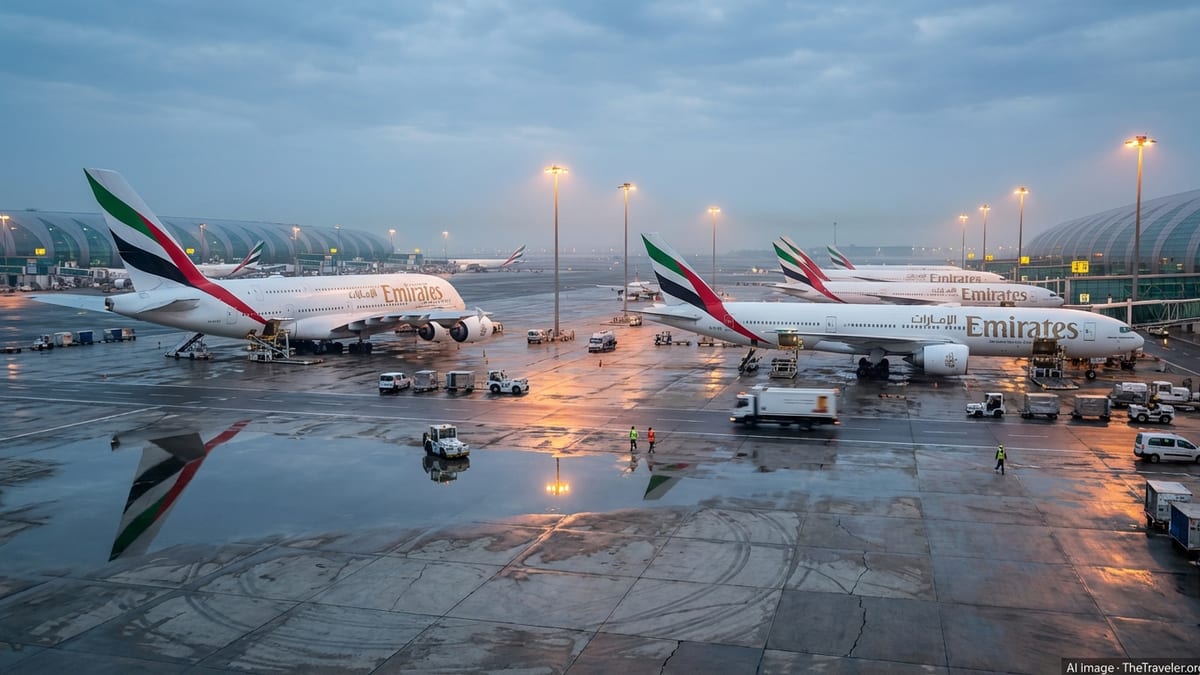
Emirates’ U.S. Services Forced Into Mid-Atlantic Reroutes
Emirates flights departing Los Angeles, San Francisco, Seattle, New York, Chicago and Houston for Dubai early on February 28 were among those caught mid-air when aviation authorities across the Middle East rapidly shut down airspace following the strikes. With Iran, Iraq and the United Arab Emirates closing key corridors and Dubai International Airport suspending inbound operations, the carrier redirected the U.S. services to alternative airports in Europe to ensure passenger safety and preserve crew duty limits.
According to live flight-tracking data and operational updates from aviation authorities, the Los Angeles and San Francisco services were rerouted to Rome and Munich, while flights from Seattle and New York diverted to Hamburg and Vienna. Services from Chicago and Houston were redirected to Budapest and Prague, turning what were intended to be nonstop journeys to Dubai into multi-leg itineraries that added hours to travel times.
Each of the widebody aircraft, predominantly Airbus A380s and Boeing 777-300ERs, continued toward Europe with additional fuel reserves to allow for last-minute routing decisions around newly restricted skies. Once airborne, crews received revised flight plans from Emirates’ operations control center in Dubai, coordinating with European air traffic control to secure arrival slots at the diversion airports.
The diversions highlight how rapidly changing geopolitical conditions can upend long-haul operations, particularly on routes that rely on narrow corridors through contested airspace between North America, Europe and the Gulf.
Middle East Airspace Closures Ripple Across Global Networks
The diversions of Emirates’ U.S.–Dubai services formed part of a much broader disruption to global aviation triggered by the strikes on Iran. Airspace over Iran, Iraq, Kuwait, Bahrain and Israel was effectively emptied as authorities issued immediate restrictions, while the United Arab Emirates temporarily halted arrivals and departures at Dubai International Airport, the world’s busiest hub for international traffic.
Preliminary data from aviation analytics firms showed that close to 40 percent of flights to Israel and nearly 7 percent of services to the wider Middle East were canceled or diverted on Saturday. Major corridors connecting Europe to South and Southeast Asia, as well as North America to the Gulf, were forced to reroute around the affected region, adding flight time, fuel burn and operational complexity for carriers.
For Emirates, whose global network is built around rapid connections through Dubai, the closure of its home hub and surrounding airspace effectively severed the final segment of its long-haul trunk routes. By diverting U.S. flights to Rome, Munich, Hamburg, Vienna, Budapest and Prague, the airline preserved aircraft and crew positioning while providing passengers with immediate access to European ground handling, immigration facilities and overnight accommodation.
Other Gulf and European carriers, including Qatar Airways, Kuwait Airways, Lufthansa and Air France-KLM, also suspended or rerouted flights involving the Middle East, signaling that disruptions could extend for days as governments and airlines evaluate the security situation and the duration of airspace restrictions.
Passengers Face Lengthy Delays and Uncertain Rebooking Options
For passengers on the six diverted Emirates flights, the sudden mid-journey change transformed nonstop trips into complex, multi-stage journeys. Travelers expecting to land in Dubai were instead processed through European airports where ground teams worked to arrange hotel stays, meal vouchers and updated itineraries, while many sought clarification via airline apps and customer service channels already strained by a surge in inquiries.
Industry analysts noted that, with Dubai International Airport suspending operations and several regional airspaces closed, Emirates and its partners had limited options for immediate onward travel to the Gulf, South Asia and Africa. Many passengers were expected to face overnight delays in Rome, Munich, Hamburg, Vienna, Budapest and Prague, with rebooked services likely to operate via alternative routings that skirt restricted skies once partial corridors reopen.
Travel agents in the United States reported a spike in urgent requests from clients seeking to reroute upcoming trips that relied on Dubai as a connection point. Some shifted itineraries to European or transatlantic hubs, while others postponed Middle East travel entirely amid uncertainty over how long the disruptions would last.
Airlines and travel advisers urged affected passengers to monitor flight-status tools closely and to allow substantial extra time for rebooking and transit, warning that knock-on effects across global networks could persist even after airspace gradually reopens.
Operational and Economic Strain on Emirates and Global Carriers
The diversion of six fuel-intensive transcontinental flights from North America to unplanned European destinations underscores the significant operational and financial strain that sudden geopolitical crises can impose on airlines. Each diversion requires complex coordination involving new overflight clearances, landing slots, ground handling arrangements and crew scheduling, all while maintaining regulatory limits on crew duty hours.
Longer routings around closed airspace mean increased fuel consumption and extended block times, which can cascade through an airline’s schedule, leading to equipment shortages, further delays and potential cancellations. For Emirates, the impact is particularly acute given its reliance on long-haul, widebody-only operations and its role as a central connector between east and west via Dubai.
Analysts suggested that if regional airspace closures persist, airlines may be forced to adopt more circuitous paths via the eastern Mediterranean, the Caspian Sea or southern routes over Egypt and Saudi Arabia, each adding time and cost. These additional expenses come on top of potential compensation and care obligations for stranded passengers, as well as revenue lost from canceled sectors into and out of the Middle East.
In the short term, carriers are expected to prioritize aircraft and crew utilization on the most in-demand and strategically important routes, potentially reducing capacity on some secondary services to free up resources for rerouted long-haul flights.
What U.S. Travelers Should Do Next
With the situation in the Middle East evolving rapidly, U.S. travelers booked on Emirates services from Los Angeles, San Francisco, Seattle, New York, Chicago and Houston were advised to check their flight status frequently and to maintain close contact with their booking channel, whether directly with the airline or through a travel advisor.
Industry guidance emphasized that passengers should expect schedule changes, extended journey times and, in some cases, last-minute diversions to European airports similar to Saturday’s events. Flexible ticket policies, including fee waivers for date changes or rerouting away from impacted hubs, are likely to be introduced or expanded as airlines respond to ongoing uncertainty.
Travel security experts also recommended that passengers maintain updated contact details with airlines and enroll in government traveler programs, where available, in case of further instability that could affect ground transportation or airport access in the wider region.
For now, the diversions of Emirates’ flagship U.S.–Dubai flights to Rome, Munich, Hamburg, Vienna, Budapest and Prague stand as a stark illustration of how swiftly shifting geopolitical fault lines can reshape the global travel map in a single day.