

More news on this day
Emirates is set to deepen its reputation as an ultra-long-haul specialist in 2026, with new schedules and fleet upgrades confirming that the airline’s very longest nonstop routes from Dubai will be dominated by links to the United States, New Zealand and South America.
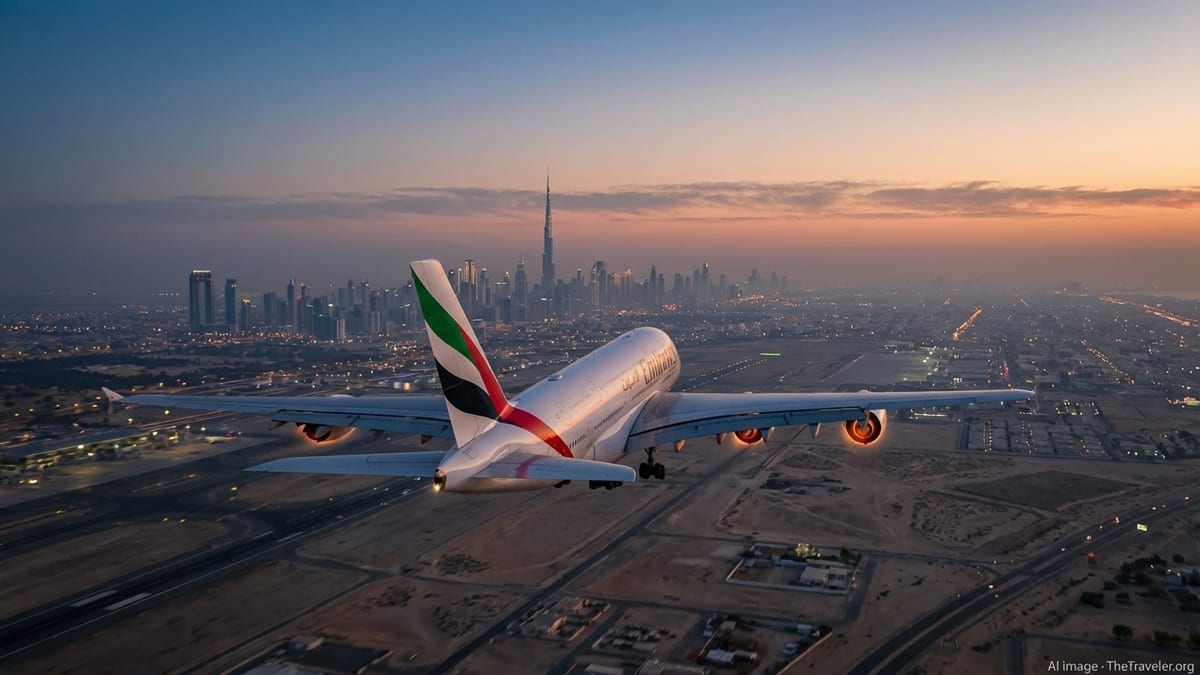
Dubai–Auckland Remains the Flagship Ultra-Long-Haul
By 2026, Dubai to Auckland is poised to retain its status as Emirates’ longest nonstop route, stretching more than 8,800 miles between the Gulf hub and New Zealand’s largest city. The daily service has become a strategic bridge between Europe, the Middle East and the southwest Pacific, placing New Zealand within one stop of dozens of onward destinations via Dubai and underpinning significant tourism and trade flows.
Schedules for 2025 show the route operating daily at roughly 15 hours and 45 minutes outbound and more than 17 hours on the return, and that pattern is expected to continue into 2026 as Emirates leans on the appeal of its high-capacity widebodies. Resilience in leisure demand to New Zealand, particularly during the southern summer high season, has helped secure the flight’s place at the top of the airline’s distance rankings.
Beyond tourism, the Dubai–Auckland link has taken on growing importance for New Zealand exporters and for corporate travel between New Zealand, the Gulf and Europe. Belly cargo capacity provides a fast channel for high-value perishables and manufactured goods, while the through-ticketing offered by Emirates and its partners eases complex itineraries that once required multiple stops across Asia or North America.
The route also illustrates the technological progress underpinning ultra-long-haul flying. Flight-planning systems dynamically adapt tracks across the Indian Ocean and southern latitudes to exploit tailwinds and avoid headwinds, shaving time off a roughly 14,000-kilometre sector while keeping fuel burn and emissions under tighter control.
US Super-Connections: Los Angeles, Houston, San Francisco and Dallas
Behind Auckland, Emirates’ next four longest nonstop routes from Dubai in 2026 will again be to the United States, reinforcing how transpacific-length sectors now criss-cross the North Atlantic and polar regions. Los Angeles, Houston, San Francisco and Dallas/Fort Worth each clock in above 8,000 miles, reflecting sustained demand between the Gulf and America’s major economic and population centres.
Dubai–Los Angeles, at around 8,300 miles, combines strong leisure traffic with premium demand from Hollywood, technology and aerospace sectors anchored in Southern California. San Francisco, just short of that distance, taps into the Bay Area’s technology and biotech clusters, while also feeding tourism from North America into the Indian Ocean and Middle East. Both routes are scheduled as daily services and remain core candidates for Emirates’ highest-capacity aircraft.
Houston and Dallas/Fort Worth mirror the oil, gas and energy-service connections that have long driven Gulf–Texas travel, but they now also serve diversified sectors such as healthcare, university research and logistics. With journey times stretching to 16 hours in the westbound direction on peak days, these flights rank among the world’s longest regularly scheduled operations and are expected to stay in Emirates’ top 10 for distance in 2026.
The strength of the US links highlights how Emirates has built its long-haul strategy around funneling traffic between multiple continents over Dubai. For American travellers, ultra-long nonstops to the Gulf now compete directly with one-stop itineraries via Europe or Asia, particularly where schedules offer overnight departures, daylight arrivals and swift onward connections to South Asia and Africa.
South America’s Role: Dubai–São Paulo and Dubai–Buenos Aires
South America also features prominently on Emirates’ list of longest nonstop routes from Dubai, anchored by the link to São Paulo and seasonal or tag-on services that extend to Buenos Aires. Dubai–São Paulo measures around 7,600 miles and sits comfortably within the airline’s top 10 longest city pairs, reflecting the importance of Brazil as Latin America’s largest economy and a major source of outbound leisure and business travel.
From 2025 into 2026, Emirates is expected to maintain strong capacity on the Brazil corridor, taking advantage of both point-to-point demand and connecting flows between South America, the Middle East, India and East Asia. The flight has proven particularly attractive for Brazilian travellers heading to destinations such as Bangkok, Tokyo or Delhi in a single stop, and for Gulf-based and European expatriates working in Brazil’s energy, agribusiness and financial sectors.
Buenos Aires has historically been linked to Dubai either via a stop in Rio de Janeiro or as an extension of the São Paulo route, and it continues to rank among Emirates’ longest operated sectors on days when the through service runs. Although not always a dedicated nonstop in both directions, the overall Dubai–Argentina journey competes in the same ultra-long-haul bracket as the airline’s US and Australasian flights, and is likely to remain a focal point for long-range fleet deployment and schedule optimization.
South America’s presence in Emirates’ top 15 longest routes also reflects wider competitive dynamics. New direct and ultra-long services from Latin America to Asia, including recently announced projects by Chinese carriers and South American airlines, are reshaping connections. Emirates’ Dubai hub remains a powerful alternative, offering a broad network reach that pure point-to-point services cannot easily replicate.
How the Top 15 Longest Routes Line Up in 2026
While exact 2026 schedules will evolve with demand and fleet availability, current filings and industry data indicate that Emirates’ 15 longest nonstop routes from Dubai will be led by Dubai–Auckland, followed closely by the quartet of US links to Los Angeles, Houston, San Francisco and Dallas/Fort Worth. Dubai–São Paulo, Dubai–Sydney and Dubai–Brisbane are also firmly positioned within this upper tier, each exceeding roughly 7,400 miles.
Rounding out the top 15 are expected to be additional long-range services into North America, including Seattle, as well as high-distance links into Australasia and possibly new ultra-long-range deployments enabled by Emirates’ next-generation aircraft. Collectively, these routes represent a small fraction of the airline’s overall network by number, but a disproportionately large share of its available seat-miles and operational complexity.
From a traveller’s perspective, the line-up demonstrates how the geography of ultra-long-haul flying has shifted. Rather than a handful of prestige routes, Emirates now operates a portfolio of city pairs that stretch aircraft and crews to the limit while connecting secondary and primary markets alike. For cities such as Auckland, Brisbane or São Paulo, Dubai provides a de facto second global hub, with through-connections to regions that would otherwise require multiple airline changes.
The composition of the 2026 top 15 also underlines Dubai’s ambition to position itself as a crossroads not only between Europe and Asia, but also between the Americas and the wider Eastern Hemisphere. By sustaining a critical mass of ultra-long sectors, Emirates increases the attractiveness of its shorter connecting routes, creating a network effect that supports frequencies and capacity across the board.
Fleet Evolution: A380, 777 and the Arrival of the A350-900ULR
Maintaining a slate of 15 ultra-long-haul routes requires careful alignment between fleet capabilities and market demand. In 2026, Emirates will still rely heavily on its Airbus A380 and Boeing 777-300ER for the very longest missions, but the gradual introduction of new-generation aircraft such as the Airbus A350-900ULR is set to reshape the upper end of the network.
The existing A380 operation already covers marquee long-haul flights such as Dubai–Auckland, Dubai–Los Angeles and Dubai–San Francisco, where slot constraints, premium demand and strong leisure traffic justify high-gauge deployment. The 777-300ER, with its range and comparatively lower capacity, enables Emirates to sustain lengthy links such as Dubai–Dallas/Fort Worth and certain rotations to Brazil and Australia where demand is robust but not yet at full A380 scale.
New ultra-long-range A350 variants entering service around mid-decade will give Emirates greater flexibility to open or reinforce thinner long-distance markets without committing the full capacity of an A380. Early deployments to Australian cities, including the high-profile launch to Adelaide with an A350-900ULR, indicate that the type will be well suited to long sectors approaching 14,000 kilometres with a focus on efficiency, lower fuel burn and improved cabin comfort.
As more A350s join the fleet through 2026, analysts expect Emirates to weigh redeploying some A380s from long but relatively lower-yield routes to denser trunk markets, while using the new aircraft to sustain or expand the top 15 longest routes. For passengers, the shift is likely to bring quieter cabins, modern premium cabins and enhanced inflight entertainment to some of the most demanding journeys on the network.
Premium Economy and the Changing Passenger Mix
One of the quieter forces supporting Emirates’ ultra-long-haul expansion is the rapid rollout of its premium economy product, which is steadily appearing on both regional and long-haul routes. By 2026, premium economy is expected to be available on a growing share of the aircraft roster serving the top 15 longest routes, including key US, Australasian and South American city pairs.
Premium economy has proven particularly popular on flights exceeding 14 hours, where travellers seek more space and comfort without paying full business-class fares. For routes such as Dubai–Auckland or Dubai–Houston, the additional cabin offers airlines a way to improve yields while also making the proposition of a single very long flight more palatable to leisure and small-business passengers.
The changing cabin mix also reflects a broader shift in passenger demographics across these ultra-long links. While corporate travel remains important, especially on US and Brazil routes, there has been a marked recovery in high-spend leisure demand and diaspora travel, with families and expatriate communities willing to invest in upgraded seating for once-a-year trips. That trend has supported Emirates’ decision to retrofit existing aircraft and to configure incoming jets with four cabins as standard.
For the airline, these changes translate into more granular revenue management across its longest flights. Rather than simply filling large economy cabins, Emirates can balance demand between business, premium economy and economy, making it easier to keep daily ultra-long-haul services viable year-round, even as fuel prices and macroeconomic conditions fluctuate.
Operational Challenges of Ultra-Long-Haul Links
Running 15 of the world’s longest nonstop routes from a single hub presents intricate operational challenges. Crew duty times, fatigue management, maintenance planning and spare aircraft availability all need to be finely calibrated to keep ultra-long sectors running reliably. Even minor disruptions can cascade quickly across a network where individual flights may consume an entire day for a single aircraft and crew pairing.
On sectors like Dubai–Auckland or Dubai–Los Angeles, Emirates must schedule augmented flight and cabin crews with carefully managed rest breaks, while the airline’s operations control centre monitors weather and airspace constraints across multiple flight information regions. Diversion options can be limited over remote stretches of ocean, requiring conservative fuel planning and continuous communication with air traffic control authorities.
Turnaround times at outstations also become critical. An A380 or 777 operating a 16-hour inbound sector has a narrow window on the ground to refuel, take on catering, complete cleaning and perform essential maintenance checks before launching into another ultra-long flight back to Dubai. Any delay can cause missed connections for hundreds of passengers funneling onto banks of onward departures in the Gulf.
Despite these challenges, Emirates has used its scale and hub structure to create resiliency. The presence of multiple daily flights on shorter regional sectors allows the airline to re-accommodate connecting passengers when long-haul services experience disruption, while a deep pool of cross-trained crew and engineers at Dubai International helps keep aircraft turns on schedule even during peak waves.
What These Routes Signal for Global Aviation in 2026
The dominance of UAE–USA–New Zealand–Brazil–Argentina links in Emirates’ longest-route table offers insight into how global aviation will look in 2026. Rather than a simple east–west network centred on Europe and North America, the map is increasingly defined by long, diagonally oriented city pairs connecting the southern hemisphere, the Gulf and the Americas.
For passengers, the practical effect is a growing choice between one very long flight and two shorter ones. Travellers from New Zealand to Europe, from Brazil to India, or from the US West Coast to Africa increasingly see Dubai as a logical intermediate point, with the trade-off between total travel time, comfort and fare levels shaping which option they select.
For airlines, Emirates’ strategy underscores the competitive value of a hub built around long-range widebodies at scale. As new ultra-long-range aircraft enter fleets around the world and more carriers experiment with nonstop routes of 8,000 miles and beyond, competition for high-yield passengers on these marathon flights will only intensify. Emirates’ top 15 longest nonstop routes from Dubai in 2026 suggest that the airline intends not just to defend its position in this space, but to deepen its role as one of the world’s defining ultra-long-haul operators.