

More news on this day
The United Arab Emirates is reshaping the future of long-haul air travel as Emirates moves to retire its ultra-dense 615-seat Airbus A380 layout, replacing the record-breaking high-capacity cabins with a new three-class configuration built around comfort, premium segmentation and higher-yield travel demand.
From Capacity Machine to Flagship Showcase
For years, Emirates’ 615-seat Airbus A380s stood as outliers in global aviation, operating as pure capacity machines on leisure-heavy, price-sensitive routes. Configured in a two-class layout with 58 business class seats and an astonishing 557 in economy, these superjumbos were designed to move as many people as possible between Dubai and high-volume destinations in Europe, Asia and the Indian Ocean.
That model is now being fundamentally rethought. Emirates has confirmed that all 15 of its high-density A380s will be converted into a new three-class configuration with 569 seats, featuring 76 business class, 56 premium economy and 437 economy seats. The project, which will run through November 2026, will see the world’s highest-capacity regularly scheduled passenger aircraft quietly bow out, replaced by a more balanced cabin mix that reflects how global travel patterns and yields have evolved since the pandemic.
The shift is emblematic of a broader strategic move underway in the United Arab Emirates, where the focus is increasingly on quality of experience and premium share rather than simply raw capacity. For Emirates, which already operates the world’s largest A380 fleet, the densest version of the aircraft was always a niche tool. As its network matures and demand for premium cabins rebounds, the airline is moving to close that chapter and bring even its most crowd-focused jets into the luxury fold.
The Retrofit Blueprint: More Classes, Fewer Seats
At the center of the transformation is a detailed retrofit blueprint that reconfigures the 615-seat layout into a three-class, 569-seat aircraft. Business class capacity will increase from 58 to 76 seats, premium economy will be added with 56 seats, and economy will shrink by 120 seats to 437. The total seat count drops by 46, a notable sacrifice in volume for an airline renowned for its ability to fill giant aircraft.
The first of these upgraded A380s is on track to enter service on April 14, 2026, debuting on the Dubai to Amman route before rotating to Prague at the start of June. Emirates expects to complete work on all 15 aircraft by November 2026, with each jet spending several weeks in the hangar for an interior strip-out and rebuild that goes well beyond simply replacing seats. The airline is using the opportunity to harmonize design language, materials and technology with the rest of its evolving A380 and Boeing 777 fleet.
Crucially, the retrofit folds these jets into Emirates’ broader multi-billion-dollar cabin upgrade program, which covers 219 aircraft in total. That scheme is introducing new generation seating, refreshed color palettes, upgraded inflight entertainment and, progressively, Starlink-powered high-speed connectivity. By aligning the former high-density A380s with this standard, Emirates is ensuring that passengers will encounter a consistent look and feel, whether they are flying a four-class flagship A380, a retrofitted 777 or one of the newly delivered A350s.
Premium Economy at the Heart of the Strategy
While the headline may be the retirement of the 615-seat layout, aviation analysts say the real story is the expansion of premium economy. Emirates has made the intermediate cabin central to its long-haul strategy, and the conversion of the densest A380s is the clearest signal yet that the airline believes in sustained demand for a product that sits between full-service economy and lie-flat business class.
Premium economy has been progressively introduced across the network since the first cabins appeared on retrofitted A380s and select Boeing 777s. By the end of 2026, Emirates plans to offer the product on close to 100 routes, turning what began as a niche experiment into a core pillar of its fleet planning. The addition of 56 premium economy seats on each ex-615-seat A380 will help accelerate that rollout, particularly on trunk routes where volume remains strong but customers increasingly show willingness to pay more for comfort and space.
For the United Arab Emirates as a hub market, this shift into premium economy is also about competitiveness. Rival airlines across Europe and Asia have invested heavily in their own intermediate cabins, and corporate travel policies have evolved to accept premium economy as a cost-effective alternative to business on certain routes. By bringing even its most leisure-focused A380s into the premium economy era, Emirates ensures that tour groups, families and business travelers alike can trade up without stepping all the way into the front cabin.
What Disappears With the 615-Seat Layout
The retreat from the 615-seat layout marks the end of a very specific chapter in the story of the A380. When Emirates introduced the configuration, it did so to solve a clear problem: how to maximize throughput on a limited number of peak-time slots while keeping per-seat costs low. The result was a two-class behemoth that lacked first class suites, onboard showers and premium economy, but could carry crowds unmatched by any other regularly scheduled jet.
In practice, these aircraft were deployed on routes where demand was driven less by corporate contracts and more by tourism, visiting friends and relatives, and seasonal peaks. Markets such as Copenhagen, Prague, Bali and Mauritius saw periods of intensive 615-seat A380 use, especially during the high-travel summers of 2024 and 2025. As travel recovered after the pandemic, packing 600 plus passengers into a single departure allowed Emirates to defend market share and keep fares competitive.
Yet the economics of such extreme density have always been unforgiving. To justify their place in the schedule, the 615-seat A380s needed consistently high load factors and strong connecting feeds, conditions that became harder to sustain as premium demand returned elsewhere in the network. More critically, every departure operated by a two-class A380 represented an opportunity cost, because the airline could not sell high-margin first class suites or as many business seats on those flights.
Network and Revenue Implications for the UAE Hub
The decision to transform the 615-seat A380s feeds into a larger recalibration of Emirates’ global network and the role of Dubai International Airport as a super-connector hub. Recent schedule data for 2026 show a visible contraction in the number of flights operated by the ultra-dense A380s, with the configuration disappearing entirely from some city pairs and being replaced by either lower-density A380 variants, Boeing 777s or the new Airbus A350s.
For destinations that previously saw the dense A380 as a symbol of scale, the shift may at first glance appear like a step down. In reality, the United Arab Emirates is trading absolute seat numbers for a more profitable and sustainable mix of capacity. By introducing cabins that can support higher average fares and upsell opportunities, Emirates gains flexibility to respond to shifts in demand, deploy aircraft more surgically and reduce exposure to sudden downturns in leisure traffic.
Dubai’s position as a global transfer hub also benefits from the move toward more diversified cabin structures. Passengers connecting between continents are increasingly seeking seamless journeys that combine comfort, connectivity and consistency of product. With the ex-615-seat A380s now set to mirror the broader Emirates interior standard, the airline reduces the risk that a single leg of a long multi-sector itinerary feels out of step with the rest.
Inside the New Cabin Experience
Although these aircraft will not match the most lavish four-class A380s in the fleet, the reconfigured jets will still represent a substantial step up for travelers accustomed to the older two-class interiors. Business class will feature fully flat beds and direct aisle access in a refreshed color scheme, with upgraded materials and finishes that echo the latest Emirates design language. The increased seat count in this cabin underscores the airline’s confidence that it can sell more high-yield seats on routes that previously skewed heavily toward economy.
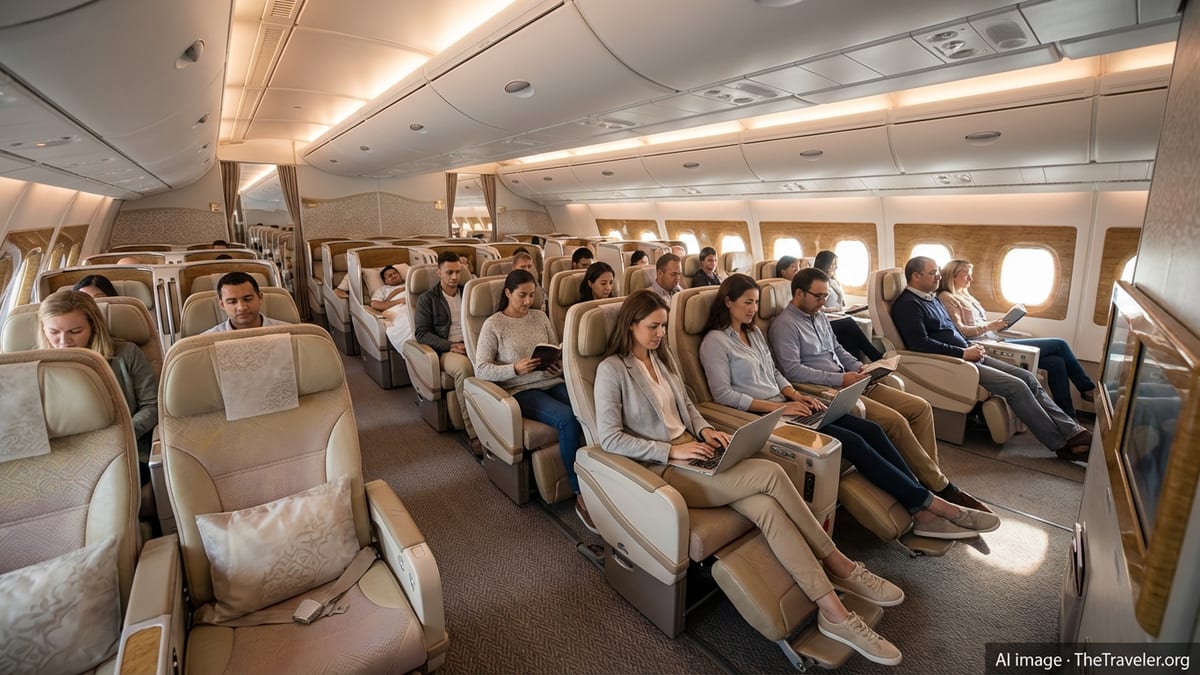
Premium economy, meanwhile, is expected to offer wider seats, greater pitch, enhanced recline and dedicated service touches such as upgraded dining and amenities. Emirates has positioned this cabin as a taste of business class at a more accessible price, and the airline’s early customer feedback on existing premium economy routes has been strong. Introducing the product on aircraft that historically offered only business and economy should change the passenger mix on those routes, encouraging some travelers to trade up from the back of the plane.
Even in economy, the retrofit is far from cosmetic. New generation seats are being installed with improved ergonomics, more personal storage, updated entertainment screens and better power options. Coupled with the airline’s investment in high-speed Wi-Fi and modern inflight entertainment platforms, the overall effect is to bring the ex-615-seat A380s in line with what passengers now expect from a flagship long-haul carrier in 2026.
Part of a Larger UAE-Led Retrofit Wave
The transformation of Emirates’ densest A380s is just one element of a sweeping modernization drive led from the United Arab Emirates. The carrier’s wider retrofit program, valued at billions of dollars, spans 219 aircraft and is one of the largest cabin refurbishment efforts ever attempted. Alongside changes to seating and layout, the project encompasses new entertainment technology, upgraded lounges, refreshed lighting and the adoption of Starlink satellite connectivity across the long-haul fleet.
This wave of investment positions the UAE as a testbed for the next generation of long-haul product. As Emirates integrates refurbished A380s and 777s with incoming A350s and Boeing 777Xs later in the decade, passengers will see a progressively more uniform standard of comfort across cabin classes. For Dubai as a global gateway, that consistency is a selling point in itself, reinforcing the idea that travelers can trust what they will get onboard irrespective of aircraft subtype.
Industry observers note that the scale and speed of the Emirates retrofit effort are effectively setting a new benchmark for legacy widebody fleets. Where some carriers have opted to retire their A380s outright, the United Arab Emirates has chosen a more ambitious path, betting that carefully updated superjumbos can continue to play a central role in the country’s aviation growth story well into the 2030s.
A New Role for the A380 in the Emirates Story
When the last of the 615-seat A380s emerges from the hangar with its new three-class layout, it will signal more than just a cabin refresh. It will mark the end of the A380 as an ultra-dense volume tool within Emirates’ fleet and the beginning of a cleaner, more premium-focused era for the superjumbo in the United Arab Emirates.
Rather than chasing pure seat count, the airline is reshaping the aircraft into a more versatile asset, capable of serving both high-volume leisure markets and increasingly discerning premium travelers. With additional business class capacity, a competitive premium economy cabin and upgraded economy seating, the reconfigured A380s will be better aligned with the mix of passengers now flowing through Dubai’s terminals.
For travelers, the change will be felt not just in the extra legroom or quieter cabins but in the way long-haul journeys through the UAE feel more cohesive from one sector to the next. For Emirates and for Dubai, the move underscores a strategic truth: in the next phase of global aviation, long-haul success will not be defined by how many seats can be squeezed onto an aircraft, but by how effectively each of those seats can be sold, experienced and remembered.