

Emirates is accelerating the worldwide rollout of its Premium Economy cabin, positioning Zurich, New York and a growing list of global gateways at the heart of a strategy that is reshaping how travelers think about comfort, value and luxury on long-haul flights.
A Strategic Step Between Economy and Business Class
When Emirates unveiled its Premium Economy concept, the airline framed it as a response to a clear shift in passenger expectations: travelers wanted more space, better dining and a refined ambiance without paying the full price of business class. In the years since, that middle-ground proposition has matured into a core part of the Dubai carrier’s global network strategy and is now visible on some of its most competitive routes, including Dubai to Zurich and Dubai to New York.
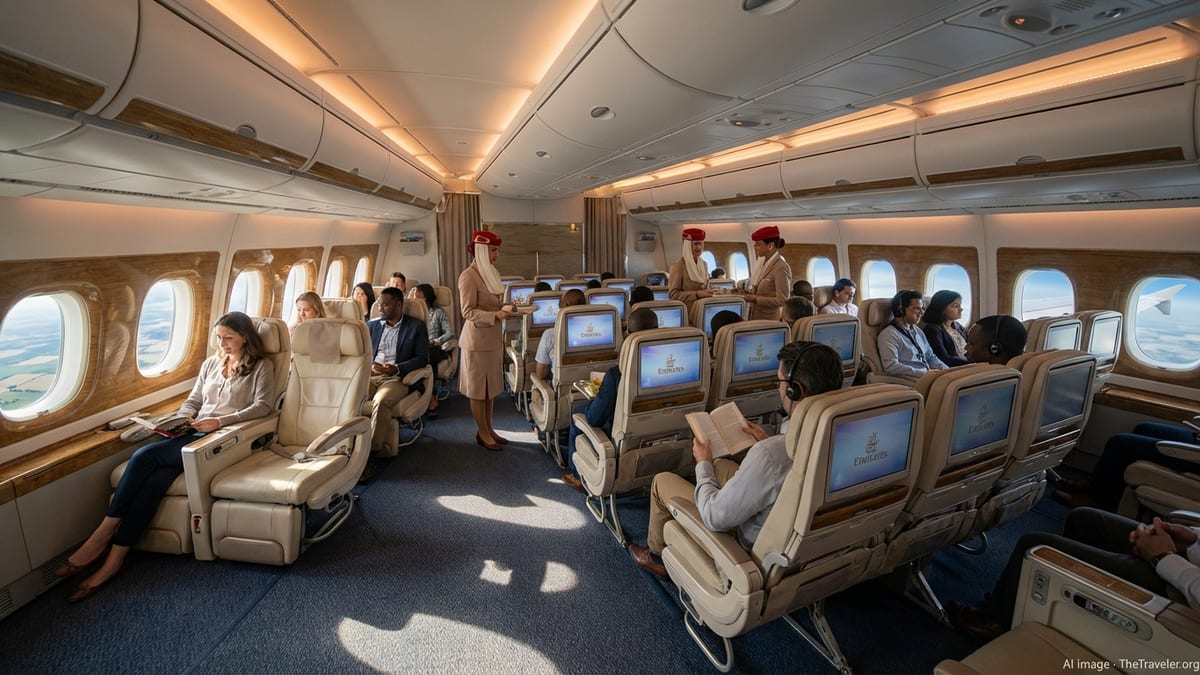
The product itself is designed to feel like a distinct cabin rather than a slightly upgraded economy section. On Emirates Airbus A380 aircraft, Premium Economy is located at the front of the main deck, separated from Economy with its own lighting scheme and service flow. Typical configurations feature 56 seats arranged in a 2-4-2 layout, with a pitch of about 40 inches, generous recline, a wider seat and a leg rest or footrest, all aimed at making overnight and ultra-long-haul flying more restful.
Beyond the hard product, Emirates has invested heavily in the overall experience. Travelers are greeted with a welcome drink, dine from printed menus featuring upgraded meals served on chinaware, and enjoy large personal screens with the latest version of the carrier’s in-flight entertainment. The airline’s management has repeatedly described Premium Economy as a “strategic differentiator” that targets premium leisure travelers and budget-conscious corporate passengers who are trading up from Economy.
That positioning has become increasingly important as long-haul demand has recovered and competition has intensified across key intercontinental corridors. By building a four-class configuration with First, Business, Premium Economy and Economy, Emirates is betting that granular cabin choice will help it lock in customer loyalty and capture more yield from each widebody departure.
Zurich: A European Showcase for the New Cabin
Zurich is emerging as a flagship European market for Emirates latest interiors. The airline has confirmed that from February 1, 2026, its second daily Dubai Zurich rotation, flights EK85 and EK86, will be upgraded to an Airbus A380, replacing a retrofitted Boeing 777. The move increases overall capacity and brings the full four-class A380 experience to more passengers on the route.
On the same date, Premium Economy is scheduled to debut on Emirates flight pair EK87 and EK88, also operated by a newly retrofitted A380. For Zurich-based travelers and those connecting through the Swiss hub, this will significantly expand access to the Premium Economy product, turning the city into one of the airline’s main European showcases for the cabin.
The Zurich expansion comes in response to strong demand from both corporate and leisure markets. Switzerland’s financial sector generates steady premium traffic, while the city’s role as a gateway to the Alps and broader Central Europe feeds year-round tourism flows. Emirates executives have indicated that routes such as Zurich, which blend high-yield business passengers with affluent holidaymakers, are prime candidates for Premium Economy because they consistently fill the cabin at attractive fares.
With both daily Zurich services moving to A380s featuring the newest interiors, Emirates is also harmonising the onboard experience for travelers who may be connecting via Dubai to Asia, Africa or Australia. The airline’s broader retrofit program is aimed at reducing product inconsistency across the network, and Zurich’s upgrade illustrates how Premium Economy is being used to anchor that effort in key European markets.
New York: Premium Economy on a Global Flagship Route
Across the Atlantic, New York remains one of Emirates most strategically important destinations and a focal point for its Premium Economy deployment. The carrier already operates multiple daily flights between Dubai and New York John F. Kennedy International Airport, including both nonstop and Milan-tagged services, and has been gradually introducing its four-class A380 on the route.
Recent schedule updates highlight that Emirates is layering refurbished A380s with Premium Economy across its New York operations. As retrofitted aircraft enter service, more JFK frequencies are transitioning to the four-class configuration, giving passengers on one of the world’s busiest long-haul corridors more opportunities to book the newer cabin. Industry data and airline briefings point to high load factors in Premium Economy on these flights, underscoring robust demand for a step up from standard Economy on journeys of 12 to 14 hours.
For the New York market, the timing is significant. Transatlantic competition has intensified as US and European carriers push their own premium-economy products. Emirates response is to lean on its A380 flagship, its extensive Dubai hub connectivity and a Premium Economy cabin that leans heavily into comfort and service. Travelers flying from JFK to Dubai can then connect onwards to cities across the Middle East, Africa, South Asia and Australasia, often staying within Premium Economy on both legs as the rollout widens.
Travel trade sources in North America note that corporate travel policies are increasingly written around Premium Economy on long sectors, particularly for mid-level staff. By ensuring that major gateways like New York are fully covered with the product, Emirates is positioning itself to capture this demand, providing a compelling alternative to business class in an environment where many companies remain cost conscious.
Inside the Cabin: What Sets Emirates Premium Economy Apart
Central to Emirates strategy is the belief that Premium Economy must feel like a genuine upgrade, not just an extra-legroom seat. The cabin design reflects this philosophy. On the A380, the seats are trimmed in cream-colored leather with stitching and wood-grain accents that echo the aesthetic of Emirates business-class cabins. Each seat typically offers around 40 inches of pitch, 19.5 inches of width and substantial recline, along with a calf rest and footrest that allow travelers to find more natural sleeping positions.
Technology and entertainment are equally central to the experience. Large high-definition screens, around 13 inches on many aircraft, provide access to Emirates extensive library of films, TV, music and live channels. In-seat power outlets, USB ports and storage spaces, including a side cocktail table for drinks and small items, are designed around the needs of passengers who want to work, relax or sleep without feeling cramped. The cabin lighting is adjustable, with scenes created to complement meals, rest periods and boarding.
The soft product has been crafted to support the premium positioning. Passengers in Premium Economy receive upgraded blankets and amenity kits on longer flights, while the dining experience features elevated menus presented on china, with metal cutlery, a wider choice of mains and more restaurant-style plating. The goal is to deliver many of the sensory cues of business class while preserving a distinct identity for the cabin.
Emirates leadership has reported that customer feedback has been consistently strong since the product was introduced. Surveys and booking trends indicate that many travelers who try Premium Economy choose to remain in the cabin on subsequent long-haul trips, whether for leisure or business, suggesting that the airline is successfully cultivating a new loyalty segment between its traditional Economy and Business Class bases.
A Massive Retrofit and Fleet-Upgrade Program
Behind the visible changes in Zurich, New York and other global cities lies one of the largest retrofit programs in commercial aviation. Emirates has committed around 5 billion US dollars to refurbish its widebody fleet, covering 219 aircraft composed of 110 Airbus A380s and 109 Boeing 777s. The program, coordinated by the Emirates Engineering team in Dubai, involves taking each aircraft out of service for several weeks to install new interiors across all cabins.
By mid-decade, dozens of aircraft had already completed refurbishment, with two more typically emerging from the hangars each month. The work includes installing thousands of new Premium Economy seats, refreshing First Class suites, overhauling Business Class layouts and upgrading Economy seating. Emirates describes the project as a key component of its strategy to stay ahead while waiting for delayed deliveries of new-generation widebodies such as the Boeing 777X.
The airline’s planning documents indicate that by the end of 2025, Premium Economy will be available on aircraft serving more than 70 cities worldwide, delivering over 2 million Premium Economy seats per year. That figure is expected to roughly double by 2026 as additional aircraft are retrofitted and new Airbus A350s join the fleet, many of them featuring the three-class layout with Premium Economy as a central pillar.
This scale is what allows Emirates to make bold commitments on routes like Zurich and New York. Rather than introducing Premium Economy on a handful of showcase sectors, the airline is building sufficient cabin capacity to make the product a mainstream choice across its long-haul network, from major hubs in Europe and North America to emerging markets in Asia, Africa and the Middle East.
Global Network Expansion: From Europe and the US to Asia and Australia
While Zurich and New York are high-profile examples, Emirates Premium Economy story is increasingly global. In Europe, the carrier is rolling out the cabin on services to cities such as Dublin, Milan and Prague as more A380s and 777s complete refurbishment. In Asia, upgraded aircraft have been scheduled for markets including Bangkok, Hong Kong, Mumbai and Colombo, with additional deployments to destinations such as Ho Chi Minh City and key Gulf routes like Amman and Bahrain.
The expansion is not limited to retrofits. Emirates is also preparing to introduce new Airbus A350 aircraft into its long-haul network, with Adelaide in Australia selected as the first destination for a long-range A350 variant featuring Premium Economy. That daily service, scheduled to begin in December 2025, will bring a quieter, more fuel-efficient widebody with three classes of service to the South Australian capital, underscoring how central Premium Economy has become to the airline’s future fleet planning.
Across Australia more broadly, Emirates is gradually ensuring that all five of its served cities have access to aircraft with the newest interiors and Premium Economy cabins. Perth, Sydney, Melbourne and Brisbane are part of this push, aligning the airline’s offering in a market where demand for long-haul comfort is strong and competition from both local and foreign carriers is intense.
By seeding Premium Economy across such a geographically diverse network, Emirates is effectively training its customer base to expect the option on long sectors. This, in turn, encourages travel agents, corporate travel managers and frequent flyers to treat Premium Economy as a default upgrade path, influencing booking behavior well beyond marquee routes like Dubai Zurich and Dubai New York.
Changing Passenger Behavior and Airline Economics
The rapid adoption of Emirates Premium Economy appears to be feeding back into how travelers plan and pay for long-haul journeys. Travel agencies in Europe and North America report that many passengers now ask specifically for Premium Economy when shopping for flights, particularly for overnight or ultra-long-haul sectors. For families, couples and solo travelers alike, the additional legroom, wider seats and enhanced service are increasingly seen as worth the fare premium over standard Economy.
From an airline economics perspective, Premium Economy cabins tend to deliver higher revenue per square meter of cabin space than Economy, without the cost profile of Business Class. By converting some Economy rows into Premium Economy and fine-tuning the balance of seats across each aircraft, Emirates is seeking to maximise yield while still filling its large widebodies. High reported load factors on Premium Economy services to cities such as New York, Zurich and key Asian hubs suggest that the strategy is working.
The product also serves as an important bridge for customers upgrading over time. Many frequent flyers who previously oscillated between Economy and occasional Business Class redemptions are now finding a third path in Premium Economy, especially when using loyalty points from Emirates Skywards. This broadens the airline’s ability to segment and reward its customer base, anchoring loyalty in a cabin that is financially sustainable for both sides.
In an industry where small differences in comfort and service can sway booking decisions, the presence of a well-regarded Premium Economy cabin can be decisive. Emirates is betting that as more aircraft featuring the product touch down in cities around the world, the cabin will become as recognisable a hallmark of its brand as the A380 itself.
Zurich, New York and the Future of Mid-Tier Luxury
The emergence of Zurich and New York as focal points for Emirates Premium Economy strategy illustrates the broader direction of long-haul travel. Both cities sit at the crossroads of finance, technology, tourism and diaspora traffic, generating a mix of travelers who are willing to invest in comfort but remain price sensitive. For these passengers, Premium Economy offers a pragmatic form of luxury that aligns with shifting corporate policies and personal budgets.
As more refurbished A380s and 777s enter service, the experience out of these hubs will increasingly mirror what passengers find on connecting legs across Emirates global network. A traveler might depart New York in Premium Economy, connect in Dubai to Zurich or Adelaide on another aircraft with the same cabin, and enjoy a consistent level of comfort and service throughout the journey. That sort of end-to-end predictability is precisely what Emirates aims to deliver.
Industry analysts expect other airlines to continue refining their own mid-tier cabins in response, but Emirates scale, retrofit investment and network reach give it an early advantage. With Zurich and New York serving as high-visibility showcases, and a growing roster of cities from Dublin to Adelaide joining the list, Premium Economy is no longer a niche experiment for the Dubai carrier. It has become central to how Emirates defines global travel in the second half of the decade.
For passengers boarding in Zurich, New York and far beyond, the effect is tangible. Long-haul journeys that once meant choosing strictly between Economy and Business now come with a new middle ground: a quieter cabin, more space, upgraded dining and a sense of attainable luxury that is gradually reshaping expectations of what it means to fly.