

More news on this day
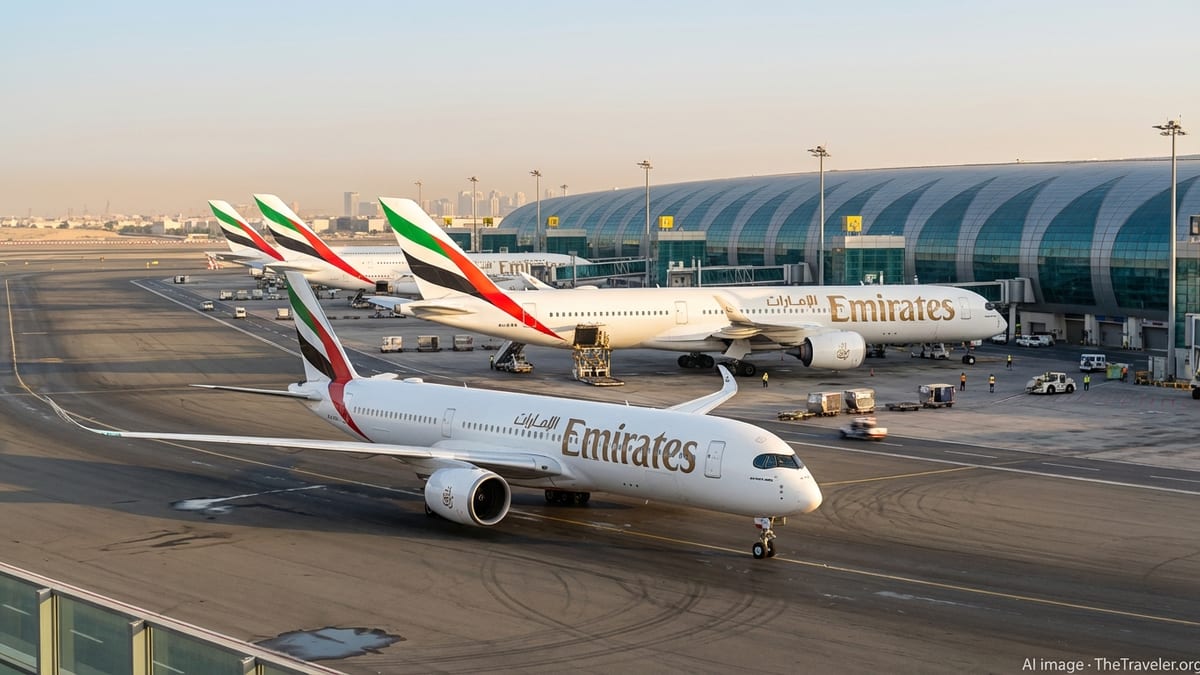
Emirates is once again nudging the boundaries of large long-haul aircraft design, this time by talking up a hypothetical “A350-2000” super-stretch that does not yet exist on Airbus’s order book.
As the Dubai carrier moves to renew and future-proof its fleet beyond the Airbus A380 era, its interest in a larger, longer A350 variant has become a focal point in the ongoing chess match between Airbus and Boeing at the top end of the widebody market.
More News
- Caribbean Travel to U.S. Upended by New Visa Freezes and Expanded Bans
- Mexico Restores E-Visas for Brazilians, Paving the Way for Borderless Tourism
- Philippine Airlines Joins Regional Carriers Powering Southeast Asia’s Tourism Boom
Emirates Looks Beyond the A380 Era
For nearly two decades, Emirates has been synonymous with the Airbus A380, building a global connecting network over Dubai around the double-deck giant. But with A380 production now closed and the fleet gradually heading toward retirement over the 2030s, the airline needs a new generation of high-capacity, long-range twinjets to maintain its hub strategy and seat economics on trunk routes.
The carrier already has a vast order book for Boeing’s 777X family, including more than 200 aircraft and additional commitments that were reinforced as recently as 2025. Yet continuing certification delays and shifting delivery timelines have pushed Emirates to widen its options. President Tim Clark has signaled that while the 777-9 and a notional stretched 777-10 remain central to plans, the airline wants Airbus to respond with something even more capable than today’s A350-1000.
That is where the idea of a stretched A350, often dubbed informally by industry watchers as the “A350-2000,” comes in. It would be a longer, higher-capacity derivative of the existing A350-1000, potentially stepping into the space once occupied by the largest 747s and the A380, but with the efficiency of a new-generation twinjet.
The A350-2000 Concept: Stretching the A350 Platform
Airbus has never formally launched an A350-2000 program, but the broad outline of what such an aircraft might look like is increasingly clear. Analysts envision a fuselage stretch beyond the current 73.8 meter A350-1000, pushing capacity comfortably above 410 passengers in a typical mixed-class layout and nudging into the range of the Boeing 777-9 and any future 777-10.
A stretched variant would likely retain the A350’s carbon-fiber fuselage and high-aspect-ratio wing, but could incorporate further aerodynamic tweaks, higher maximum takeoff weight and possibly revised wingtip devices to handle additional payload and range. The goal would be to deliver A380-like seat counts on key routes, without the penalties of four engines or the infrastructure demands of operating a double-decker aircraft.
From Emirates’ perspective, an A350-2000 would complement, rather than replace, its large 777X commitment. By pairing a high-capacity A350 stretch with the 777-9, Emirates could diversify risk across two manufacturers, increase flexibility in cabin layouts and missions, and ensure it can continuously match capacity to demand on long-haul corridors between Dubai, Europe, Asia and the Americas.
Why Emirates Wants a Bigger A350
Tim Clark has long argued that demand growth, particularly through the Gulf mega-hubs, will sustain the need for very large aircraft on dense trunk routes. The retirement of older high-capacity jets and capacity constraints at some airports have, in his view, opened a structural gap for efficient “mini-jumbo” twinjets that can carry 400 to 450 passengers with strong cargo capability over 8,000 to 9,000 nautical miles.
While the A350-1000 already pushes into that territory, Emirates sees headroom for more seats and thrust. Clark has suggested that the -1000 is underpowered by around 10,000 pounds of thrust compared with what he would like to see, and has publicly floated a target of about 107,000 pounds per engine. A stretched A350-2000, with a reinforced structure and more powerful engines, would give the airline more margin out of hot-and-high airports and greater operational flexibility on ultra-long sectors with high payloads.
At the network level, such an aircraft could slot in where A380s are too large or inflexible, but where smaller twins risk constraining revenue. Emirates has repeatedly emphasized that its aircraft are flown hard, at very high utilization and often at full passenger and cargo loads. A stretched A350 tailored to that operating profile would allow the carrier to keep unit costs low while preserving schedule density and connectivity across its Dubai hub.
Engine Durability: The Hurdle Airbus Must Clear
Behind the headline-grabbing talk of an A350-2000 lies a very pragmatic concern: engines. Emirates’ reluctance to commit to the existing A350-1000 has centered on the Rolls-Royce Trent XWB-97 powerplant and its performance in harsh desert environments. Clark has repeatedly highlighted that the engine’s time-on-wing in hot, dusty conditions falls well short of the 2,000 to 2,500 cycles the airline expects.
Those durability limitations directly affect maintenance costs, fleet availability and the number of spare engines an airline must purchase. For a high-utilization operator like Emirates, which “whacks these aeroplanes around the skies” at heavy loads, an engine that comes off wing too frequently can quickly erode the operating cost advantages promised by a new aircraft type.
Rolls-Royce has launched a substantial investment program to improve the durability of the XWB family, including the higher-thrust XWB-97, and is feeding technologies from its UltraFan demonstrator into current engines. The company has reported a growing order backlog for the XWB-97 and says ongoing improvements are already enhancing performance. Yet, by Emirates’ own assessment, the engine is still not where the airline wants it to be for its specific mission profile.
If Airbus were to move forward with an A350-2000, engine capability would be even more critical. A heavier, longer aircraft with more seats and payload would either require further uprated versions of the XWB-97 or a next-generation powerplant. That in turn raises development costs and timelines, making Emirates’ vocal demands both a technical challenge and a strategic consideration for Airbus and Rolls-Royce.
Boeing 777X, Market Dynamics and Competitive Pressure
Emirates’ push for an A350-2000 cannot be separated from the broader duel between Airbus and Boeing at the top of the twinjet market. Boeing’s 777-9 is currently the largest new-generation twin in development, with typical three-class capacity around 426 passengers, a wingspan over 71 meters and advanced GE9X engines. It is central to Emirates’ future fleet, but its protracted certification has opened space for Airbus to promote the A350-1000 and any future stretch as a more available solution for other airlines.
The A350 platform has steadily gained traction, with more than 650 aircraft delivered and a widening customer base, including major orders for the A350-1000 from Gulf newcomer Riyadh Air. Airlines are attracted by its fuel efficiency, long range and cabin comfort, and the type has been chosen for ultra-long-haul missions such as Qantas’s Project Sunrise. This momentum strengthens the business case for Airbus to consider a larger derivative if enough blue-chip customers signal interest.
For Emirates, encouraging Airbus to develop an A350-2000 also exerts competitive pressure on Boeing. If Airbus appears poised to field a rival capable of matching or exceeding the capacity of any future 777-10, Boeing faces added urgency to keep the 777X on track and to refine its own stretch proposals. Clark has been candid about using his airline’s buying power to influence both manufacturers, and the A350-2000 is part of that high-stakes negotiation.
Fleet Strategy and Risk Management for Emirates
Beyond the technical details, Emirates’ interest in an A350 stretch speaks to a broader risk-management strategy. The airline has historically balanced its long-haul fleet between Airbus and Boeing, using competition to secure better pricing, stagger delivery streams and avoid overreliance on a single program. The A380’s early end of production and the 777X delays have illustrated how vulnerable even a powerful carrier can be to manufacturer decisions and certification setbacks.
By advocating for an A350-2000 while firming up its 777X commitments, Emirates is signaling that it wants two robust, independent large-widebody families available in the 2030s. That would give the carrier options if one program faces new delays or technical issues, and it would support a more nuanced matching of capacity to demand across its network. A slightly smaller A350-1000 or -2000 could be used on routes where the 777-9 would be too large, while still delivering A380-like economics per seat in a denser configuration.
Emirates has already begun integrating the smaller A350-900 into its fleet, opening up new medium- and long-haul routes where the 777 is too much aircraft. A successful stretch program would allow the airline to grow within the same family, benefiting from cockpit commonality, shared maintenance infrastructure and flexible cabin planning. That, in turn, would help future-proof its business model as traffic patterns evolve and sustainability pressures increase.
Could the A350-2000 Become Reality?
Whether the A350-2000 ever progresses beyond industry shorthand into a launch program depends on more than the wishes of one airline, even one as influential as Emirates. Airbus would need to be convinced that global demand for an ultra-large twinjet is strong enough to justify development costs, especially as regulators and environmental groups scrutinize aviation emissions and noise footprints.
The manufacturer has been cautious about committing to major new widebody projects while it ramps up single-aisle production and navigates supply chain constraints. Executives have instead focused on incremental improvements to existing platforms, from cabin densification options to higher takeoff weights and performance packages that extend range and payload. A heavily stretched A350 would require a far deeper redesign, touching everything from landing gear and wing structure to systems and engine integration.
Still, airlines across Asia, the Middle East and parts of Europe continue to see strong growth on certain long-haul corridors, and the retirement of older 777-300ERs and A380s will create a capacity gap that current twins only partially fill. If Emirates can be joined by a cluster of other potential launch customers, and if Rolls-Royce or another engine supplier can demonstrate a clear path to the required thrust and durability, the A350-2000 could evolve from a talking point into a credible project.
FAQ
Q1. What is the A350-2000 that Emirates is talking about?
It is an industry nickname for a possible stretched version of the Airbus A350-1000 that would carry more passengers and potentially offer greater range, but has not been officially launched by Airbus.
Q2. Why is Emirates interested in a stretched A350?
Emirates wants a high-capacity, fuel-efficient twinjet to help replace its Airbus A380s over the next decade and to maintain strong seat economics on busy long-haul routes out of Dubai.
Q3. How would an A350-2000 compare to the Boeing 777X?
In concept, an A350-2000 would compete directly with the largest 777X variants, aiming for 400 to 450 seats in a typical configuration and long-range performance suitable for dense intercontinental routes.
Q4. What is holding Emirates back from ordering the current A350-1000?
The airline has concerns about the durability and maintenance costs of the Rolls-Royce Trent XWB-97 engines in hot, dusty conditions, and wants longer time-on-wing before committing.
Q5. Is Airbus actively developing the A350-2000?
Airbus has signaled openness to further A350 developments, but it has not announced a formal A350-2000 program and is still gauging airline demand and technical requirements.
Q6. When could an A350-2000 enter service if it were launched?
Given the scale of design, testing and certification work required, industry analysts suggest that even a near-term launch would likely translate into service entry sometime in the early-to-mid 2030s.
Q7. How does engine technology affect the feasibility of an A350-2000?
A stretch would require higher thrust and robust durability, so Rolls-Royce or another manufacturer would need to provide engines that deliver more power while meeting ambitious maintenance and operating cost targets.
Q8. What role does Emirates play in influencing new aircraft designs?
As one of the world’s largest long-haul carriers and a major customer for both Airbus and Boeing, Emirates can shape product roadmaps by publicly specifying what it wants and backing those requests with large potential orders.
Q9. Would an A350-2000 replace the 777X in Emirates’ plans?
Emirates views a potential A350 stretch as complementary rather than a replacement, giving it a broader toolkit of large twinjets to match capacity and range to different routes and market conditions.
Q10. What does this debate mean for travelers?
If projects like the A350-2000 move forward, passengers on major long-haul routes could see newer twin-engine jets with A380-level capacity, improved cabin comfort and better fuel efficiency operating into the 2030s and beyond.