

More news on this day
Emirates is undertaking one of the most ambitious cabin overhauls in commercial aviation, transforming its high-density Airbus A380 fleet with a new three-class layout that introduces Premium Economy and dramatically expands Business Class, in a bid to capture surging demand for upscale long haul travel while keeping the superjumbo at the center of its network strategy.
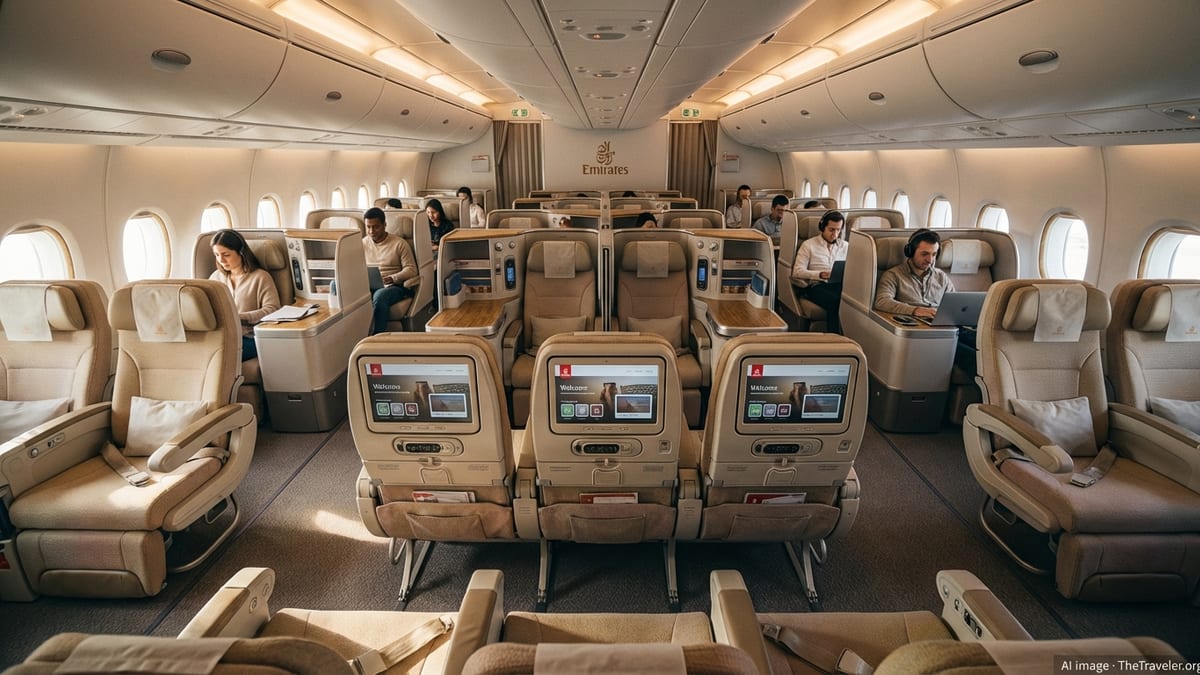
A Bold Reconfiguration of the World’s Largest Passenger Jet
The Dubai based carrier, already the largest operator of the Airbus A380, is retiring its two class, 615 seat configuration and replacing it with a more segmented three class design that prioritizes premium cabins over raw capacity. The reconfigured aircraft will feature 76 Business Class seats, 56 newly added Premium Economy seats and 437 Economy seats, bringing total capacity to 569 passengers, down from 615.
The move marks a decisive shift away from the previous high density layout, which combined 58 Business Class seats with an expansive 557 seat Economy cabin. By November 2026, all 15 of these densest A380s are expected to complete conversion to the new three class standard, aligning them with the rest of the Emirates superjumbo fleet and creating a more consistent offering across key long haul routes.
Industry analysts say the decision balances revenue optimization with shifting traveler expectations. While seat count falls by around 8 percent, the introduction of Premium Economy and a larger Business Class is expected to lift yield per passenger, especially on routes where demand for comfort and privacy has outpaced traditional economy bookings since the pandemic.
Premium Economy Takes Pride of Place on the Upper Deck
The heart of the transformation is the formal introduction of Premium Economy onto Emirates’ former high density A380s. The airline has chosen to position the 56 seat Premium Economy cabin at the front of the upper deck, occupying the footprint that on four class A380s is normally reserved for 14 First Class suites. This redesign turns the entire upper deck into premium real estate, with Premium Economy at the front and Business Class stretching through the middle and rear sections.
Emirates’ Premium Economy product, already in service on a growing number of A380s and Boeing 777s, features wider seats, generous pitch, deeper recline, and elevated dining, designed to bridge the gap between Economy and Business Class. Positioning the cabin on the upper deck, with its quieter atmosphere and more intimate feel, is intended to reinforce the perception of a distinct, upgraded experience rather than a marginal tweak to standard economy.
The airline has been steadily extending Premium Economy across its network and now plans to offer the cabin on 99 destinations by the end of 2026 across A380s, Boeing 777s and next generation Airbus A350s. The retrofit of the 15 high density A380s is a key pillar of that expansion, adding thousands of weekly Premium Economy seats on trunk routes linking Dubai with Europe, Asia, Africa and the Americas.
Business Class Grows and Moves Center Stage
Parallel to the Premium Economy rollout, Emirates is significantly enlarging and repositioning Business Class on the reworked A380s. Business capacity will rise from 58 to 76 seats, matching the count found on the carrier’s four class superjumbos and ending the anomalous layout that previously distinguished the high density subfleet.
All Business Class seats will now be located exclusively on the upper deck, occupying the middle and rear sections. This simplifies the cabin map and removes the split arrangement in which some upper deck space had been dedicated to Economy. For frequent flyers, this should mean a more predictable experience regardless of which A380 variant is rostered on a particular route.
As part of the broader multi year retrofit program, Emirates is also installing new Business Class seat models, improved lighting, refreshed finishes and upgraded inflight entertainment across both A380s and Boeing 777s. Future phases, due to accelerate from 2026, will add Safran business seats and next generation Panasonic entertainment systems, along with free high speed Wi Fi via Starlink, underscoring the airline’s push to keep its hard product competitive even as new widebody types arrive from rival carriers.
From High Density Workhorse to Premium Heavy Flagship
The 615 seat A380s were originally designed as high capacity workhorses for dense leisure and labor routes, where demand for low fares and sheer seat volume outweighed appetite for premium cabins. Post pandemic travel patterns, however, have shifted in favor of higher yield cabins, with strong corporate demand returning and affluent leisure and “bleisure” travelers prioritizing space and comfort on long flights.
By pivoting these aircraft to a three class layout, Emirates is effectively recasting them as premium heavy flagships rather than pure volume movers. The reduction of 120 Economy seats makes room for the new Premium Economy cabin and expanded Business Class, and signals confidence that higher average fares will offset the loss of overall capacity, especially on markets where the A380 has become an aspirational product in its own right.
Fleet planners also benefit from a more standardized configuration. Once the retrofit is completed, all Emirates A380s will share the same Business Class seat count and consistent placement of premium cabins, simplifying scheduling, catering, crew familiarization and maintenance planning. For passengers, it reduces the risk of “product lottery” where the onboard experience varied significantly depending on which variant operated the flight.
New Routes and Schedules Showcase the Revamped A380
The rollout of the reconfigured A380s is being carefully sequenced across the network to spotlight their premium credentials. The first high density A380 converted to the new three class standard is set to enter service on the Dubai to Amman route in April 2026, operating for a short period before being reassigned to Prague from June. Both cities have featured prominently in Emirates’ recent Premium Economy announcements, reflecting their role as test beds for the updated layout.
Additional 569 seat A380 deployments are scheduled to follow across a mix of regional and long haul routes through 2026, including Bangkok, Birmingham, Denpasar, Dusseldorf, Jeddah, Kuala Lumpur, London Gatwick and Mauritius, according to recent schedule filings. These markets combine strong leisure flows with growing demand for mid tier and business travel, giving Emirates a wide canvas on which to gauge the response to its new cabin balance.
The refurbished aircraft will complement the airline’s parallel push to equip more destinations with four class A380s featuring First Class at the very top of the product pyramid. Cities such as New York, Zurich, Milan and Dublin are already lined up to receive additional retrofitted A380s and upgraded Boeing 777s this year, often with Premium Economy debuting or expanding alongside refreshed Business Class cabins.
A Multi Billion Dollar Retrofit Program Gains Pace
The A380 cabin transformation forms part of a broader, multi billion dollar investment program that Emirates launched in 2021 and has since expanded several times. The initiative now covers more than 200 aircraft across the A380 and Boeing 777 fleets, with workstreams ranging from seat replacement and cabin reconfiguration to new inflight entertainment platforms and connectivity upgrades.
By late 2025, the airline had already refurbished dozens of widebody jets, averaging two aircraft emerging from the Emirates Engineering Centre each month with completely overhauled interiors. From August 2026, the next phase will see 60 additional A380s and 51 Boeing 777s receive new Safran Business Class seats, RECARO Premium Economy seating and updated Economy chairs, alongside 4K screens, immersive moving maps and fleetwide Starlink broadband.
The scope and tempo of the project are unusual in an industry where many carriers have opted to retire older widebodies rather than invest heavily in cabin renewals. Emirates has taken the opposite route, betting that its extensive A380 and 777 fleets can remain competitive deep into the next decade if their interiors match or exceed the standard of upcoming models such as the Boeing 777X and Airbus A350.
Strategic Bet on Premium Travel Demand
Behind the hardware changes lies a clear strategic calculation about where airline profits will be made in the next decade. Emirates’ decision to sacrifice some of the A380’s maximum capacity for more premium seating aligns with broader industry trends showing sustained strength in high yield segments, even as overall global capacity has returned to or surpassed pre pandemic levels.
Premium Economy, in particular, has become a focal point for revenue growth. Priced significantly above standard economy but well below business class, it attracts a wide mix of customers, from small business owners and flexible corporate travelers to families willing to pay extra for comfort on long flights. By rolling out a distinct, upper deck Premium Economy cabin with upscale finishes and service touches, Emirates is positioning itself to capture that segment at scale.
At the same time, the enlargement of Business Class on the A380 dovetails with the airline’s wider efforts to refresh its premium proposition on the Boeing 777 and forthcoming Airbus A350. With new suites, updated lounges and upgraded dining and connectivity rolling out in parallel, Emirates aims to maintain its reputation as a benchmark carrier for long haul comfort as competition intensifies from Gulf, European and Asian rivals.
What It Means for Passengers and the Future of the A380
For travelers, the reimagined A380 promises a more clearly tiered cabin choice without sacrificing the aircraft’s marquee appeal. Passengers can expect quieter, more intimate upper deck cabins, more consistent Business Class layouts and the option of Premium Economy on an expanding list of routes, often paired with refreshed lounges and upgraded inflight entertainment.
The changes also extend the commercial life of the A380 at a time when most airlines have either retired or sharply reduced their superjumbo fleets. Emirates is effectively doubling down on the aircraft, but with a configuration that better reflects current demand patterns and its own hub and spoke business model. By turning the upper deck into an all premium space and standardizing Business Class across the fleet, the carrier is reinventing the jet as a flexible premium platform rather than a simple capacity solution.
As the first reconfigured aircraft enter passenger service from spring 2026 and more follow through the year, the success of Emirates’ gamble will be closely watched by competitors and aviation analysts alike. If the blend of increased premium seating, consistent cabin experience and strong route selection pays off, the A380 could yet enjoy a long and profitable second act, with Emirates’ red tailed superjumbos remaining some of the most sought after rides in the skies.