

More news on this day
Emirates is moving to restore full flight capacity across its Middle East network as global air travel demand surpasses pre-pandemic levels, signaling a decisive new phase in the region’s aviation recovery and reaffirming Dubai’s role as a critical crossroads for long-haul traffic between Europe, Asia and Africa.
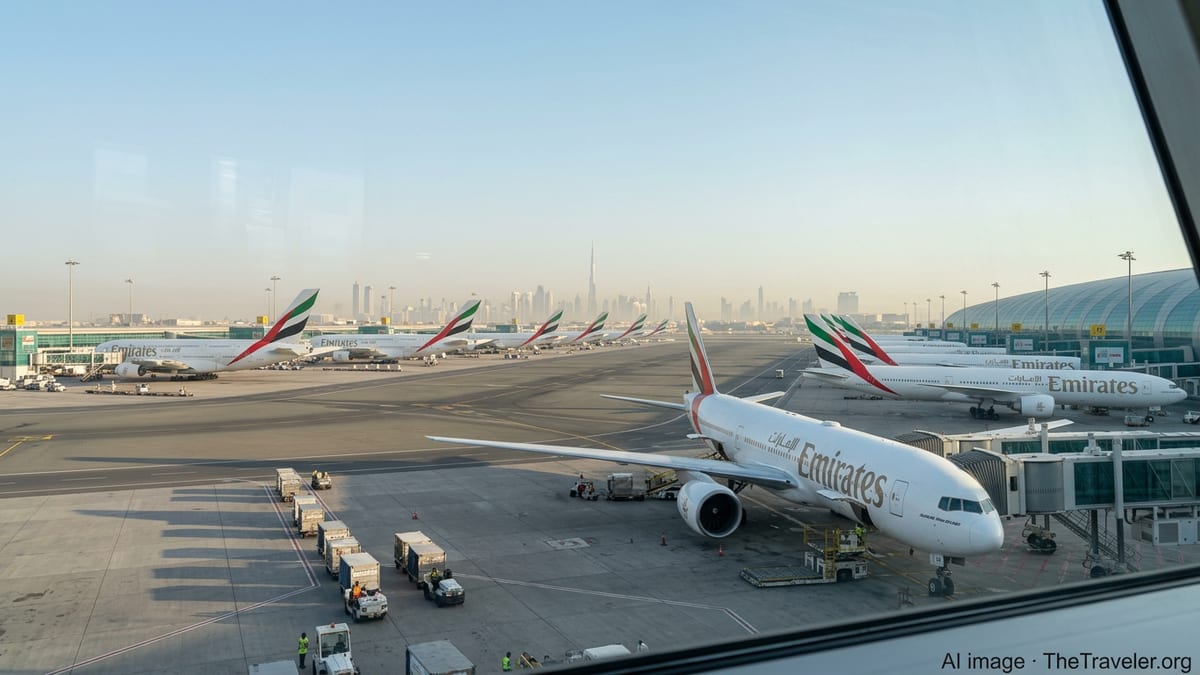
Emirates Rebuilds Its Middle East Network After Turbulent Years
The Dubai-based carrier has spent the past two years methodically rebuilding its regional schedule after the pandemic and subsequent geopolitical disruptions forced deep cuts to frequencies and, in some cases, temporary route suspensions. As airspace restrictions ease and demand rebounds, Emirates is now restoring capacity on key Middle Eastern routes to, and via, Dubai, edging back toward its pre-crisis network strength.
According to the airline’s recent network updates, Emirates has reactivated most of its traditional gateways across the Gulf, Levant and wider Middle East, pairing the restored passenger network with expanded cargo belly capacity. Additional frequencies are being layered back on busy corridors where corporate and VFR (visiting friends and relatives) traffic has rebounded most strongly, allowing the carrier to close the remaining gap to its 2019 seating capacity.
Industry data shows that as of early 2025 Emirates was operating more than 3,000 flights per week across 130-plus destinations worldwide from its Dubai hub, with a particularly dense schedule into South Asia, the Gulf and wider Middle East. That footprint has steadily widened as new aircraft join the fleet and traffic flows normalize across key long-haul markets.
The airline’s network planners have focused first on restoring daily and double-daily patterns on trunk routes, which underpin connectivity for onward long-haul services. This has included reinstating multiple daily services on core Middle East city pairs to support smooth connections to Europe, Asia and Africa, and to protect Dubai’s competitiveness against rival hubs in Doha and Abu Dhabi.
Regional Capacity Restoration Tied to Global Demand Surge
Emirates’ push to bring its Middle East operation back to full strength comes as global passenger numbers set new records. Figures from the International Air Transport Association show that worldwide air passenger demand in 2024 moved almost four percent above 2019 levels, with the Middle East outperforming that global average thanks to strong long-haul traffic and the rapid reopening of key markets.
Middle Eastern carriers collectively recorded high load factors and some of the strongest profit margins in the industry as 2024 turned to 2025, buoyed by resilient premium demand and robust leisure flows to and from the Gulf. The region’s network airlines leveraged their long-haul business models and geographically strategic hubs to capture traffic that previously flowed over other corridors, particularly on Europe–Asia and Africa–Asia routes.
For Emirates, this backdrop has created the conditions to justify reinstating frequencies that were still below 2019 levels. Higher yields, strong connecting demand and more stable fuel prices have helped offset continuing cost pressures and supply chain constraints. The carrier’s decision to restore full capacity across its Middle East network is therefore closely aligned with the broader global trend of normalized, and in some segments elevated, demand.
At the same time, the capacity restoration is being calibrated carefully to avoid over-expansion. Industry forecasts point to more moderate single-digit growth in passenger traffic through 2025 compared with the double-digit surges of the immediate post-pandemic years, prompting airlines like Emirates to balance growth ambitions with disciplined capacity management.
Fleet Investments Anchor Emirates’ Long-Term Middle East Strategy
The restoration of regional capacity is underpinned by an aggressive long-term fleet strategy. Emirates has doubled down on widebody aircraft, placing substantial new orders for Boeing 777-9s and inducting next-generation Airbus A350s, a move designed to secure efficient lift on dense trunk routes that feed and depend on Middle East connectivity.
Recent commitments at the Dubai Airshow added dozens of new 777-9s to the airline’s already significant backlog, extending Emirates’ role as the largest operator of the type once it enters service. These widebodies will progressively replace older aircraft and provide incremental capacity, allowing the airline to sustain multiple daily rotations on regional sectors while supporting long-haul expansion.
In parallel, Emirates is coordinating closely with sister carrier FlyDubai, which has embarked on its own fleet expansion anchored by high-capacity narrowbodies. The two airlines operate complementary networks through Dubai, with FlyDubai serving thinner regional and medium-haul markets and Emirates focusing on widebody operations. As both fleets grow, the combined system is expected to add further depth and flexibility across the Middle East.
For travelers, these fleet investments translate into more choice of departure times, better connectivity windows in Dubai and higher seat availability on popular routes. For airports around the region, they bring renewed prospects for growth in passenger numbers and cargo throughput, helping to restore jobs and ancillary revenues lost during the downturn.
Dubai’s Hub Role Strengthens Amid Shifting Global Corridors
The strategic restoration of Emirates’ Middle East capacity is also a response to shifting global traffic patterns that have further elevated the importance of Gulf hubs. Constraints on certain traditional air corridors and evolving geopolitical risks have redirected a significant portion of long-haul traffic through the Arabian Peninsula, sharpening competition among hub carriers but also expanding the addressable market for Dubai.
Dubai International Airport has remained one of the world’s busiest international gateways, and Emirates’ rebuilding of its regional network is crucial to maintaining that status. Every additional daily frequency in the Middle East widens the catchment area feeding Dubai, ensuring that travelers from secondary and tertiary cities can access long-haul services with a single, timed connection.
This strategy is reinforced by Emirates’ extensive web of codeshare and interline agreements, which now provide access to hundreds of additional destinations beyond its own network. By tightly integrating regional flights with long-haul services and partner operations, the carrier aims to make Dubai a one-stop option for an ever larger share of global travelers, particularly those moving between emerging markets.
Analysts note that as the global aviation system moves beyond the recovery phase into a more mature growth cycle, the carriers best positioned to capitalize will be those that can combine scale, connectivity and operational resilience. Emirates’ methodical return to full Middle East capacity is widely viewed as a central pillar in its effort to retain that competitive edge.
Opportunities and Risks in a Normalizing Aviation Cycle
While Emirates’ restoration of capacity across the Middle East reflects confidence in long-term demand, it also comes at a time when the industry faces a new set of challenges. Supply chain bottlenecks in aircraft and engine manufacturing, persistent infrastructure constraints at key airports and the rising cost of sustainable aviation fuel all threaten to limit how quickly carriers can grow.
Regulators and industry bodies are simultaneously pressing airlines to accelerate decarbonization, a shift that requires substantial investment just as many balance sheets are still healing from pandemic-era losses. For Gulf carriers built around long-haul connecting traffic, achieving net-zero targets will require a combination of fleet renewal, operational efficiencies and future access to low-emission fuels at scale.
Nevertheless, demand indicators remain broadly positive. Business travel is stabilizing, leisure travel continues to expand and the Middle East’s own tourism ambitions are generating new intra-regional flows. For Emirates, this environment supports a strategy of restoring capacity to meet existing demand while retaining the flexibility to redirect aircraft as markets evolve.
With full Middle East capacity now within reach and broader global aviation firmly in recovery, Emirates is positioning itself to carry a larger share of the world’s travelers through Dubai in the years ahead, reinforcing the Gulf’s status as the nexus of modern long-haul air travel.