

More news on this day
Emirates’ decision to suspend most flights to and from Dubai in response to widespread Middle East airspace closures has become one of the most visible shocks of the current regional crisis, disrupting global travel corridors between Europe, Asia, Africa, and beyond.
Get the latest news straight to your inbox!
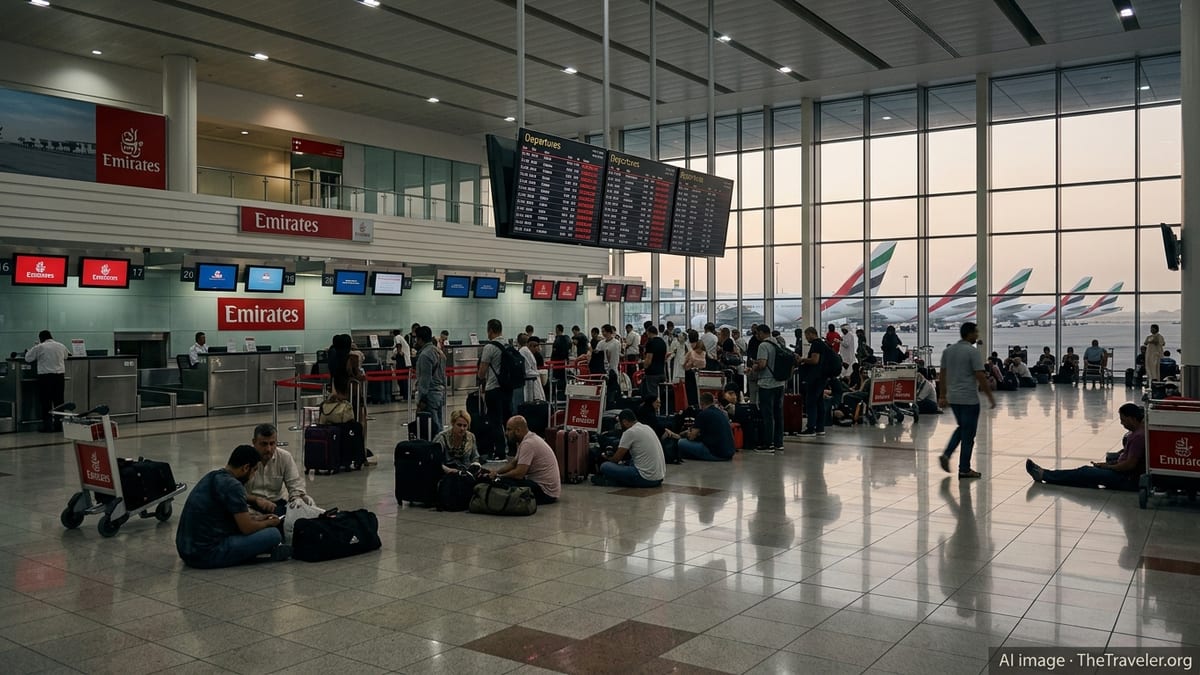
How the Middle East Crisis Grounded a Global Hub
Dubai International Airport is one of the world’s busiest aviation crossroads, and Emirates is its dominant carrier. When regional airspace over parts of the Gulf and neighboring states closed in late February and early March 2026 following cross-border strikes and escalating tensions, Emirates moved from rerouting select services to a near-total suspension of scheduled passenger operations to and from Dubai for several days.
Publicly available operational updates show that all regular Emirates flights in and out of Dubai were halted through the first week of March, with only limited relief and repatriation services operated on select routes. Industry trackers report cancellation rates for the airline that at one point approached 40 percent or more of scheduled services, as airspace restrictions extended over Iran, Iraq, Israel, Jordan, Qatar, Bahrain, Kuwait, and the United Arab Emirates.
As authorities in several Gulf countries began gradually reopening airspace, Emirates restarted flights to a growing list of destinations. However, schedules remain sharply reduced compared with pre-crisis levels, with fewer frequencies on trunk routes and some cities still temporarily suspended. Aviation analysts describe the disruption as the most severe to hit Gulf hubs since the height of the pandemic.
The situation remains fluid, with airlines stressing that schedules are subject to change at short notice depending on airspace availability and security conditions. Travelers are being urged by official travel advisories and airline notices alike to check flight status before heading to the airport and to allow extra time for rebooking or alternative routing.
Asia–Europe and Africa Corridors Face Longer Journeys and Higher Fares
One of the most immediate global effects of Emirates’ flight reductions is on the dense network of connections between Asia, Europe, and Africa that normally funnel through Dubai. Published aviation data indicate that thousands of flights across the region have been canceled or rerouted, forcing airlines to fly longer paths that avoid closed or restricted airspace.
For passengers, that has translated into longer journey times, additional fuel stops, and sharply tighter seat availability on remaining services. Travel industry reports suggest that on some key Asia–Europe city pairs, fares have surged as capacity dropped when Emirates, along with other Gulf carriers, cut frequencies or paused flights entirely.
Alternative hubs such as Istanbul, Riyadh, Jeddah, and major European gateways are absorbing some of the displaced demand, but with constraints of their own. According to aviation consultancy assessments, carriers in South and Southeast Asia have been particularly affected, with large numbers of their Europe-bound passengers historically transiting through Dubai on Emirates or its regional rivals.
Corporate travel managers report shifting high-priority business travelers onto more circuitous routings via Europe or East Asia, while some leisure trips are being postponed altogether. Tour operators in Europe and Asia that rely on Emirates’ extensive network for multi-stop itineraries are revising programs week by week as flight availability changes.
Tourism Destinations Feel the Loss of Gulf Connectivity
Emirates’ route map touches more than 130 destinations worldwide, and many of those cities depend on Dubai as a primary or secondary gateway for international visitors. Tourism boards and industry groups in Africa, the Indian Ocean, and parts of Asia and Europe have warned in recent days that prolonged reductions in Gulf connectivity could weigh heavily on visitor arrivals.
Destinations such as the Maldives, Mauritius, Seychelles, East African safari hubs, and secondary European cities have long relied on Emirates’ multiple daily frequencies and favorable connection times. When those flights are cut back or consolidated, it becomes harder for travelers to reach resorts and regional airports in a single travel day, potentially reducing demand or diverting visitors to better-served competitors.
Hotel operators and resort chains are closely monitoring booking trends as the crisis unfolds. Early indications from travel agencies and booking platforms point to a rise in cancellations and date changes for itineraries scheduled in March and April, especially where passengers were due to connect through Dubai. Some markets are offering flexible change policies and targeted discounts in an effort to hold on to existing bookings once flight options normalize.
For city destinations like Dubai itself, the short-term impact is stark. With Emirates operating a reduced schedule and advising passengers not to travel to the airport without confirmed bookings, the usual stream of transit visitors who add stopovers for shopping, events, or business meetings has slowed sharply, affecting hotels, retail, and hospitality venues across the emirate.
Cargo, Supply Chains, and the Energy Market Under Pressure
Emirates is not only a passenger airline; its SkyCargo division is a major global freight carrier linking manufacturing centers in Asia with consumer markets in Europe, Africa, and the Americas. The grounding and rerouting of passenger flights, many of which carry significant belly-hold cargo, are having a knock-on effect on time-sensitive supply chains.
Logistics reports indicate that airfreight capacity through Dubai dropped significantly during the peak of the closures, with some cargo shifted to freighter-only services or alternative hubs where space is available. This has driven up spot airfreight rates on certain corridors, particularly for high-value goods such as electronics, fashion, pharmaceuticals, and critical spare parts.
At the same time, the broader Middle East crisis has led to notable cuts in regional oil production and temporary disruptions at key export terminals, according to economic analyses tracking the conflict. Reduced output from producers around the Gulf has already pushed up global energy prices, increasing fuel costs for airlines just as they face longer detours and operational uncertainty.
Higher jet fuel prices feed directly into airline cost structures, and industry economists suggest that carriers may respond with surcharges or fare increases if elevated energy prices persist. That would add another layer of expense for both leisure and business travelers on top of already constrained capacity from Emirates and other affected airlines.
What Travelers and the Industry Should Watch Next
For now, travelers with upcoming Emirates bookings are being advised by publicly available airline and government travel updates to monitor their reservations closely, use official channels to rebook or request refunds if eligible, and avoid traveling to airports without confirmed flights. Travel insurance policies that cover disruption due to conflict or government-mandated airspace closures are being scrutinized as passengers seek compensation for unexpected expenses.
On the industry side, the key variables to watch include how quickly regional airspace fully reopens, how rapidly Emirates can restore capacity on core routes, and whether demand rebounds once a more stable operating pattern emerges. Fleet and crew positioning, the availability of alternative routings that remain commercially viable, and the duration of elevated fuel prices will all influence the speed of recovery.
Tourism ministries and destination marketing organizations are also weighing short-term measures to support affected businesses. Some are expected to pivot promotional campaigns toward origin markets that can be reached without transiting the Gulf, while keeping a close eye on when Emirates and other Gulf carriers can bring back lost seats.
Analysts widely note that the current crisis underscores how central Gulf super-connectors like Emirates have become to the architecture of global air travel. The airline’s sharp flight reductions, though temporary, reveal the extent to which tourism flows, trade links, and even energy markets are intertwined with the airspace above a volatile region.