

More news on this day
Emirates passengers are facing major disruption in March 2026 as the escalating Iran conflict triggers sweeping airspace closures across the Gulf, forcing suspensions, diversions, and lengthy reroutes on some of the world’s busiest long-haul corridors.
Get the latest news straight to your inbox!
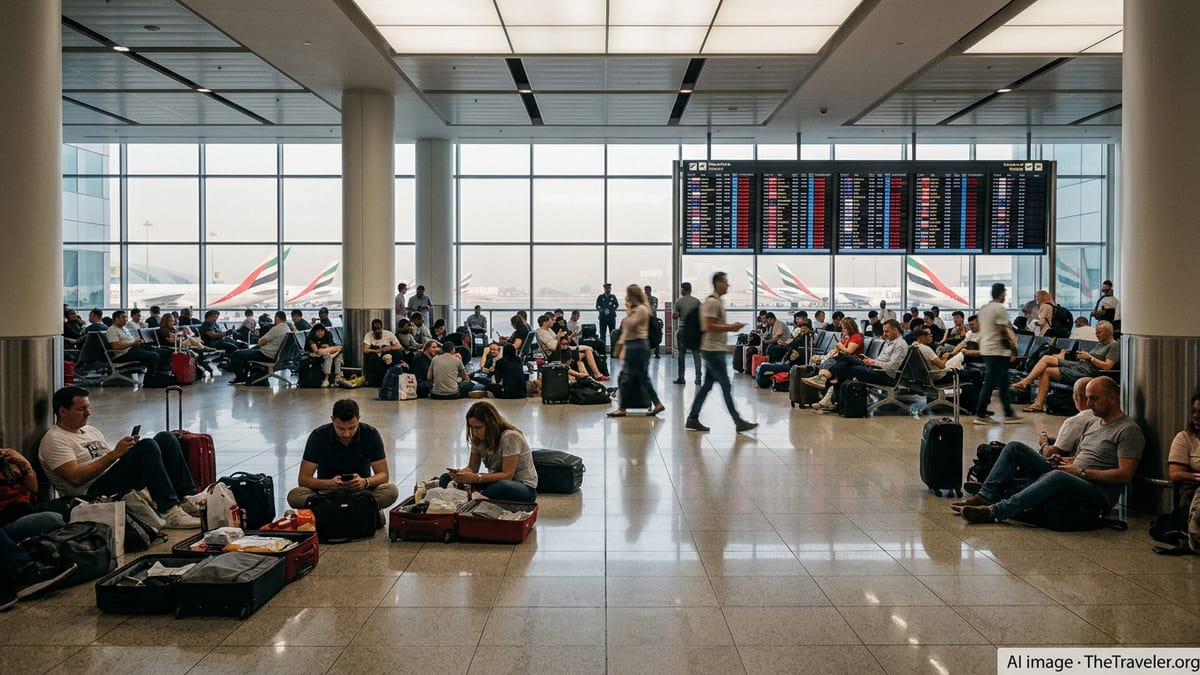
Regional Conflict Shuts Key Gulf Aviation Corridors
The latest phase of the Iran conflict, sparked by joint United States and Israeli strikes on Iranian targets beginning on 28 February 2026, has rapidly spilled into the skies. Large sections of airspace across Iran, Iraq, the Gulf and the eastern Mediterranean have been closed or severely restricted for civilian traffic as missile and drone attacks continue to target infrastructure and major cities.
Publicly available airspace tracking and industry advisories show that the United Arab Emirates, Bahrain, Qatar, Iran, Iraq and Israel have all imposed emergency measures, ranging from full closures to tightly controlled corridors at specific altitudes. The European Union Aviation Safety Agency has issued a Conflict Zone Information Bulletin warning of a high risk to civil aviation in the Middle East and Persian Gulf, urging airlines to avoid affected flight information regions wherever possible.
These restrictions have hit regional hubs at the heart of global aviation. Dubai International Airport and Abu Dhabi International Airport, normally central to long-haul networks between Europe, Africa, Asia and Australia, have seen large parts of their operations curtailed since the end of February. Analysts note that this single cluster of closures has disrupted a key air bridge linking the Eastern and Western hemispheres, with knock-on effects for schedules far beyond the Middle East.
Travel risk consultancies report that airspace in neighbouring states, including Saudi Arabia and Jordan, is also subject to heightened controls and partial closures, further complicating attempts to design safe alternative routings. Muscat in Oman has emerged as a preferred diversion and relief hub, but capacity constraints and shifting military dynamics mean the situation remains fluid from day to day.
Emirates Suspensions, Reroutes and Reduced Schedules
According to published coverage by international and regional media, Emirates suspended regular scheduled passenger operations from Dubai in the immediate aftermath of the initial strikes, as Iranian missiles and drones targeted airports and strategic sites across the Gulf. Reports indicate that Dubai’s main hub sustained limited physical damage, while emergency procedures and security measures forced a temporary halt to departures and arrivals.
In the days since, the airline has begun operating a reduced and highly modified schedule, prioritising select trunk routes and essential connectivity while avoiding Iranian airspace and other designated conflict zones. Flight tracking data and airline advisories show long-haul services that would normally overfly Iran, Iraq and the Gulf now taking extended detours over Turkey, the Caucasus, Central Asia or North Africa, adding hours to journey times and increasing fuel burn.
Some destinations remain temporarily suspended or subject to rolling short-notice cancellations, particularly where both origin and destination lie within or adjacent to restricted airspace. Travellers transiting Dubai and other Gulf hubs report missed onward connections, unplanned overnight stays and complex rebooking processes as airlines attempt to rebuild viable networks around a moving patchwork of closures and military exclusions.
Industry outlets note that Emirates, along with other Gulf carriers such as Etihad and Qatar Airways, is working within national security directives that impose Emergency Security Control of Air Traffic zones over parts of the UAE and neighbouring states. These measures limit available routes and departure slots, meaning that even when flights are technically permitted, overall capacity through the region is sharply reduced.
Global Ripple Effects for Long-Haul Travelers
The impact of the Iran conflict on Emirates services is being felt well beyond the Middle East. Data from aviation analytics firms cited by international media indicate that tens of thousands of passengers a day who would normally connect through Dubai, Abu Dhabi or Doha are affected by cancellations, diversions and missed connections.
Airlines across Europe and Asia are adjusting their schedules to account for the loss or degradation of the traditional “Middle East corridor” between Europe and South or Southeast Asia, as well as between North America and destinations in India, Pakistan and Australasia. Some carriers are temporarily routing services via southern paths over the Arabian Sea and Indian Ocean, while others are increasing reliance on northern routes over Central Asia and Eastern Europe where security assessments allow.
For Emirates travelers, the practical consequences range from relatively minor delays on rerouted flights to significant disruption where itineraries rely on tight connections or involve multiple sectors across the region. Travel publications report that passengers bound for popular leisure destinations such as the Maldives, Sri Lanka and East Africa have faced particular uncertainty, as many of these routes are structured around Gulf hub connections now operating under severe constraints.
Corporate travel managers and tour operators are revising itineraries and contingency plans, with some temporarily shifting bookings away from conflict-affected hubs where alternative routings are feasible. However, given Emirates’ central role in linking secondary cities worldwide, complete avoidance of the carrier and its Dubai hub is not always practical, especially for travellers originating in smaller markets with limited direct long-haul options.
Official Advisories and Safety Assessments
Government travel advisories are reinforcing the sense of uncertainty for Emirates customers and other travelers using Gulf hubs. Western foreign ministries have issued broad warnings against non-essential travel to parts of the Middle East, highlighting both the direct security risks from missile and drone strikes and the indirect risks from unstable aviation conditions and sudden airspace changes.
Conflict zone guidance from international aviation bodies stresses that airlines bear responsibility for their own risk assessments and routing decisions, even where airspace remains technically open. Publicly accessible bulletins recommend that operators avoid, or exercise extreme caution in, the airspace of Iran, Iraq and several Gulf states while active hostilities continue. Safety notices emphasise the potential for misidentification, military activity near civilian flight paths and the risk of debris or interceptions in contested skies.
At the national level, the UAE’s General Civil Aviation Authority has signalled through public statements that air traffic decisions are being made in coordination with regional and international partners, with safety described as the overriding priority. The regulator and major airports have urged passengers to rely on verified airline and airport communications rather than social media when assessing the status of flights, and to avoid travelling to the airport unless they hold a confirmed and reconfirmed booking.
Security analysts caution that the situation may evolve quickly if there are further military escalations, targeted attacks on transport infrastructure or changes in the posture of regional states participating in or affected by the conflict. In practice, this means that even routes currently operating on a limited basis through Emirates’ network may be subject to abrupt rescheduling or suspension with little advance warning.
What Emirates Passengers Should Expect in the Coming Days
For travelers booked with Emirates in March 2026, the prevailing message from airlines, airports and travel risk consultancies is to prepare for continued volatility. While limited services are resuming on selected routes, the combination of damaged infrastructure, high military alert levels and complex airspace restrictions makes a rapid return to normal operations unlikely in the short term.
Reports from corporate travel agencies and global mobility firms recommend that passengers reconfirm all sectors 24 to 48 hours before departure, monitor airline apps closely for schedule changes and retain documentation of any delays or cancellations. Where itineraries involve tight connections in Dubai or other Gulf hubs, travellers are being advised to consider longer buffers or to rebook via alternative routings if timing is critical.
Experts in travel risk management also highlight the importance of flexible tickets, comprehensive travel insurance and contingency planning. In cases where Emirates is forced to cancel flights at short notice due to new security directives or airspace closures, re-accommodation options may be limited by capacity and by the parallel disruption facing other carriers in the region.
Although there are early signs of partial reopening in some Gulf airspace under strict security controls, the broader conflict dynamic around Iran means that the aviation environment is likely to remain fragile. For now, Emirates customers planning to transit or depart via Dubai should anticipate longer journeys, changing routings and the possibility of sudden disruption as the situation in the skies above the Middle East continues to shift.