

More news on this day
Emirates is grappling with one of the most disruptive episodes in its history, as regional airspace closures and security concerns force the Dubai-based carrier to suspend most operations, leaving tens of thousands of passengers stranded but eligible for expanded rebooking and refund options.
Regional Crisis Shuts Down a Global Hub
The shock suspension of Emirates services followed cascading airspace closures across the Middle East after strikes and counterstrikes involving Iran, the United States and Israel. Authorities shuttered or restricted routes over multiple countries, effectively sealing off some of the world’s busiest flight corridors and turning Dubai International Airport from a hyper-efficient hub into a holding pattern for grounded jets and displaced travelers.
Dubai International and Al Maktoum International airports halted operations after February 28, with damage reported at parts of Dubai’s main terminal complex and heightened security restrictions across the United Arab Emirates. Emirates responded by suspending all flights to and from Dubai for defined windows, initially through March 1 and later extending the stoppage while officials assessed infrastructure and airspace safety. The pause coincided with wider shutdowns in Abu Dhabi and tight restrictions in neighboring states, amplifying the shock to global aviation networks.
What began as a regional security crisis quickly became a worldwide travel emergency. As Emirates grounded aircraft and diverted inbound services, long-haul itineraries linking Europe, Africa, Asia and Oceania through Dubai unraveled in real time. Airline data providers and airport operators reported thousands of cancellations and diversions across several days, with Emirates at the epicenter due to the sheer volume of traffic ordinarily funneled through its hub.
Compounding the pressure, the disruption struck during a busy travel period, with business travelers, migrant workers, expatriate families and tourists all heavily represented on the airline’s route map. Many faced abrupt layovers in third countries, while others were left queuing at closed or partially functioning terminals in the Gulf, trying to secure information and alternative ways home.
Passengers Stranded Across the UAE and Beyond
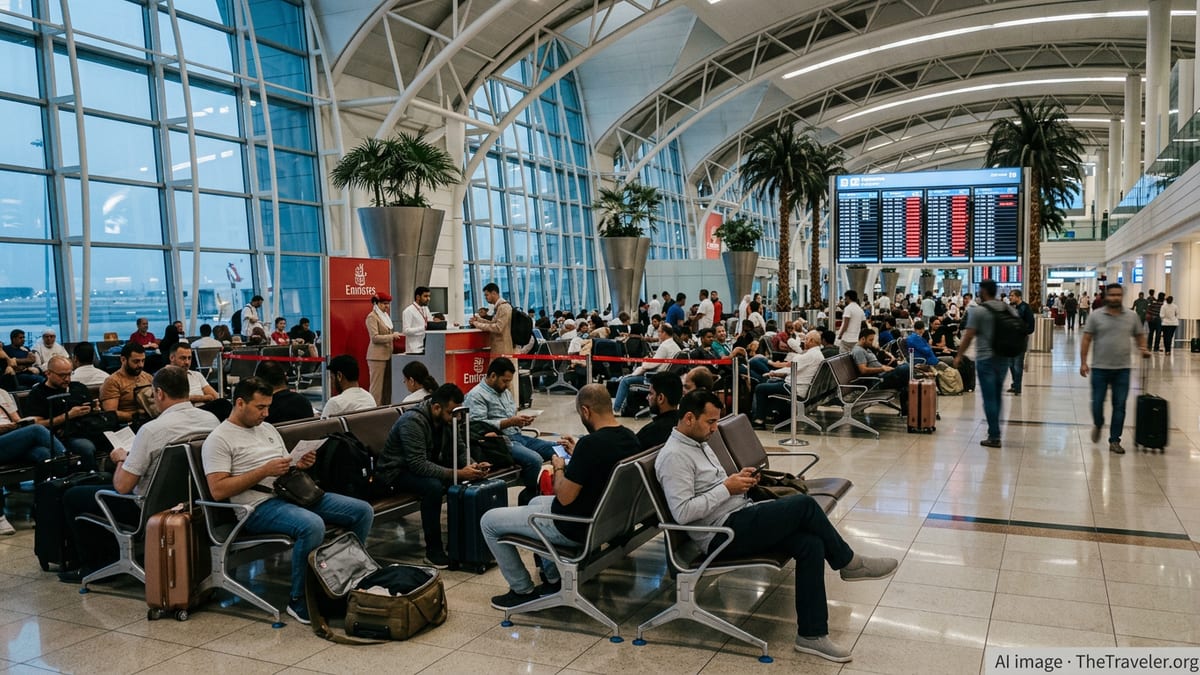
By early March, aviation authorities in the UAE estimated that more than 20,000 passengers were stranded at airports in Dubai, Abu Dhabi and Sharjah alone, with many more affected further afield as Emirates adjusted its global network. Local officials described a complex logistical effort to move people out of crowded terminals and into temporary accommodation, while airport staff worked around the clock to handle a backlog of disrupted flights.
Travelers reported long waits for updates as operational teams juggled security clearances, aircraft positioning and crewing challenges. With both Dubai airports effectively shut and Abu Dhabi’s field operating on a limited, tightly controlled basis, many connecting passengers saw their onward journeys disappear from departure boards. Others reached the Gulf only to discover their final legs canceled and their return options uncertain.
While stranded travelers were most visible in the UAE’s airports, disruption rippled across the airline’s global footprint. Passengers in Europe, Asia, Africa and the Americas faced last-minute cancelations or significant delays as Emirates proactively pulled flights from the schedule rather than risk aircraft becoming stuck in closed airspace. Some customers were left in hotels near origin airports, while others opted to rebook via alternative carriers and hubs, often at short notice and with limited seat availability.
Corporate travel managers and tour operators reported a surge in emergency itinerary changes as they tried to reroute clients around closed corridors. For many organizations, the episode underscored the vulnerability of itineraries that rely heavily on a single super-connector hub, even one with the resilience and redundancy Emirates and Dubai have spent decades cultivating.
Flexible Rebooking, Waived Fees and Expanded Refunds
Faced with mounting disruption and intense customer pressure, Emirates moved to broaden its commercial flexibility. The airline is offering affected passengers complimentary rebooking within an extended travel window, allowing itineraries to be shifted by up to several weeks beyond original departure dates without change fees or fare differences in designated booking classes. This policy applies to tickets issued before specified cutoff dates that coincide with the onset of the crisis.
Customers who no longer wish to travel, or whose trips have been overtaken by unfolding events, are being offered full refunds. Emirates has directed travelers who booked directly with the carrier to manage cancellations and refund requests through its digital self-service channels or contact centers, while those who purchased tickets via travel agents are being told to work through their original point of sale. The airline is emphasizing that refunds will be processed back to the original form of payment, following its established customer service plan.
In parallel with schedule changes, Emirates has activated its disrupted-travel protocols. These include automatic attempts to rebook passengers onto the next available Emirates service once operations resume, and, where operationally feasible, rerouting via alternative gateways in coordination with codeshare and interline partners. The carrier is using email and SMS alerts to push real-time updates, urging passengers to ensure their contact details are correct in their booking profiles.
Industry analysts note that the scale of the current disruption is testing the limits of airline rebooking systems and call center capacity. Even with generous waivers and clear refund eligibility criteria, sheer demand has translated into long waits and, in some cases, confusion over entitlement. Consumer advocates are advising travelers to keep detailed records of communications and out-of-pocket expenses, in case further compensation discussions arise once the immediate crisis eases.
Government Support, Airport Aid and On-the-Ground Realities
The UAE government has moved aggressively to cushion the humanitarian impact of the shutdown. The country’s General Civil Aviation Authority, working with airport operators and local authorities, has arranged free accommodation, meals and basic necessities for thousands of travelers stuck in transit. Emergency visas have been granted to tourists whose original plans did not include entering the UAE, allowing them to clear immigration and move into hotels while they await new flights.
Hotels near major airports have been instructed to extend stays for guests who cannot depart, with costs covered under government-backed assistance programs in many cases. Volunteers, private firms and local residents have stepped in to offer additional support, from temporary lodging to language assistance and transportation between terminals, hotels and city centers. The combination of official measures and grassroots aid has helped prevent already overloaded terminals from becoming unmanageable.
Inside airports, staff have activated irregular-operations protocols first developed in response to severe weather and earlier large-scale disruptions. These include distributing meal vouchers, setting up additional customer service desks, and designating quiet zones and family areas where passengers can rest. While premium passengers are often the first to receive hotel vouchers and rebooking assistance, officials say efforts are being made to prioritize vulnerable travelers, including the elderly, families with young children and those with medical needs.
Despite these initiatives, the lived experience for many passengers has been arduous. Social media posts and eyewitness accounts describe crowded terminals, limited seating, and periods of limited information as airlines and regulators coordinated next steps. With uncertainty still surrounding the full reopening timeline and the stability of regional airspace, many travelers remain in limbo, weighing whether to wait for their Emirates flights or seek entirely different routes home.
Longer-Term Lessons for Emirates and Global Aviation
For Emirates, the crisis poses both immediate operational challenges and longer-term strategic questions. The airline has built its brand on reliability, extensive connectivity and a seamless hub experience in Dubai. This episode illustrates how external shocks, particularly those tied to geopolitics and airspace restrictions, can compromise even the most robust network models and leave premium brands scrambling to protect their reputations.
Aviation experts suggest that once the situation stabilizes, Emirates is likely to review its contingency planning, including backup routing options, aircraft and crew positioning strategies, and digital tools for passenger communication during fast-moving disruptions. The carrier’s generous rebooking and refund measures are designed not only to comply with regulatory expectations, but also to reassure frequent travelers and corporate clients that their loyalty will be recognized when events spiral beyond anyone’s control.
The broader industry is also watching closely. Global carriers have faced a rising tide of operational shocks in recent years, from pandemics and extreme weather to airspace closures linked to conflict. The Emirates episode reinforces calls for more resilient scheduling, greater diversification of hubs, and stronger coordination between airlines, airports and governments when crises erupt. For travelers, it is likely to fuel growing interest in flexible tickets, comprehensive travel insurance and itineraries that build in buffers for the unexpected.
As Emirates works to restart its network in phases, the immediate focus remains on getting stranded passengers moving again and honoring the flexible promises made during the peak of the disruption. How well the airline executes that effort, and how clearly it communicates evolving options for rebooking and refunds, will shape customer sentiment long after the last delayed flight finally reaches its destination.