

More news on this day
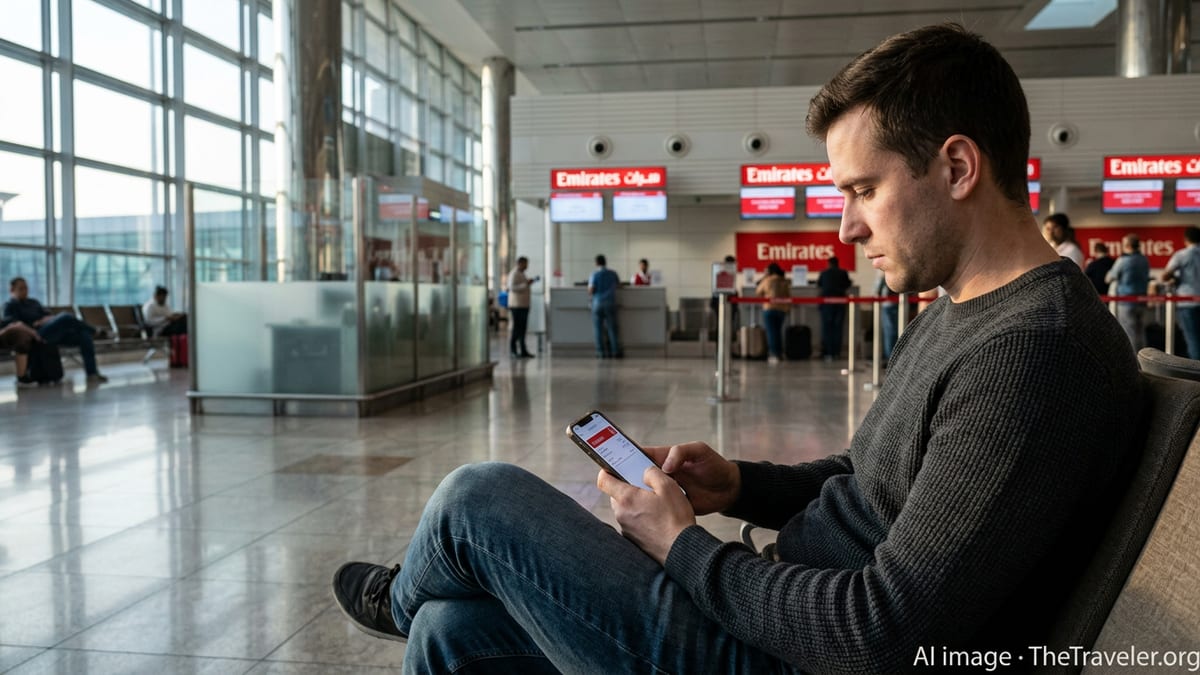
Emirates has quietly rolled out a new self-service rebooking option that lets many passengers change disrupted flights with just a few clicks, a move aimed at easing pressure on its call centers and cutting the time travelers spend waiting in airport lines during one of the airline’s most challenging operational weeks in recent memory.
Get the latest news straight to your inbox!
New Digital Shortcut for Disrupted Itineraries
According to recent customer updates and online reports, Emirates has enabled a streamlined rebooking flow directly through its Manage Booking page and mobile app for select disrupted journeys. Passengers with upcoming departures on affected routes are finding new prompts inside their booking that surface alternative dates and times, replacing what previously required a lengthy phone call or an in-person visit to a ticket desk.
The new feature appears to focus first on travelers whose flights fall within a defined disruption window, offering them the choice to shift to the next available Emirates service at no additional change fee, subject to fare conditions and seat availability. For many users, this means they can secure a new itinerary in minutes instead of spending hours on hold.
Publicly available guidance indicates that the digital option is currently most reliable for itineraries within roughly seventy two hours of departure, giving priority to those with the most urgent travel dates. Travelers seeking to move trips further into the future are being directed to standard customer support channels or their travel agencies, suggesting that Emirates is phasing in automation gradually rather than opening self-service for every scenario at once.
Early accounts shared on travel forums describe the experience as similar to online seat selection: passengers log into their booking, see a list of alternative flights, and confirm a new option without entering payment details if the change falls under disruption waivers. This aligns with a broader industry push toward empowering travelers to fix problems themselves when things go wrong.
Relief for Strained Call Centers and Airport Desks
The timing of Emirates’ expanded self-service tools coincides with significant regional airspace restrictions and a wave of cancellations and schedule changes that began in late February 2026. In the days following, travelers documented extended waits to reach human agents, with some reporting repeated disconnections after more than two hours in call center queues.
Airport customer service counters in Dubai and other hubs have also faced heavy demand, as stranded passengers attempted to secure scarce seats on a smaller number of operating flights. Travelers described long physical queues and temporary help desks set up in hotels for those stuck in transit, underscoring the scale of the disruption.
By shifting a portion of rebooking activity into authenticated online channels, the airline is seeking to free frontline staff to handle more complex cases, such as itineraries involving multiple carriers, special assistance needs, or group travel. For passengers, the change reduces the need to repeatedly dial hotlines or travel to the airport simply to adjust a departure date.
Industry observers note that large full service airlines often struggle to rapidly scale up live customer support when crisis events trigger mass changes across the network. Self-service tools that tap into the same inventory used by agents can therefore act as a pressure valve, provided they are designed clearly enough for infrequent travelers to use without confusion.
Who Can Click to Rebook and How It Works
Public information and user reports suggest that eligibility for Emirates’ new click-to-rebook flow depends on both the ticket’s origin of purchase and its disruption status. Travelers who booked directly with Emirates, either online or via the official app, appear to have the broadest access to the tool when their flight has been cancelled, rescheduled, or otherwise flagged as severely delayed.
Once eligible passengers retrieve their booking using their surname and reference code, the system may display a dedicated rebooking banner or button. Selecting it typically reveals a curated list of dates and flights that align with the airline’s current waiver policy, which in recent days has allowed customers to move travel to dates later in March or into April in response to the ongoing situation.
Those who purchased tickets through online travel agencies or third party agents may still be required to coordinate changes through the original point of sale, even if the underlying Emirates flight qualifies for flexible handling. In such cases, the airline’s digital tools may show updated flight status information without unlocking full self-service options, reflecting the shared responsibility between carrier and intermediary.
Travel accounts also describe some limitations. Passengers looking to reroute via different cities or to switch to partner airlines usually cannot complete those changes entirely online and must wait to speak with a representative. Seat availability constraints on heavily booked routes mean that not everyone sees the same range of alternative flights, even when their disruption circumstances are similar.
Practical Tips for Travelers Using the New Option
With schedules still unsettled on some routes, travel experts advise passengers to treat Emirates’ digital rebooking tool as a first stop rather than a last resort. Checking Manage Booking or the mobile app before calling can clarify what choices are currently on the table and may secure a new itinerary before limited seats disappear.
Customers are also encouraged to refresh their booking periodically, as options can change quickly when additional flights are added, equipment is swapped, or operational constraints ease. Some travelers have reported that rebooking choices visible at one time of day were different later, suggesting that the system responds dynamically to network changes and seat inventory.
For those who do not see an instant rebooking button, verifying that the booking reference, name spelling, and travel dates match the original e ticket can avoid technical hiccups. If the booking was made via a third party, contacting that seller while simultaneously monitoring Emirates’ official updates may help align what is possible through each channel.
Travelers who have already reached their destination but still hold onward Emirates segments are being reminded to track status messages closely and avoid unnecessary trips back to the airport. Recent guidance emphasizes that passengers should only travel to the terminal when their booking shows as confirmed on an operating flight, with new details visible in their digital itinerary.
A Faster Path Forward During an Unusual Travel Week
Emirates’ move toward click based rebooking comes amid a broader industry trend in which airlines seek to translate complex disruption policies into user friendly digital flows. For a carrier that typically handles tens of millions of international passengers each year through its Dubai hub, even a modest increase in self-service adoption can have a visible effect on airport crowding and phone waiting times.
For travelers, the ability to change flights from a hotel room, lounge seat, or home office rather than standing in line offers a different kind of reassurance during a week marked by uncertainty. While the new system does not yet cover every passenger scenario, its rollout suggests that more of the rebooking process could move online in the months ahead.
As airspace conditions evolve and Emirates continues to adjust its schedule, passengers are likely to see additional tweaks to how digital tools present options and eligibility. For now, the core message to those affected is clear: check your online booking first, and use the new click to rebook option where available, before resorting to long waits in airport or phone queues.