

More news on this day
As airlines race to capture travelers trading up from economy without paying business-class prices, premium economy on Emirates and Japan Airlines has emerged as a key battleground where comfort, service and dining are under intense scrutiny.
Get the latest news straight to your inbox!
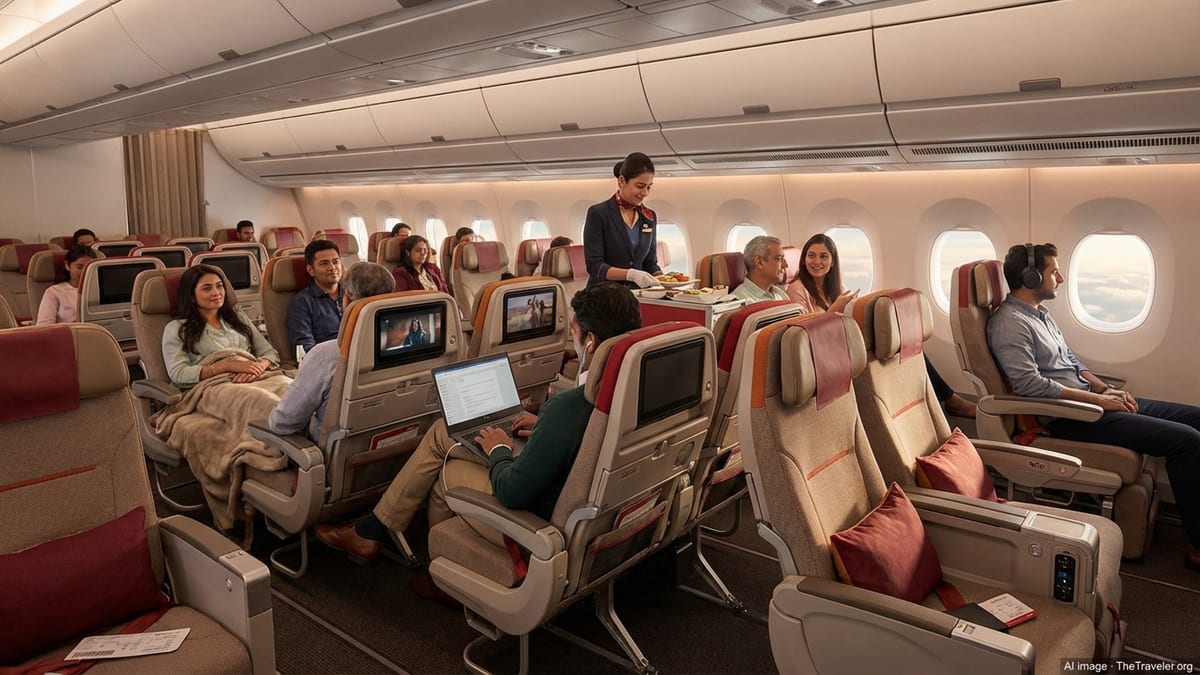
Cabin Design and Seat Comfort: Space vs. Serenity
On board Emirates, premium economy has been built as a showcase cabin, with the airline heavily promoting its leather recliner-style seats on refurbished Airbus A380s and Boeing 777s. Publicly available specifications indicate seat pitch in the range of 38 to 40 inches and width around 19.5 inches, putting Emirates toward the top end of the segment for legroom. The A380 layout in a 2-4-2 configuration gives many travelers the option of window pairs that feel noticeably more private than the dense layouts in standard economy.
Japan Airlines takes a different approach with its JAL Sky Premium seats, prioritizing a calmer, more traditional premium economy shell. JAL states that pitch in its latest international premium economy reaches approximately 42 inches, with recline of around 10 inches, and it emphasizes that pitch and width are comparable to earlier-generation business class. Recent cabin updates on the carrier’s Airbus A350-1000 have also added higher partitions and redesigned privacy dividers, aiming to create a quieter space rather than a showpiece cabin.
For pure numbers, Japan Airlines has a slight edge in legroom, and its hard-shell style design means passengers can recline without significantly intruding on the person behind. Emirates counters with more plush cushioning, deeper seat padding and modern touches such as powered leg rests and adjustable headrests on many A380s. Travelers prioritizing maximum personal space may lean toward JAL, while those seeking a softer, lounge-like seat surface and a more dramatic cabin aesthetic often gravitate to Emirates.
Noise levels and cabin feel also differ. Emirates’ premium economy, located at the front of the A380 main deck, benefits from the aircraft’s quiet profile but can feel livelier due to the airline’s larger cabin and higher overall passenger volume. JAL’s smaller premium economy sections typically feel more subdued, aligning with the airline’s broader reputation for low cabin noise and restrained ambiance.
Service Culture: Discreet Precision vs High-Touch Hospitality
Service on Japan Airlines in premium economy broadly tracks the carrier’s reputation for precision and consistency. Reports from frequent flyers and industry reviews describe crews who are unobtrusive but highly responsive, with an emphasis on efficient routines and minimal disruption in the cabin. Announcements are usually brief, service flows are predictable, and there is a strong focus on keeping the environment orderly and calm.
Emirates, by contrast, leans into a more demonstrative hospitality style. Premium economy passengers often report a welcome drink on boarding, a more pronounced sense of ceremony at mealtimes and visible efforts to differentiate the service from standard economy. Cabin crew interaction tends to be more proactive, with staff offering refills, additional snacks and explanations of menu choices on longer flights.
The trade-off is one of style rather than substance. Travelers who prefer a quietly attentive approach, limited announcements and minimal cabin movement may find Japan Airlines more aligned with their expectations. Those who enjoy a sense of occasion and a service pattern that feels closer to business class, even if not identical, are more likely to appreciate Emirates’ approach.
Consistency is also a factor. Japan Airlines has been operating premium economy for more than a decade and has garnered repeated recognition at industry awards, including recent honors for the world’s best premium economy cabin and seat. Emirates, while rapidly expanding its product and retrofitting more aircraft, remains in a phase of rollout, so passenger experiences can vary depending on whether a route is served by the latest A380s or older configurations still being refreshed.
Dining and Drinks: Japanese Refinement vs Global Indulgence
Dining is where the two airlines most clearly showcase their national identities. Japan Airlines emphasizes Japanese culinary traditions even in premium economy, with menus that often feature rice-based main courses, seasonal vegetables and carefully presented side dishes alongside a Western option. Public information on JAL’s premium economy offering highlights upgraded meals compared with economy, including improved presentation, hot towel service and expanded beverage choices, though not the full restaurant-style service seen in business class.
Emirates positions premium economy dining as a step-change from the back of the plane. The airline promotes courses served on china with metal cutlery, larger main dishes and dessert selections that resemble a pared-back version of its business-class service. Menus typically combine Middle Eastern, European and Asian influences, supported by a wine list and sparkling options that are noticeably broader than in standard economy.
In practice, Japan Airlines often appeals to travelers who value subtle flavors, lighter dishes and a focus on quality ingredients over sheer portion size. The presentation tends to be simple but meticulous, reflecting the broader aesthetic of the airline. Emirates, meanwhile, courts those who equate premium with abundance, richer sauces and an elevated beverage service that includes carefully branded wines and nonalcoholic options.
Special meals and dietary options are available on both carriers, but Emirates’ extensive long-haul network gives it more opportunities to tailor menus to different regions, from North America to Europe and Africa. JAL keeps a tighter focus on routes into and out of Japan, which can mean more consistent catering quality from its Tokyo hubs, especially on flights showcasing seasonal Japanese ingredients.
Amenities, Entertainment and Ground Experience
Beyond the seat and the plate, premium economy is increasingly defined by what happens before boarding and after take-off. Japan Airlines offers one notable advantage on many international routes by providing premium economy passengers with access to dedicated check-in counters and, in several cases, business-class lounges. Publicly available material and traveler reports highlight that lounge access is a standard inclusion on a number of long-haul flights, adding significant value for passengers connecting through Tokyo.
Emirates focuses more on the onboard experience. The airline’s in-flight entertainment system, with large high-definition screens and extensive content libraries, is one of the strongest in the industry. Premium economy passengers typically benefit from larger screens than those in economy, as well as upgraded headphones. USB charging, AC power outlets and Wi-Fi access are widely available, although pricing and connection quality can vary by route and aircraft.
JAL’s latest cabins have upgraded to 4K-resolution screens of about 16 inches in premium economy on aircraft like the A350-1000, reflecting the airline’s investment in high-quality visuals rather than sheer content volume. The interface is minimalist, and the programming leans heavily on Japanese films, television and cultural content, alongside international titles. For travelers who prioritize picture clarity and a calm user interface, this approach can be particularly appealing.
On the ground, Emirates’ scale at Dubai means premium economy customers benefit from well-resourced hubs, but they generally do not receive lounge access as standard. Priority boarding and dedicated counters are appearing more often as the product matures, yet the line between economy and premium economy at check-in remains less sharply defined than on JAL routes where premium economy is firmly integrated into the airline’s premium ground experience.
So Who Really Wins for Premium Economy Travelers?
Choosing between Emirates and Japan Airlines in premium economy ultimately comes down to what travelers value most. Japan Airlines delivers one of the most spacious seat footprints in the segment, a very quiet cabin and a service culture built on restraint and precision. Its recent recognition in industry awards for premium economy seats and overall product aligns with long-running feedback that JAL offers a consistently strong experience on long-haul flights.
Emirates, meanwhile, brings visual flair, an upgraded dining and drinks program and a premium economy seat that, while slightly tighter on paper, still offers generous comfort by international standards. The cabin design, particularly on the A380, has been crafted to feel like a distinct class rather than a modest upgrade, and the airline’s entertainment system and global menu variety remain major draws.
For travelers prioritizing legroom, privacy and a more understated style, publicly available evidence suggests Japan Airlines currently has the edge. For those who equate premium with showpiece cabins, richer dining and a high-touch service style, Emirates makes a compelling case. With both carriers still investing in their products, the rivalry in this increasingly crowded middle cabin looks set to intensify across routes linking Asia, the Middle East and North America in the coming years.