

More news on this day
Emirates has issued an urgent travel advisory warning of significant disruption at Dubai International Airport as severe weather moves across the UAE, with passengers urged to check their flight status, allow extra time for their journey, and avoid unnecessary trips to the terminal.
Get the latest news straight to your inbox!
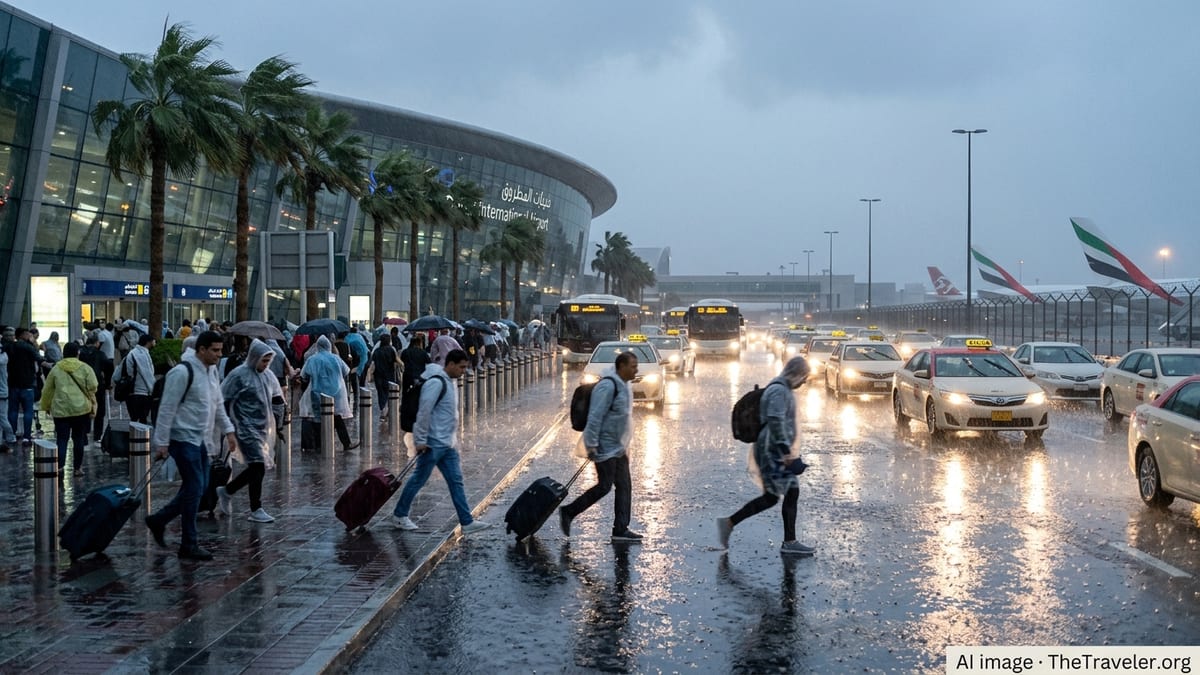
Severe Weather Adds New Strain to Already Disrupted Hub
The latest weather alert comes at a time when Dubai International Airport is still operating under pressure after weeks of regional instability and intermittent flight suspensions. Publicly available information from airport bulletins and airline updates indicates that the combination of heavy rain, low visibility and potential thunderstorms is expected to slow ground operations, from aircraft turnaround to baggage handling.
Forecasts for Dubai suggest periods of intense rainfall and gusty winds that can quickly overwhelm drainage and road systems, raising the possibility of waterlogged access routes to the airport and localized flooding in surrounding districts. In similar events in past years, such conditions have led to long queues on the main highways to the terminals and delays in both arrivals and departures.
Operational data and recent disruption patterns across the Gulf show that even short bursts of severe weather can trigger knock‑on effects lasting many hours, especially at hub airports that run close to capacity. For Emirates, which relies heavily on tightly timed connections through Dubai, any slowdown in ground operations can rapidly cascade through its global network.
Travel industry analysts note that these weather‑related constraints are unfolding against the backdrop of a region still dealing with intermittent airspace restrictions and evolving security concerns. This context heightens the risk that otherwise manageable weather disruption could translate into more pronounced schedule changes for international travelers.
Emirates Issues Advisory and Urges Passengers to Recheck Plans
According to recent customer advisories shared by Emirates through its public channels, the airline is warning that flight schedules may be adjusted at short notice as the weather system approaches Dubai. Travelers are being encouraged to monitor their booking status closely, sign up for notifications, and verify their departure time before setting out for the airport.
In earlier disruption phases this March, Emirates repeatedly urged customers not to travel to Dubai International Airport unless they had a confirmed booking and had been specifically advised that their flight would operate. The current weather‑related warning is described in similar terms, with an emphasis on limiting crowds in the terminal to passengers with active, confirmed itineraries.
Passenger forums and recent disruption notices show that the airline has been using a mix of rebooking, refunds and limited repatriation services to manage demand when large parts of its schedule are curtailed. For travelers whose journeys are time‑sensitive, the new severe‑weather alert may require contingency planning, including alternative routings or date changes where possible.
Publicly available guidance from multiple carriers using Dubai suggests that passengers should anticipate longer than usual queues at check‑in, security and immigration if conditions deteriorate, even if their flights remain scheduled. Those with tight onward connections through the hub are especially vulnerable to even modest departure delays.
Dubai Airport Operations Vulnerable to Heavy Rain and Low Visibility
Dubai International Airport is one of the world’s busiest international hubs, handling tens of millions of passengers each year and operating a dense schedule of long‑haul services. Under normal conditions it functions with rapid aircraft turnaround times and continuous movements on parallel runways. Severe weather, particularly intense rain and dust‑laden winds, can significantly reduce this operational efficiency.
Airport operation summaries and previous incident reports from the UAE highlight several recurring challenges when severe weather hits. Heavy downpours can lead to standing water on taxiways and service roads, forcing temporary diversions and slowing pushback and towing procedures. Strong crosswinds, meanwhile, can result in increased separation between aircraft, reducing the total number of movements per hour.
Low clouds and poor visibility also have implications for aircraft sequencing on approach and departure. While Dubai’s runways and air‑traffic management systems are equipped to handle reduced visibility, safety protocols require more conservative margins in adverse conditions, which in turn can cause holding patterns, diversion of inbound flights to alternate airports, or short‑notice cancellations.
Ground transport to the airport is another potential weak point. When heavy rain coincides with peak travel periods, congestion on Sheikh Zayed Road and other key arteries can extend journey times dramatically. Public transport services may also experience delays if localized flooding affects roads and stops near the terminals.
Practical Guidance for Travelers Heading to or Through Dubai
With the severe‑weather alert in place, travelers booked on Emirates and other airlines through Dubai in the coming days are being advised by publicly available travel advisories and airline notices to build more flexibility into their plans. That begins with checking for real‑time updates on flight status in the hours leading up to departure, as schedules may change repeatedly over a short period.
Passengers who do need to reach Dubai International Airport are encouraged to leave significantly earlier than usual, taking into account the possibility of slow‑moving traffic, road closures or diversions around waterlogged junctions. Those using taxis or ride‑hailing services may find wait times extended if vehicles struggle to reach certain parts of the city during heavy downpours.
For travelers in transit through Dubai, travel consultants recommend carrying essentials in hand luggage, including medications, chargers and a change of clothes, in case a short connection turns into an overnight delay. Recent experience from earlier disruption this month shows that hotel allocation and rebooking queues can become lengthy when a large number of passengers are affected at once.
Passengers with flexible tickets or optional journeys, such as leisure trips that can be postponed, may wish to consider alternative dates while Emirates and other carriers work through potential weather‑related delays. Refund and rebooking policies have been adjusted several times in recent weeks during broader regional disruption, and similar flexibility may be made available again if the latest conditions materially affect operations.
Ongoing Uncertainty for the Region’s Aviation Network
The severe‑weather warning for Dubai adds another layer of uncertainty to a regional aviation landscape already unsettled by recent airspace restrictions and security concerns. Flight‑tracking data and aviation sector reports over the past month show repeated suspensions and partial resumptions of services at several major hubs across the Middle East.
Dubai’s central role as a connection point between Europe, Asia, Africa and Australasia means that any significant slowdown at its main airport often has global repercussions. Delays and reroutings can ripple outward to secondary airports as airlines reposition aircraft and crew, and as passengers seek alternative ways to complete their journeys.
Industry observers note that while airlines and airports in the region have gained experience in managing large‑scale disruption, the combination of severe weather and a volatile security environment can still overwhelm contingency planning in the short term. In that context, Emirates’ urgent travel warning is being interpreted as a signal that further operational turbulence is likely, even if the exact scale and duration remain difficult to predict.
For now, travelers with upcoming itineraries touching Dubai are being urged, through publicly available advisories and media coverage, to remain alert to changing conditions, keep documentation and contact details updated, and be prepared for last‑minute changes to routes and timings as the latest weather system passes over the city.