

More news on this day
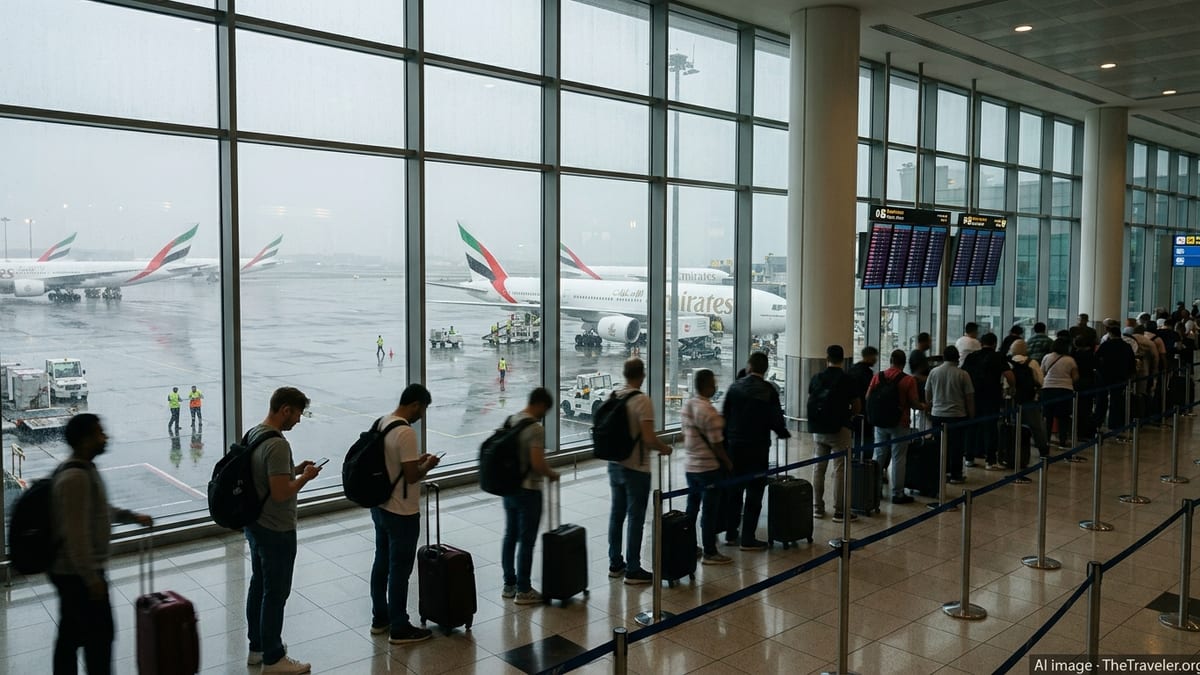
Emirates is warning passengers of delays at Dubai International Airport as adverse weather conditions disrupt flight schedules and ground operations, adding fresh complications for travelers already navigating a period of instability in the region.
Get the latest news straight to your inbox!
Weather Disruption Hits an Already Strained Hub
Dubai International Airport is operating under fresh strain as poor weather conditions lead to delays and schedule adjustments across Emirates services. Publicly available information indicates that recent adverse conditions, including reduced visibility and periods of heavy cloud and rain in parts of the United Arab Emirates, have limited the efficiency of arrivals and departures at what is normally one of the world’s busiest hubs.
The weather-related disruption is unfolding against a backdrop of wider operational challenges in Dubai’s airspace this month. Regional security concerns and temporary airspace restrictions have already led to cancellations, rerouting, and a phased resumption of flights, leaving airlines with little margin to absorb additional delays triggered by deteriorating weather.
As a result, Emirates is cautioning travelers that journeys through Dubai may take longer than planned, with knock-on effects for connecting itineraries. Passengers are being urged, through public updates, to build in extra time and to treat all timings as subject to change at short notice.
What Emirates Passengers Can Expect Today
According to recent operational updates, Emirates is continuing to run a reduced and carefully managed schedule while it works around both airspace constraints and the latest weather issues. That means some flights are departing close to their planned times, while others are experiencing rolling delays as ground crews and air traffic controllers adjust to shifting conditions.
Travelers may encounter longer queues at check-in, security, and boarding gates, as airlines consolidate services and re-accommodate customers affected by earlier disruptions. Ground handling operations, including baggage loading and aircraft towing, can also slow down when rain, standing water, or low visibility affect ramp safety, further contributing to late departures.
Passengers holding connections through Dubai should be prepared for schedule changes, including retimed departures or, in some cases, overnight stays if onward flights are no longer viable the same day. Reports from recent days show that rebooking windows have widened as carriers balance safety, crew duty-time limits, and constrained airspace corridors.
Advice for Travelers Heading to or Transiting Through Dubai
Public advisories from airlines and airport authorities over recent weeks have consistently emphasized one point: do not travel to the airport until flight status is confirmed. That guidance remains particularly relevant when weather-related delays compound existing disruption, as terminals can quickly become congested with passengers whose flights have not yet been cleared to operate.
Travelers are strongly encouraged to monitor their booking through official airline channels, use mobile apps where available, and pay close attention to email or SMS notifications about any changes. Given the volatility of conditions, a flight that appears on time earlier in the day can move to delayed, retimed, or even canceled status as air traffic flow is recalibrated.
Those with tight connections may want to explore more conservative options, such as voluntarily moving to later departures where airline waivers allow, to reduce the risk of misconnecting in Dubai. Travel insurance policies and flexible ticket rules may offer additional protection, but passengers should review the terms carefully, especially when disruption stems from a combination of weather and regional events.
Impact on Regional and Long-Haul Networks
Dubai International Airport’s role as a global transit hub means that any localized disruption tends to ripple across multiple regions. When weather slows movements in and out of Dubai, long-haul flights to Europe, North America, Asia, and Africa can all experience altered timings or aircraft swaps, affecting seat availability and onward connections.
Recent schedules show that select long-haul services have already been operating on modified timings due to earlier airspace constraints in the Middle East. The latest weather issues are layering additional complexity onto these adaptations, with some routes seeing adjusted departure times to align with narrower operational windows and crew availability.
Shorter regional services within the Gulf and to nearby markets may be used tactically to reposition aircraft and crews, meaning those flights can be especially vulnerable to retiming or consolidation. Travelers on these sectors should be prepared for schedule updates close to departure as Emirates seeks to keep its wider network functioning as smoothly as conditions allow.
Planning the Next Few Days of Travel
Available assessments from aviation and risk-monitoring organizations suggest that operations at Dubai International Airport are likely to remain sensitive to both meteorological conditions and the broader regional situation in the short term. Even as weather patterns improve, airlines may need additional time to clear backlogs, reposition aircraft, and restore regular rotations.
For travelers, this means the coming days may still involve irregular operations, including last-minute gate changes, extended tarmac waits, or revised routings. Those yet to begin their journeys should factor in the possibility of further adjustments when planning hotel stays, ground transport, and time-sensitive commitments at their destination.
Staying flexible, keeping documentation and contact details up to date, and checking flight status repeatedly in the 24 hours before departure remain the most practical steps for minimizing disruption. While Emirates and other carriers continue to calibrate their schedules around changing conditions, passengers who remain informed and adaptable are likely to navigate the situation with fewer surprises.