

More news on this day
San Francisco International Airport’s visually striking side by side landings, long a favorite of planespotters and frequent flyers, have been halted under a new Federal Aviation Administration order that sharply restricts simultaneous approaches on the airport’s closely spaced parallel runways and cuts hourly arrivals by one third.
Get the latest news straight to your inbox!
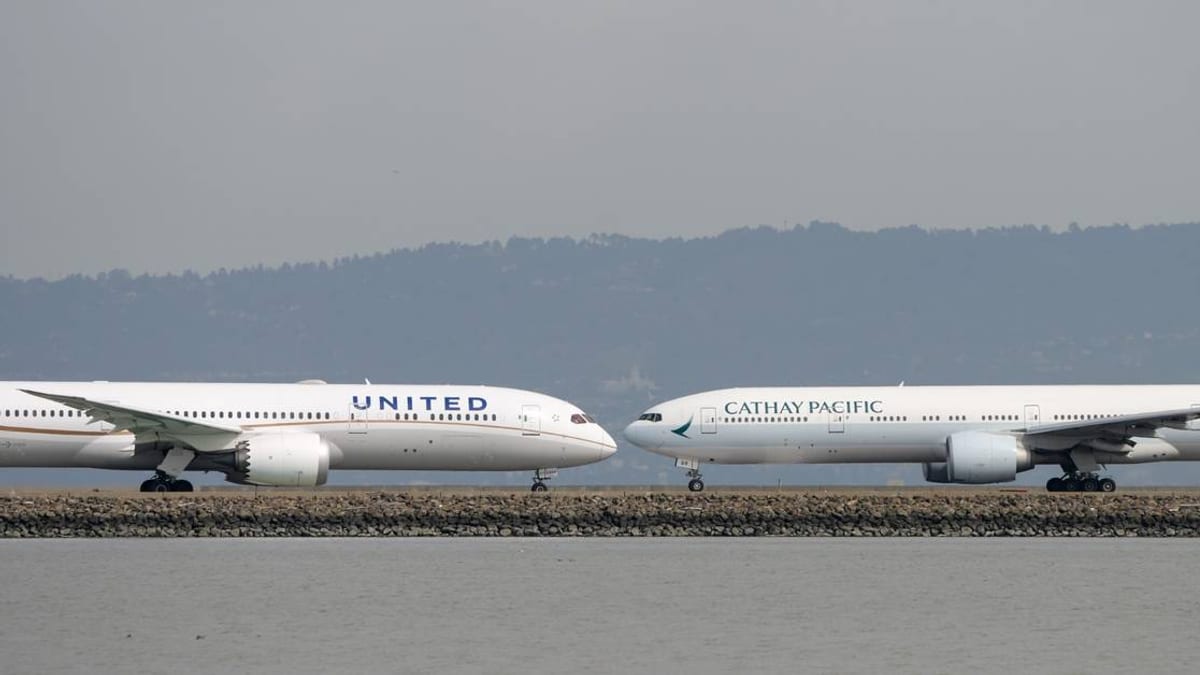
Image by Simple Flying
What the New FAA Order Changes at SFO
Publicly available information shows that the FAA has reduced San Francisco International Airport’s permitted arrival rate from about 54 landings per hour to roughly 36, a drop of around one third. The change coincides with a six month runway repaving project but is tied to a revised safety framework for how aircraft may approach and land on the airport’s parallel east west runways.
According to recent coverage, the key shift is a prohibition on the iconic side by side visual approaches to the main 28L and 28R runways that allowed two aircraft to touch down in close succession while maintaining their own visual separation. Those procedures leveraged the fact that SFO’s parallel runways are just 750 feet apart, near the minimum spacing historically allowed for dependent parallel operations in clear weather.
Under the new rules, approaches that once would have resulted in visually synchronized landings must now be sequenced with greater spacing, effectively forcing a staggered flow of arrivals. The FAA’s order applies at all times rather than only in poor weather, which means the capacity boost that SFO once enjoyed on clear days from dual side by side landings has been removed.
Reports indicate that departures, including parallel takeoffs, are currently less affected, but the loss of simultaneous landing capacity is expected to ripple through airline schedules, especially at peak bank periods for hub carriers.
Safety Concerns Around Closely Spaced Parallel Runways
The decision is rooted in longstanding concerns about operations on closely spaced parallel runways, a category that includes SFO because its main parallel pair is separated by less than 1,000 feet. FAA technical documents on closely spaced parallel operations describe how small navigation errors, strong crosswinds, or go arounds can quickly turn into loss of separation events when aircraft are operating in tight proximity.
Recent news reporting links the SFO move to a broader climate of scrutiny after several high profile runway and approach incidents across the United States, including a deadly collision in March at New York’s LaGuardia Airport involving an Air Canada jet and a fire truck. While the FAA has stated that the SFO rule change is specific to conditions at the Bay Area airport, it comes at a time when near misses and incursions have been drawing national attention.
Historical incidents have also shaped perceptions of risk at San Francisco. A widely studied 2017 close call involving an Air Canada flight that lined up with a taxiway instead of the runway highlighted how complex nighttime visual operations at SFO can be. Although that event did not involve dual parallel landings, analysts note that closely spaced layout, bright city lighting, and converging traffic patterns contribute to a higher workload environment for pilots and controllers.
By eliminating side by side visual arrivals, the FAA is effectively choosing a more conservative operational model that trades raw capacity for added margins in separation and maneuvering room when something unexpected happens on final approach.
Operational Fallout: Delays, Scheduling Shifts, and Airline Responses
Early assessments from airline and airport observers suggest that the reduced arrival rate will translate into more frequent delays into SFO, particularly during busy morning and evening periods when transcontinental and regional flights converge. With fewer landing slots per hour, the system has less ability to absorb minor disruptions such as late departures from origin airports or brief weather slowdowns in the Bay Area.
Published reports describe the new regime as a permanent safety rule layered on top of a temporary construction related constraint, meaning that even after the current repaving project ends, SFO will not return to its previous maximum arrival capacity. For airlines, that raises difficult questions about how many flights they can sustainably schedule without triggering chronic congestion.
Carriers with large presences at SFO are expected to respond with a mix of strategies, including retiming flights into less congested hours, using larger aircraft on some routes to preserve seat capacity, and relying more on nearby Oakland and San Jose airports for additional lift. Industry analysts note that some marginal routes or frequencies could become harder to justify if on time performance erodes or operating costs rise due to extended taxi and holding times.
Passengers are being advised in consumer travel coverage to plan for longer connection buffers, especially for itineraries that involve SFO as a connecting point. Even modest delays on inbound legs could now be more likely to cascade into missed connections when the arrival bank is operating near the new, lower ceiling.
Why SFO’s Parallel Landings Mattered to Travelers and the Industry
For many travelers and aviation enthusiasts, SFO’s parallel landings were more than a technical procedure. The sight of two jets descending side by side over the Bay, sometimes appearing almost wingtip to wingtip from the cabin window, became part of the airport’s visual identity. Social media has long featured videos of synchronized touchdowns captioned as “secret races” between aircraft.
Behind the spectacle, those operations played a quiet but important role in keeping one of the West Coast’s primary international gateways functioning at high throughput on clear days. With SFO constrained by both water and surrounding communities, adding runways has been politically and environmentally challenging. That context made procedural solutions, such as closely spaced parallel operations, a central tool for squeezing more capacity out of the existing footprint.
Industry observers note that the new FAA restrictions remove a competitive advantage SFO held over some other coastal airports that lack similar parallel landing capability. The change could subtly shift traffic patterns over time, as airlines review their network strategies and consider whether to grow more aggressively at alternative Bay Area airports with fewer runway constraints.
At the same time, some safety advocates have argued that the loss of the iconic visuals is a reasonable tradeoff if it means lowering the probability of a rare but catastrophic event. For them, the end of parallel landings at SFO symbolizes a broader recalibration of acceptable risk in an era when even near misses quickly dominate headlines.
What Comes Next for SFO’s Airspace and Travelers
Looking ahead, attention is likely to focus on whether procedural refinements or technology upgrades can partially recover lost capacity without reintroducing the most contentious aspects of close parallel landings. FAA guidance on closely spaced operations has evolved alongside new surveillance and navigation tools, and some experts suggest that future concepts could allow more efficient sequencing while maintaining increased separation.
The airport and federal regulators are reported to be exploring ways to optimize arrival and departure flows under the new constraints, including refined approach paths, updated controller staffing models, and improved coordination with neighboring Oakland and San Jose airports. Any significant changes, however, will require careful environmental and community review in a region that is particularly sensitive to noise and overflight impacts.
For now, travelers can expect SFO to feel a bit more congested and less visually dramatic on arrival, with single file streams of aircraft replacing the twin approaches that once defined the airport’s aerial choreography. The policy shift marks the end of a distinctive chapter in Bay Area aviation and underscores how quickly long familiar practices can change when safety calculus and capacity pressures collide.