

More news on this day
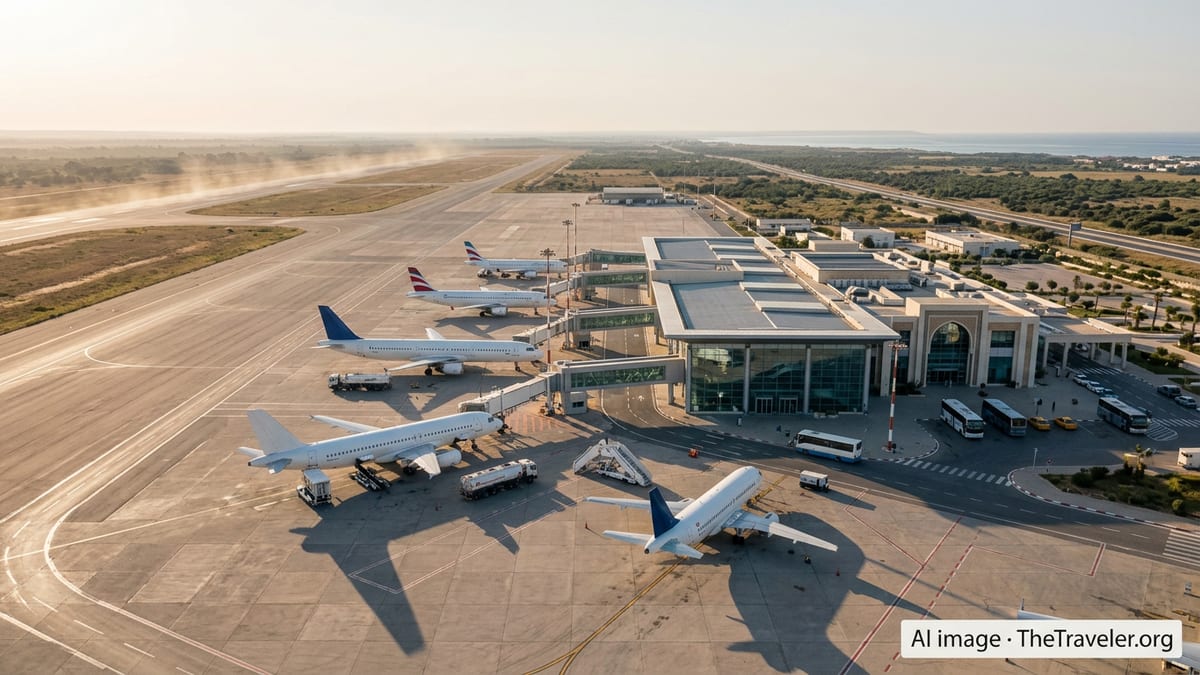
On a stretch of Tunisia’s central coastline between Hammamet and Sousse, Enfidha-Hammamet International Airport is shaking off years of underuse and emerging as a pivotal platform for the country’s next tourism surge.
Get the latest news straight to your inbox!
A Strategic Gateway Comes Back to Life
Opened in 2009 to handle up to several million passengers a year, Enfidha-Hammamet International Airport long operated far below its design capacity as political shocks, regional competition and the pandemic hollowed out charter traffic. Recent figures and industry reports now indicate that this once-quiet gateway is rapidly regaining momentum, positioning itself as a second major hub for leisure arrivals after Tunis-Carthage.
According to data compiled from international air transport bulletins, Enfidha handled around 1.3 million passengers in 2024, representing growth of more than 50 percent compared with 2023. TAV Tunisia, the airport’s operator, has publicly outlined projections of around 1.5 million travelers for the 2025 season, signaling a further step toward unlocking the facility’s latent capacity.
This recovery is unfolding against a broader backdrop of rising air traffic across Tunisia. Official statistics cited by regional business outlets show passenger numbers through Tunisian airports climbing steadily in 2023 and 2024 as European and regional carriers restore capacity, package operators return, and confidence in the destination improves.
For Enfidha-Hammamet, the reawakening is particularly significant because its catchment area includes many of the country’s most popular beach resorts, from Hammamet and Nabeul in the north to Sousse, Port El Kantaoui and Monastir further south, all connected by the A1 motorway that runs parallel to the coast.
New Routes, Charters and Tour Operator Bets
The sharpest signal of Enfidha’s new role comes from its growing route map. The airport’s own communications for the 2024 season highlight the development of more than 15 new destinations and over 15 additional routes to existing cities, largely driven by European leisure airlines and charter operators. This expansion has underpinned the doubling of passenger numbers between 2023 and 2024, according to the same updates.
Coverage in specialist aviation media notes that Enfidha has become a focal point for renewed charter activity from markets including the United Kingdom, Germany, France, Poland and the Nordic countries. Several major tour operators have concentrated their Tunisia programs around the airport because of its proximity to large resort zones and the availability of slots compared with the more congested capital airport.
Partnerships with carriers and travel companies have also intensified. Reports on TAV Tunisia’s strategy describe agreements with airlines and agencies aimed at locking in higher volumes of leisure traffic over multiple seasons. By aligning charter schedules with hotel capacity and ground transport, these partnerships are designed to stabilize flows beyond the traditional summer peak and support shoulder-season tourism.
Industry observers point out that this charter-led resurgence fits closely with Tunisia’s broader tourism plans, which prioritize higher-spending and longer-stay visitors while diversifying source markets. With aircraft arriving full from secondary European cities that lack direct links to Tunis, Enfidha-Hammamet is becoming an important bridge between mid-sized European towns and Tunisia’s Mediterranean resorts.
Economic Ripple Effects Along the Sahel Coast
The airport’s rebound is already translating into visible economic effects in the surrounding Sahel region. Local media in Sousse and neighboring governorates report rising activity in hospitality, transport and services tied to the growing flow of tourists through Enfidha, from airport transfer companies and taxi cooperatives to small guesthouses and restaurants.
TAV Tunisia has framed the airport as an anchor for regional development, emphasizing its role in job creation and indirect employment. Publicly available information from the operator highlights a workforce expanded for the 2024 and 2025 seasons, alongside contracting for security, cleaning, maintenance and retail concessions that involve local companies.
The airport has also been used as a platform to showcase Tunisian craftsmanship and culture. Coverage of recent initiatives describes exhibition spaces in the departures hall where artisans display ceramics, textiles and other products from across the country. The aim is to leverage the captive audience of departing passengers to promote regional products, deepen visitor engagement with local culture and stimulate demand for handmade goods.
Economists following the sector argue that the concentration of charter arrivals at Enfidha can help distribute tourism income more evenly along the coast, reducing pressure on Tunis and supporting investment in secondary cities. As more visitors land closer to their resorts, travel times shorten, costs fall and the perceived distance between airport and beach narrows, making Tunisia more competitive against rival Mediterranean destinations.
Infrastructure, Connectivity and the Traveler Experience
Beyond flight schedules, Enfidha-Hammamet’s potential to reshape tourism also depends on what happens once travelers step outside the terminal. The airport benefits from direct access to the A1 motorway, which links it efficiently with Hammamet, Sousse, Monastir and further south to Sfax and Gabes. Travel forums and recent traveler accounts note that private transfers, tour operator coaches and shared minivans known as louages are the most common ways to reach nearby resorts and cities.
However, public transport connectivity remains uneven. Online discussions frequently highlight limited bus frequencies, the need to change vehicles in Enfidha town for onward journeys and the absence of direct rail links. For independent travelers, this can translate into longer door-to-door journey times compared with those on package holidays, which typically include pre-arranged transfers.
Inside the terminal, passengers report a mix of strengths and growing pains. Recent feedback shared on social platforms and travel forums cites efficient check-in and security, along with generally smooth handling of charter waves that can bring dozens of aircraft in a single day during high season. At the same time, complaints about high prices in certain airport shops, queues at passport control during peak hours and limited late-night transport options hint at areas where further improvements could enhance the overall experience.
Industry analysts note that as traffic grows, maintaining service quality will be decisive. Investments in digital information screens, queue management, retail mix and basic amenities can influence how visitors perceive their entire trip. For a destination heavily reliant on first-time package tourists, a positive airport experience is often a key factor in repeat bookings.
From Seasonal Gateway to Year-Round Tourism Engine
The central question for policymakers and operators is whether Enfidha-Hammamet can evolve from a highly seasonal charter hub into a more balanced, year-round gateway. Data from air transport bulletins show that while summer remains dominant, shoulder seasons in spring and autumn are gaining ground as more European travelers seek off-peak sun and lower prices.
Tunisia’s tourism strategy documents emphasize diversification beyond beach tourism through cultural circuits, desert experiences and wellness travel. Enfidha’s location on the main north-south axis, within reach of the Cap Bon peninsula, the Sahel coast and inland historic sites, gives it a natural role in enabling more varied itineraries, particularly if domestic transport connections are strengthened.
Analysts also point to an emerging opportunity in religious and event-related travel. Recent reports highlight the use of Enfidha to handle flights for Tunisian pilgrims and special interest groups, demonstrating the airport’s ability to manage large, time-sensitive operations alongside leisure traffic. As Tunisia competes to host conferences, sports events and festivals, the availability of a modern, relatively uncongested airport close to major resort hotels could become a strategic asset.
If current growth trajectories hold, Enfidha-Hammamet may, within a few seasons, shift from being a symbol of underused infrastructure to a case study in how targeted partnerships, improved connectivity and patient investment can rewire a country’s tourism geography. For now, each new arrival carries not only holidaymakers but also the prospect of a broader rebalancing of Tunisia’s visitor economy around this once-sleeping giant on the Mediterranean shore.