

More news on this day
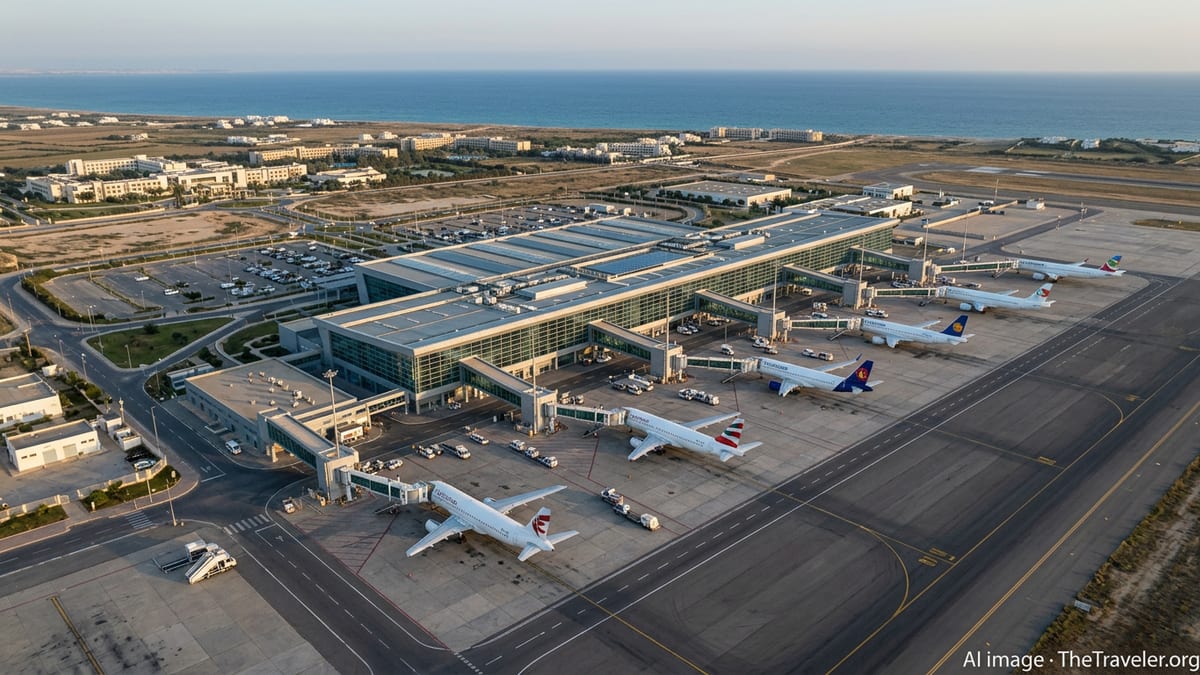
As Tunisia posts record-breaking visitor numbers and tourism revenues, Enfidha-Hammamet International Airport is rapidly evolving from a seasonal charter gateway into a strategic Mediterranean hub that is reshaping travel flows and helping drive the country’s latest wave of economic growth.
Get the latest news straight to your inbox!
A Strategic Gateway in a Record Tourism Year
Located on Tunisia’s central eastern coast between the resorts of Hammamet and Sousse, Enfidha-Hammamet International Airport has become a focal point of the country’s tourism resurgence. Publicly available data shows that Tunisia welcomed more than 10 million visitors in 2024, with subsequent reports indicating that arrivals surpassed 11 million across the first 11 months of 2025, setting new national records and cementing tourism as one of the strongest pillars of the economy.
Tourism receipts have risen in parallel. Central bank figures and regional business coverage indicate that revenues reached roughly 7.5 billion Tunisian dinars in 2024, an increase of around 8 percent on the previous year, and continued to climb in 2025, outpacing pre-pandemic levels. The sector’s direct and indirect contribution now accounts for close to a tenth of national output and supports hundreds of thousands of jobs, particularly in coastal governorates that depend heavily on holidaymakers.
Against this backdrop, Enfidha-Hammamet has moved from the margins toward the center of Tunisia’s air transport map. The airport was initially conceived as a relief gateway for the saturated Monastir Habib Bourguiba Airport and to better serve fast-growing resort belts. Its growing role in handling both traditional charter flights and an expanding mix of scheduled services is increasingly visible in recent passenger trends and route announcements.
Industry observers note that as visitor volumes have recovered and then surpassed pre-2020 levels, Tunisia’s tourism growth has increasingly been funneled through a handful of high-capacity gateways. Alongside Tunis-Carthage, Enfidha-Hammamet now ranks among the most important, particularly for European leisure markets that are driving much of the current boom.
Rapid Route Expansion and New Airline Interest
Enfidha-Hammamet International Airport, operated by TAV Tunisia, has seen a steady widening of its route network as carriers respond to renewed demand for Mediterranean beach and cultural holidays. Schedules published for recent seasons show services linking Enfidha directly with major European source markets, including the United Kingdom, France, Germany, Poland, the Czech Republic and the Baltic states, as well as with regional hubs that feed transfer traffic.
Low-cost and leisure airlines have been particularly active. Travel and aviation industry coverage highlights a rising number of seasonal flights from secondary European cities, reflecting the appetite of tour operators to package Tunisian beach resorts for price-sensitive travelers. Charter operations that once concentrated on a few peak summer months are being stretched deeper into the shoulder seasons, making better use of the airport’s capacity and supporting jobs year-round.
Recent editions of Tunisian aviation and tourism magazines point to a growing list of carriers using Enfidha-Hammamet as their primary Tunisian entry point, especially for all-inclusive resort packages in Hammamet, Sousse and the emerging coastal strip around Enfidha itself. Airport-focused reports describe days in high season when dozens of international arrivals and departures are processed in tight waves, matching hotel check-in patterns and tour bus schedules that radiate to nearby resorts.
As the airport’s connectivity profile broadens, sector analysts argue that Enfidha-Hammamet is shifting from a purely seasonal facility into a more resilient component of Tunisia’s national aviation system. The addition of new airlines and a diversification of origin markets are helping to spread risk, lessen reliance on any single country and position Tunisia to compete with rival Mediterranean destinations for both volume and higher-spending visitors.
Infrastructure, Accessibility and Regional Development
Built with a long-haul runway, modern passenger terminal and direct access to Tunisia’s A1 motorway, Enfidha-Hammamet International Airport was designed to handle up to several million passengers per year, with room for further expansion. Transport sector documentation highlights its strategic location roughly midway along the main coastal tourist corridor, placing it within straightforward transfer distance of Hammamet, Sousse, Monastir and emerging resort zones to the south.
Improved ground connectivity has amplified this effect. The A1 motorway includes a dedicated interchange for the airport, while regional roads link directly to hotel zones and industrial areas. Publicly available planning material indicates that logistics and light industrial projects have begun clustering near the airport and motorway exits, encouraged by faster access to ports and urban centers such as Sousse and Nabeul. This is reinforcing Enfidha’s role not only as a tourism gateway but also as a broader economic node.
Urban development specialists point to visible changes in nearby towns, where new guesthouses, service businesses and residential projects are emerging to serve both tourism workers and airport-related employment. Rising tourism revenue has supported local tax bases and encouraged upgrades to public spaces, beachfront promenades and hospitality training programs in surrounding governorates.
In parallel, the airport’s modern handling facilities have made it easier for Tunisia to pursue niche segments such as conference travel, sports tourism and short-break holidays from European and regional markets. These segments, which often require reliable flight schedules and efficient ground transport, are seen by industry analysts as important levers for lifting average visitor spending and smoothing demand across the year.
Macroeconomic Impact and Jobs Across the Coast
The tourism surge anchored in part by Enfidha-Hammamet has had pronounced macroeconomic effects. International financial and policy reports on Tunisia note that tourism’s share of gross domestic product has rebounded to around 9 to 10 percent, with the sector also playing a significant role in export earnings and foreign currency inflows. This has provided a crucial buffer for an economy facing persistent fiscal and debt challenges.
Employment is another critical dimension. Tourism and its related services are among Tunisia’s most labor-intensive industries, supporting direct jobs in hotels, restaurants, tour agencies and transport, as well as indirect employment in agriculture, construction and manufacturing. Analyses of recent seasons suggest that rising visitor numbers have helped stabilize work opportunities in coastal regions where alternatives are often limited, particularly for younger workers and women.
Local economic observers highlight a knock-on effect extending well beyond beachfront resorts. Increased air arrivals via Enfidha-Hammamet have supported handicraft producers, cultural sites, excursion operators and small businesses ranging from cafés to car-rental firms. Domestic tourism, which has also grown as more Tunisians travel internally, adds an additional layer of demand and further justifies investments in infrastructure and service quality.
Tourism revenues, while still vulnerable to external shocks such as geopolitical tensions or shifts in airline capacity, are increasingly viewed as a stabilizing component of Tunisia’s balance of payments. The airport’s ability to channel large volumes of visitors quickly and efficiently has become central to maintaining that role, especially during peak European holiday periods when foreign exchange earnings surge.
Positioning Tunisia in a Competitive Mediterranean Market
As competition intensifies among Mediterranean destinations, Tunisia’s strategy has gradually shifted from relying mainly on low-cost beach packages toward a more diversified offering that includes culture, wellness, desert experiences and higher-end coastal stays. Analysts of regional tourism trends note that air connectivity is a decisive factor in this repositioning, and Enfidha-Hammamet is at the heart of these efforts along the country’s eastern seaboard.
Comparative tourism studies show that countries such as Spain, Turkey and Egypt have leveraged modern regional airports to unlock new visitor segments and encourage repeat travel. Tunisia’s current trajectory, reflected in steady route additions and extended operating seasons at Enfidha-Hammamet, suggests a similar ambition to climb the rankings of preferred short- and medium-haul destinations for European, Maghreb and Middle Eastern travelers.
Looking ahead, sector specialists see opportunities to deepen the airport’s integration with broader economic plans, including renewable energy projects, digital services and agro-industrial initiatives that can benefit from enhanced connectivity. At the same time, there is recognition that growth must be managed carefully, with attention to environmental pressures on coastal ecosystems and the need for sustainable water and energy use in tourism hotspots.
For now, the numbers point to a clear trend: Tunisia’s tourism revival is gathering pace, and Enfidha-Hammamet International Airport has emerged as one of the main engines powering that expansion, helping to connect the country more closely to global travel flows and channeling new investment into its Mediterranean shores.