

More news on this day
A potential engine fire on an American Airlines flight departing San Diego International Airport prompted the aircraft to return to the gate, drawing an emergency response on the ramp and causing ripple-effect delays across an already busy schedule of departures.
Get the latest news straight to your inbox!
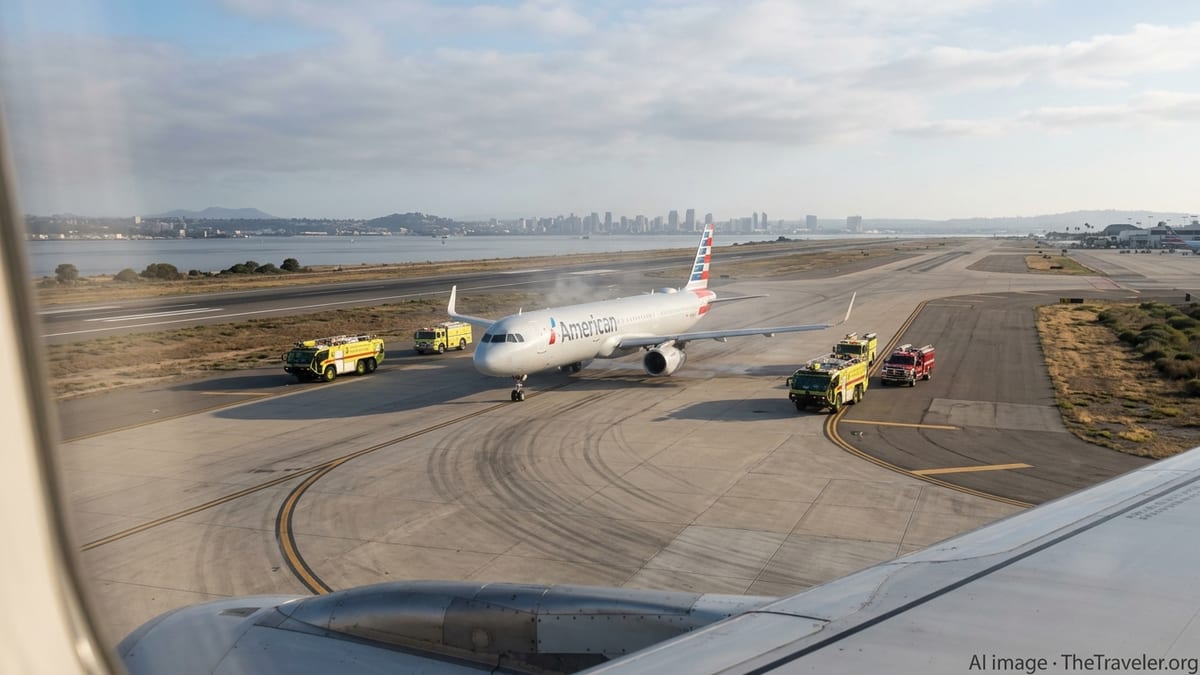
Flight Returns to Gate After Reported Engine Issue
According to early reports from local media and aviation tracking data, the American Airlines flight was in the departure phase at San Diego International Airport when the crew reported a possible problem with one of the engines. The aircraft did not continue to takeoff and instead returned to the gate as a precaution, where ground crews and emergency vehicles met the plane.
Publicly available information indicates that the suspected issue was described as a potential engine fire, though detailed technical findings had not been released at the time of writing. Visuals shared on social platforms by other passengers at San Diego showed the aircraft stationary near the terminal, with fire and rescue vehicles positioned nearby.
San Diego International, which operates on a single runway and relatively tight taxiway layout, can experience significant knock-on effects when an aircraft is held in place for safety checks. In this case, aircraft waiting behind the American Airlines flight reportedly faced extended taxi and hold times while the situation unfolded.
While formal confirmation of the exact nature of the malfunction remains pending, the sequence of events followed common safety practice in commercial aviation: the crew treated any sign of possible fire as an immediate priority, returned the aircraft to a controlled position, and requested assistance from airport emergency services.
Passengers Face Delays and Missed Connections
Travelers on the affected American Airlines service reported extended time on board while the aircraft awaited clearance and ground handling decisions. As the incident occurred during a busy period of the day at San Diego International, the disruption quickly translated into missed connections and rebookings across the carrier’s network.
Published coverage and social media posts from passengers suggest that travelers were eventually directed back into the terminal while the aircraft was inspected. Some customers were rebooked on later American Airlines departures out of San Diego, while others were routed through alternative hubs to reach their final destinations.
Because San Diego International is a popular origin for connections through major hubs such as Dallas Fort Worth and Phoenix, even a single disrupted flight can produce a cascade of schedule changes. Passengers described scrambling to adjust onward hotel and car rental reservations, a now familiar scenario when unplanned mechanical checks interrupt routines.
Although frustrating for travelers, aviation safety analysts routinely emphasize that the industry is structured to prioritize conservative decision-making whenever engine performance or fire indications are involved. The additional time spent in the terminal, they note, is the direct result of those precautionary layers.
Emergency Response Highlights Airport Preparedness
The response at San Diego International featured multiple fire and rescue vehicles converging on the American Airlines aircraft, consistent with standard procedures when a possible engine fire is reported. Even when visible flames are not confirmed, any warning indicator related to heat or smoke near an engine typically prompts a full-scale airport response.
Recent aviation incidents in other cities, including cases where post-landing engine fires led to emergency slide deployments, have kept global attention on how airports stage equipment and personnel for rapid reaction. At San Diego, images and eyewitness accounts from the scene show firefighting units taking up standby positions while crews assessed the aircraft on the ground.
San Diego’s single-runway configuration can complicate logistics during such events, as emergency vehicles need to move quickly without unduly disrupting unrelated arrivals and departures. In this case, operations continued with delays, illustrating how airports balance active safety responses with the need to maintain traffic flow whenever possible.
The visible presence of emergency services around the American Airlines jet served as a reminder to many travelers of how frequently airport fire departments drill for scenarios involving engine troubles, smoke indications, or fuel-related issues near the wings and nacelles of modern airliners.
Mechanical Precautions and Broader Airline Safety Context
While a final technical assessment of the San Diego event was not yet available, the decision to halt a departure over a suspected engine fire aligns with industry-wide guidelines. Engine indications, unusual vibrations, or reports of smoke in the vicinity of the nacelle are treated conservatively, often leading to inspections, component replacements, or engine changes before an aircraft is returned to service.
American Airlines, like other major carriers, operates under strict maintenance and safety oversight frameworks that include regular engine monitoring and real-time diagnostic tools. Over the past several years, a number of high-profile incidents at airports in the United States and abroad have involved engine failures or fires, resulting in heightened public attention but also in visible demonstrations of evacuation and response procedures.
Aviation safety data over the long term continues to show that turbine engine issues are generally contained events, with multiple layers of redundancy built into aircraft design. Incidents where fire indications occur on the ground or during low-speed phases of flight often end with precautionary shutdowns and ground inspections rather than serious injury.
In the San Diego case, initial accounts did not reference injuries among passengers or crew, and the impact of the event appeared to be concentrated on scheduling and logistics. For many travelers, the disruption underscores a recurring reality of modern air travel: mechanical systems are overseen by an extensive safety net, but when any anomaly appears, timely arrival often takes a back seat to thorough checks and conservative decision-making.
San Diego Operations Continue Amid Investigation and Rescheduling
San Diego International Airport resumed normal operations after the affected American Airlines flight was moved from its initial position and the immediate response period passed. Departures that had been held on taxiways or at gates began to move again, albeit with departure times pushed back as crews worked through the backlog.
Airlines operating at the airport, including American, adjusted schedules through the rest of the day to accommodate passengers from the disrupted flight. Rebooking desks and digital self-service options saw a surge in use as travelers sought new routings to minimize the impact on their plans.
Any formal investigation into the reported engine issue is expected to review cockpit data, maintenance records, and post-incident inspections of the engine and its associated systems. The process commonly takes weeks or months before detailed findings are made public, and interim updates are often limited to brief factual summaries.
For San Diego’s local tourism and business community, the incident serves as a reminder of how dependent the region is on the reliability of its air links. Even short-lived disruptions on a single aircraft can ripple across conferences, cruise departures, and leisure itineraries, reinforcing the close connection between aviation safety procedures and the broader travel economy of Southern California.