

More news on this day
Enugu’s fast-rising state-backed carrier is accelerating its fleet expansion and unveiling new domestic routes that promise to tighten air links between Enugu, Lagos, Abuja and Port Harcourt, signaling a fresh phase of competition and connectivity in Nigeria’s aviation market.
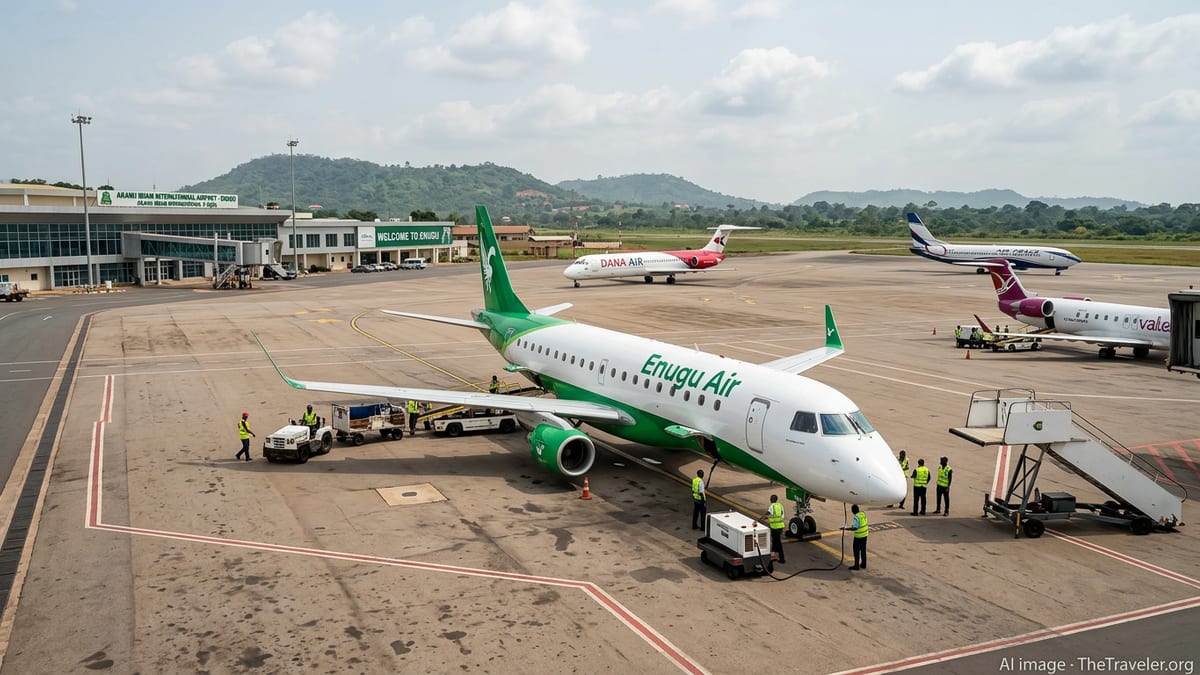
New Aircraft Power Enugu’s Domestic Ambitions
Enugu Air, the state-owned airline created to anchor growth around Akanu Ibiam International Airport, has moved from concept to credible contender in less than two years, underpinned by a rapid ramp-up of regional jets and a clear focus on key business and political corridors. After launching initial services with a small Embraer fleet operated in partnership with XEJet in mid-2025, the carrier is now backed by a multiyear plan that will see its aircraft numbers climb sharply through 2026.
Enugu State officials have confirmed that three aircraft were already inducted into the fleet in 2025, with additional deliveries scheduled before the end of that year and a larger wave of acquisitions budgeted for 2026. Taken together, the programme is expected to take Enugu Air’s fleet to around 20 aircraft by the end of next year, positioning the airline to sustain higher frequencies and new routes on core domestic sectors.
At the same time, the state government is investing in airport infrastructure, including a concession and upgrade of Enugu’s airport with a new international wing and cargo facilities. These improvements are intended to support higher aircraft movements and transform the city from a primarily regional destination into a more competitive hub that can funnel traffic between Nigeria’s southeast, Lagos, Abuja and the oil-rich south-south region.
Industry analysts say the strategy reflects a wider shift in Nigerian aviation, where state-backed and privately owned carriers alike are betting on newer, more efficient aircraft to stabilize schedules and tap pent-up demand on short and medium-haul routes. Enugu Air’s move into a larger fleet underscores that regional jets are now central to this domestic growth story.
Fresh Links Between Enugu, Lagos, Abuja and Port Harcourt
The most immediate impact for travelers is the opening and strengthening of routes linking Enugu with Lagos, Abuja and Port Harcourt, three of Nigeria’s busiest aviation and commercial centers. Enugu–Lagos remains a high-priority trunk route, feeding business travelers, students and traders into the country’s dominant economic hub, while Enugu–Abuja connects the southeast directly to federal institutions and diplomatic missions in the capital.
With more aircraft available, Enugu Air is expected to increase frequencies on these sectors and introduce additional timings that better match corporate and governmental travel patterns, especially early-morning departures and late-evening returns between Enugu and both Lagos and Abuja. This would give passengers same-day return options that have historically been constrained by limited schedules and unpredictable disruptions.
On the Enugu–Port Harcourt axis, the new capacity opens a faster alternative to congested road corridors for professionals in oil and gas, logistics and services operating between the southeast and the Niger Delta. Regular point-to-point flights can cut travel times dramatically compared with overland journeys, and they provide more predictable arrival windows for time-sensitive business engagements.
Travel consultants in Nigeria note that as Enugu Air grows, it will likely coordinate with existing players that already operate across Lagos, Abuja, Enugu and Port Harcourt, allowing for smoother interline connections and more resilient schedules. The expectation in the market is that competition on these four-city pairings will sharpen, with travellers benefiting from additional choice and potentially more competitive fares.
Competitive Pressure on Established Domestic Carriers
Enugu’s expansion is unfolding against a backdrop of ambitious fleet growth across Nigeria’s private airlines, particularly those already entrenched on routes touching Lagos, Abuja and Port Harcourt. Enugu-based United Nigeria Airlines, which started scheduled flights in 2021 and has grown into a nationwide carrier, is itself adding capacity and preparing to induct Boeing 737-800 aircraft from 2026, a step that will increase seat counts and improve economics on busy domestic sectors.
Other carriers such as Ibom Air and ValueJet have been deepening their presence on Lagos and Abuja corridors, and in some cases adding flights into Enugu and Port Harcourt as part of broader network strategies. The combined effect is a more crowded, more dynamic marketplace in which on-time performance, customer service and pricing will all come under closer scrutiny from a growing middle-class customer base.
Aviation analysts argue that Enugu Air’s backing by a state government gives it a different risk profile from privately owned airlines, potentially allowing it to sustain marginal routes longer while demand builds. That in turn could pressure competitors to respond with promotional fares or tactical capacity increases on key city pairs, particularly during peak travel seasons such as festive periods and political cycles.
Yet the competitive landscape also carries operational challenges. Nigeria’s domestic market has struggled with foreign exchange constraints, high fuel costs and episodic infrastructure bottlenecks. Enugu’s fleet expansion and new domestic routes will test how well airlines and regulators can coordinate to manage congestion, maintain safety oversight and avoid the boom-and-bust cycles that have previously plagued the sector.
Economic Ripple Effects for Nigeria’s Emerging Hubs
Beyond ticket sales and airport traffic statistics, Enugu’s growing fleet and new routes have broader economic implications for the cities along its network. Closer air links between Enugu, Lagos, Abuja and Port Harcourt are expected to stimulate trade, conferences and investment flows, as businesses find it easier to move teams and goods rapidly between Nigeria’s main commercial, political and energy centers.
Hotels, ride-hailing operators, car-rental firms and small hospitality businesses in Enugu are already positioning for an uptick in traffic as more flights take off and land each day. Real estate developers and logistics companies are watching closely, seeing the airport upgrades and airline expansion as signals that the city could evolve into a secondary hub for both passenger and air-cargo movements in the southeast.
For Lagos and Abuja, additional connections to Enugu and Port Harcourt dovetail with broader national infrastructure efforts, including rail projects and highway improvements, that aim to integrate Nigeria’s regions more tightly. Improved scheduling options and new direct flights can help unlock tourism itineraries that combine urban, cultural and coastal experiences, benefiting local guides, tour operators and creative industries.
In Port Harcourt, stronger air links with Enugu offer opportunities for more diversified travel beyond core oil and gas traffic, opening the door to conferences, academic exchanges and cultural events that draw visitors from the southeast and beyond. If sustained, these flows may support efforts to reposition the city and surrounding region as a more rounded business and lifestyle destination.
Infrastructure, Regulation and the Road Ahead
The success of Enugu’s fleet expansion and new domestic routes will depend heavily on reliable infrastructure and vigilant regulation. Ongoing upgrades at Enugu’s airport, including runway works and planned terminal enhancements, are designed to accommodate higher traffic volumes and prepare for eventual international operations. Regulators are expected to keep a close eye on safety standards as more aircraft and airlines jostle for slots at major airports in Lagos, Abuja and Port Harcourt.
Nigeria’s civil aviation authorities have in recent years tightened oversight of fleet renewals, maintenance practices and financial fitness, in a bid to reduce the risk of abrupt airline failures that can strand passengers and disrupt connectivity. Enugu Air’s growth trajectory will be closely watched as a test case of whether state-linked carriers can combine political backing with robust corporate governance and operational discipline.
Industry observers point out that if Enugu successfully scales up its fleet while maintaining punctuality and service quality, it could provide a template for other regional governments seeking to leverage aviation as a catalyst for development. Conversely, missteps around scheduling, maintenance or customer care could quickly erode public confidence in a market where travellers are often sensitive to reliability issues.
For now, travellers in Enugu, Lagos, Abuja and Port Harcourt are beginning to feel the early benefits of a more connected network, as additional aircraft and new routes give them more options and greater flexibility. As more jets join the fleet and new services bed in over the coming year, Nigeria’s domestic skies are likely to grow busier, with Enugu playing a more prominent role in how the country moves.