

More news on this day
Europe’s original high speed corridor between Rome and Florence has just been reborn for the twenty first century, as Italy completes the transition of the Direttissima line to the cutting edge European Rail Traffic Management System, promising faster, smoother and more reliable journeys for millions of tourists shuttling between the two cities.
Get the latest news straight to your inbox!
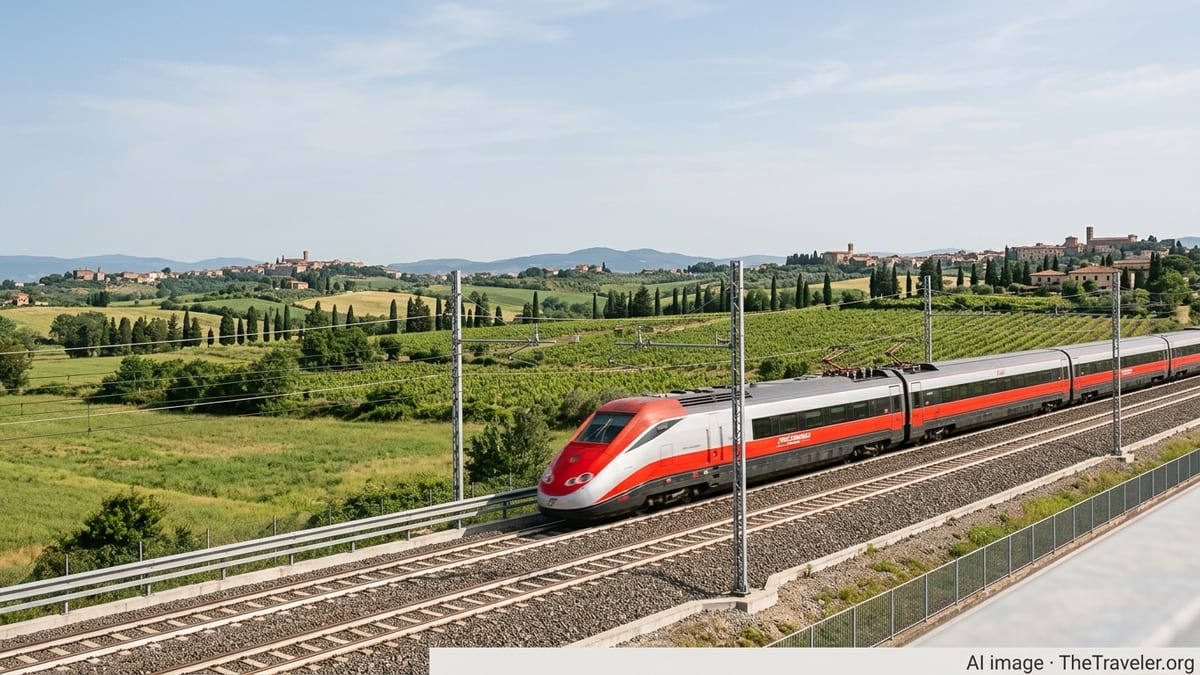
A landmark upgrade on Europe’s first high speed route
The Florence–Rome Direttissima, the pioneering fast line that opened in stages from the late 1970s, has long been the backbone of central Italy’s rail network. High speed Frecciarossa and Italo services already linked the capitals of Tuscany and Lazio in as little as 1 hour 30 minutes, making rail the preferred option for domestic and international travellers alike.
Publicly available information from infrastructure manager Rete Ferroviaria Italiana and its engineering arm Italferr shows that the line has now completed its conversion to ERTMS, a digital signalling and train control system that replaces older trackside signals with continuous communication between trains and control centres. Earlier phases brought ERTMS to the Rovezzano–Arezzo Sud and Arezzo Sud–Orvieto Sud sections; with the recent activation of the remaining stretch to Settebagni on the outskirts of Rome, the entire 240 kilometre Direttissima is now under the new regime.
The Rome–Florence corridor is one of the most heavily used in Italy, carrying dense flows of high speed, intercity and regional trains. The completion of ERTMS brings the route into line with the country’s newer high speed lines and supports a broader national programme, financed in part through Italy’s National Recovery and Resilience Plan, to extend the same technology across thousands of kilometres of track by 2026.
For travellers planning classic Italy itineraries that combine Rome’s ancient monuments with Florence’s Renaissance streets, the change is largely invisible on the surface. The trains look the same and timetables are only gradually being adjusted. Yet the technology quietly reshapes what is possible on a line that was already fast by historical standards.
How ERTMS changes the experience between Rome and Florence
ERTMS, and more specifically its ETCS digital signalling component, allows trains to run closer together while maintaining or even improving safety margins. Instead of relying on fixed blocks and traditional colour light signals beside the tracks, onboard computers constantly receive data about line conditions and permitted speeds, automatically supervising the driver’s actions.
On the Direttissima this means greater flexibility to thread a mix of express and stopping services through a busy corridor. Capacity gains can be used in different ways: more trains at peak times, more even spacing across the day, or additional recovery margins to absorb minor disruptions before they cascade into wider delays. Operator information and industry analysis indicate that the national objective is to improve punctuality and regularity, two metrics closely watched by travellers choosing between rail and air.
The smoother braking and acceleration profiles enabled by continuous supervision can also translate into a more comfortable ride. High speed sets such as the Frecciarossa 1000 were already equipped to interact with ERTMS from their introduction, and the completed rollout along the Rome–Florence route lets these trains use their full suite of onboard systems. For many passengers the most noticeable difference will not be headline top speeds, but shorter dwell times at intermediate stops, fewer unexplained pauses on open track and a greater sense that the journey proceeds at a steady, confident pace.
For the wider network, bringing ERTMS to the Direttissima helps align central Italy’s main artery with the standards used on other Italian high speed lines such as Rome–Naples. That interoperability is important for long distance services that cross multiple corridors and for international operators looking to access Italy’s market in future, potentially broadening the range of products on offer to visitors.
Tourism benefits on Italy’s busiest cultural corridor
The Rome–Florence axis is not just a domestic commuter route; it is a showcase corridor for Italian tourism. Before the latest upgrade work, high speed trains on this stretch already carried millions of visitors each year, thanks to dense frequencies, competitive fares and the convenience of central stations like Roma Termini and Firenze Santa Maria Novella.
With the ERTMS conversion complete, operators now have more scope to fine tune timetables to match tourist demand. Planning documents and service booklets published in late 2025 signalled phased works leading to the 2026 activation, accompanied by temporary timetable reductions while test trains verified the new systems. As those test phases fall away, the expectation in industry coverage is that capacity can gradually be rebuilt and even enhanced, particularly at popular mid morning and late afternoon departure times that align with hotel check out and check in patterns.
Improved regularity is especially valuable for travellers making tight connections, whether to regional trains bound for Tuscan hill towns or to long distance services toward Venice and Milan. More predictable arrival times in Florence and Rome reduce the need to pad itineraries with excessive transfer buffers, giving visitors greater confidence to rely on rail rather than arranging private road transfers.
The psychological effect should not be underestimated. Travel forums and consumer reports over recent years have highlighted temporary constraints in ticket availability during engineering works on the Florence–Rome line, causing confusion among tourists planning holidays months in advance. As the ERTMS programme moves from construction to steady operation, the narrative around the corridor can shift from disruption to improvement, reinforcing the image of Italy’s railways as a modern, high quality way to traverse the country.
What visitors can expect on board and at stations
Most of the tangible changes linked to ERTMS occur out of sight, in equipment rooms, lineside cabinets and onboard electronics bays. Yet travellers moving between Rome and Florence are likely to notice secondary upgrades that accompany such a major programme, from refreshed track and overhead lines to updated information systems.
According to official project descriptions, the Direttissima works go beyond signalling to include renewal of certain station and line side installations. In practice this translates into more resilient infrastructure during extreme weather, faster recovery after incidents and a technology base that can support further enhancements such as real time occupancy data or more sophisticated delay management tools. For tourists, the result should be fewer last minute platform changes and clearer communication when they do occur.
On board, high speed operators have an incentive to capitalise on the newly optimised corridor by refining their products for international visitors. This can include more consistent bilingual announcements, improved onboard Wi Fi performance and clearer seat reservation displays, all of which benefit from stable, predictable running patterns under ERTMS. While such features are commercial decisions rather than direct consequences of the signalling upgrade, the underlying infrastructure makes premium services easier to schedule and operate.
Importantly, the Rome–Florence run remains short enough that it competes strongly with air travel on overall door to door time. If the ERTMS rollout delivers the anticipated gains in punctuality, the balance tilts further in favour of rail, especially for travellers conscious of the environmental impact of their choices.
A model for rail led tourism across Italy
The completed ERTMS deployment on the Rome–Florence Direttissima is part of a broader transformation of Italy’s rail network. National plans funded through European recovery instruments envisage thousands of kilometres of routes, from coastal lines in Tuscany and Lazio to long distance corridors in the south, being equipped with the same technology over the next few years.
For the tourism sector this matters because it widens the area that can be visited comfortably by train on a short or medium length holiday. As more lines feeding into Rome and Florence adopt ERTMS and related upgrades, secondary destinations can be slotted more reliably into tightly planned itineraries. Cities such as Arezzo and Orvieto, already connected to the high speed spine, stand to benefit from their position on a corridor that is both faster and more dependable.
The Rome–Florence experience therefore serves as a high profile demonstration of what digital signalling can deliver on a route where expectations are already high. If the corridor continues to show improvements in performance data and traveller satisfaction as ERTMS settles into everyday use, it is likely to bolster political and commercial support for similar investments elsewhere in the country.
For now, travellers booking a seat between the Colosseum and the Duomo may not see the complex technological story behind their ticket. What they will encounter is a journey that feels more like a metropolitan shuttle than an intercity trek, reinforcing the perception of Italy as a place where high culture and high speed rail travel comfortably side by side.