

More news on this day
Eswatini Air will launch its first direct service between King Mswati III International Airport and Lusaka’s Kenneth Kaunda International Airport on 1 April 2026, a strategic new route expected to strengthen tourism flows, unlock business opportunities and reinforce Southern Africa’s growing web of regional air links.
A New Nonstop Link Between Eswatini and Zambia
The new route will provide the first direct air connection between the Kingdom of Eswatini and Zambia’s capital, Lusaka, eliminating the need for passengers to route through Johannesburg, which is currently the main connecting hub for this journey. By cutting out a transfer and reducing total travel time, the service is expected to make cross-border trips significantly more convenient for both leisure and corporate travellers.
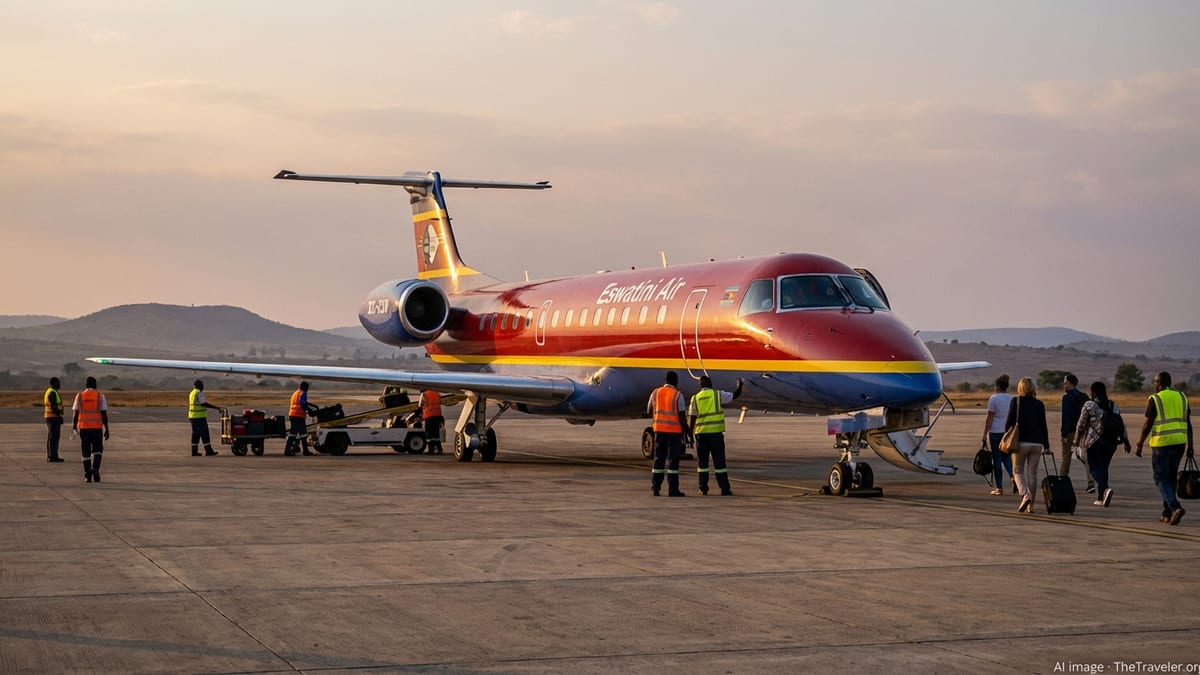
Flights will operate between King Mswati III International Airport, Eswatini’s modern international gateway, and Kenneth Kaunda International Airport, the primary aviation hub for Zambia. Eswatini Air plans to deploy its Embraer ERJ 145 regional jets on the route, using the 50-seat aircraft’s range and efficiency to match demand on this emerging corridor while maintaining competitive operating costs.
Although detailed schedules and weekly frequencies are set to be confirmed closer to launch, the airline has signalled that timings will be designed to offer smooth connections with its existing network. This means passengers originating in Johannesburg, Durban, Cape Town or Harare will be able to connect through Eswatini onto Lusaka with shorter layovers and more seamless itineraries.
The launch marks a major step in Eswatini Air’s strategy to position its home base as a nimble regional hub. It also reflects rising demand for point-to-point connectivity within Southern Africa, as travellers increasingly look for alternatives to long detours through larger, often congested airports.
Strengthening Tourism Flows Across Southern Africa
Tourism leaders in both Eswatini and Zambia have welcomed the new route as a catalyst for multi-country itineraries that combine the two destinations with other established regional draws. By linking Eswatini’s cultural heritage and wildlife reserves with Zambia’s renowned safari circuits and Victoria Falls gateway, the direct service is expected to make it easier for tour operators to stitch together more diverse packages.
Eswatini offers visitors a compact yet varied tourism product, from traditional cultural festivals and craft markets to mountain landscapes, game reserves and community-based tourism projects. Until now, travellers looking to combine Eswatini with Zambia have generally faced time-consuming routings via South Africa, often involving long layovers and higher overall travel costs.
Zambia, meanwhile, continues to grow its profile as a safari destination, with strong demand for experiences in South Luangwa, Lower Zambezi and Kafue national parks, as well as stays in and around Livingstone for visits to Victoria Falls. The new nonstop flight gives Zambian and international tour operators a more straightforward way to add Eswatini to itineraries that already feature these well-known attractions.
Industry analysts note that as long as schedules are timed to connect with key inbound long-haul markets, particularly from Europe and the Middle East, the Eswatini–Lusaka link could help distribute tourists more evenly across the region. This would support smaller destinations that often struggle to gain visibility against larger regional hubs but offer authentic, lower-density experiences that are increasingly in demand.
Business and Trade Ties Set for a Lift
Beyond leisure travel, the new service is expected to benefit business travellers and cross-border trade. Zambia and Eswatini are both members of regional economic communities such as the Southern African Development Community and the Common Market for Eastern and Southern Africa, and there is growing interest in exploiting intra-African trade opportunities as the African Continental Free Trade Area gradually advances.
Executives in sectors including mining services, agribusiness, construction, banking and telecommunications already travel regularly between the two countries, often for short, time-sensitive trips. The removal of an intermediate stop and the availability of more direct timings should translate into shorter door-to-door journeys, enabling faster deal-making and more efficient corporate travel budgets.
For Eswatini, stronger connectivity to Lusaka opens the door to deeper engagement with Zambia’s relatively diversified economy, which serves as a gateway into several land-linked markets to the north and west. For Zambian companies, easier access to Eswatini offers a route into the wider network of partners and suppliers based in the industrial heartland of South Africa and in neighbouring Mozambique, reachable through Eswatini Air’s network and regional road links.
Financial analysts say that while passenger numbers on the new route may be modest in absolute terms during the early stages, the presence of a dedicated nonstop service sends an important signal to investors. Reliable air links are often a prerequisite for new regional projects, whether in infrastructure, tourism investment, or services, and the Eswatini–Lusaka connection helps fill a previous gap on the Southern African map.
Eswatini Air’s Growth Strategy and Fleet Expansion
Eswatini Air, a commercial subsidiary of the Royal Eswatini National Airways Corporation, only began operations in March 2023. In less than three years, it has built a core network linking Eswatini with Johannesburg, Cape Town and Durban in South Africa, alongside Harare in Zimbabwe. The addition of Lusaka will be the airline’s fifth scheduled destination and its third country served.
The carrier has focused on using Embraer ERJ 145 regional jets, which are well suited to short to medium regional sectors and can be profitable at lower passenger volumes than larger narrowbody aircraft. The airline has announced plans to grow its fleet from two to three ERJ 145s to support network expansion, including the Lusaka route and potential future services to other regional cities.
Operational performance has been a cornerstone of the airline’s positioning. Industry reports indicate that Eswatini Air achieved impressive on-time performance and schedule integrity during its inaugural year, helping to build consumer confidence and a reputation for reliability in a market where delays can be common. Maintaining this track record as the network grows will be important for the success of the new Lusaka link.
Management has made clear that the airline’s strategy is to serve routes that are currently underserved or dominated by indirect options, rather than competing head-to-head with larger carriers on heavily trafficked city pairs. The Lusaka launch is consistent with this approach, targeting a niche corridor with clear tourism and business demand but limited direct connectivity.
Boosting Regional Connectivity and Hub Alternatives
The Eswatini–Lusaka route also reflects a broader trend in African aviation towards greater point-to-point connectivity between secondary cities and smaller capitals. For years, travellers within Southern Africa often had little choice but to route through Johannesburg, even when flying between neighbouring states. This added to travel time and constrained the development of regional tourism circuits.
By positioning King Mswati III International Airport as a compact, user-friendly hub for short regional connections, Eswatini Air is aiming to capture some of the traffic that would otherwise flow through larger airports. For passengers, the benefits include easier transfers, shorter walking distances, and fewer queues, along with the potential for simplified fares across multiple sectors on a single ticket.
For the broader region, the development of smaller hubs can help spread aviation-related economic benefits, from airport jobs to ancillary services such as catering, maintenance and ground handling. It may also encourage competition between hubs, which can contribute to more competitive fares and better service standards.
Transport economists point out that as additional regional airlines in Southern Africa launch new services of their own, from secondary cities in Zambia and Zimbabwe to new links within Namibia and Botswana, the value of Eswatini’s connections could increase further. If schedules are coordinated, travellers will have a wider menu of multi-stop itineraries that avoid over-reliance on any single gateway.
Opportunities for Tour Operators and Travel Trade
Tour operators and destination management companies in both countries are moving quickly to design products around the new route. For inbound travellers landing in Lusaka from long-haul markets, a direct onward flight to Eswatini will simplify the logistics of combining Zambia’s safari regions with Eswatini’s cultural and scenic attractions, often within a single holiday.
In practical terms, this could mean new itineraries that start with several days on safari in South Luangwa or Lower Zambezi, followed by a short stay in Eswatini for hiking in the highlands, community visits or cultural festivals. For travellers who begin their journeys in South Africa, the combination of Eswatini Air’s routes opens options for loop-style itineraries that include Johannesburg, Cape Town, Eswatini and Lusaka without extensive backtracking.
The travel trade expects that improved air access will particularly benefit small and mid-sized operators, lodges and guesthouses, which often rely on flexible regional links and cannot always secure block bookings on larger, more capacity-constrained routes. With a 50-seat aircraft and regional focus, Eswatini Air can provide a level of scale that matches these businesses’ needs.
Travel agents in both markets are also watching fare structures closely. Competitive pricing, combined with the time savings of a nonstop service, could persuade more travellers to opt for multi-country trips or to shift from overland journeys to air travel on certain sectors, especially during peak tourism seasons when road borders are busier.
Competitive Landscape in Southern African Skies
The launch of Eswatini Air’s Lusaka service comes amid a wider reshaping of Southern Africa’s regional aviation sector. Several airlines, including carriers in Zimbabwe and Zambia, have announced or begun new routes linking their capitals to regional cities, with a particular focus on boosting access to key tourism hubs and deepening economic ties.
In this context, Eswatini Air’s move is both a response to and a driver of growing competition. While the Eswatini–Lusaka city pair has not previously supported a nonstop service, passengers have had alternatives via other hubs. Eswatini Air will need to differentiate itself through reliability, customer service and efficient connections if it is to capture and retain a meaningful share of regional traffic.
Industry observers say that the relatively small size of the ERJ 145 may work in the airline’s favour in the early stages, allowing capacity to be aligned with demand while the market develops. If the route performs well, there may be scope over time to increase frequency or explore additional connections from Eswatini into central and eastern parts of the continent.
For now, the Lusaka route represents a calculated step that strengthens the airline’s presence in the Southern African Development Community region without overextending its resources. It also gives Eswatini Air a stronger voice in regional aviation discussions and potential future partnerships or interline agreements with other African and international carriers.
Outlook: Measured Growth with Regional Impact
As the 1 April 2026 launch date approaches, stakeholders across tourism, trade and aviation will be watching booking trends closely. Forward demand from tour operators, corporate travel buyers and regional institutions will offer early clues about how quickly the market is responding to the new option.
Government and aviation officials in Eswatini have framed the route as part of a broader national strategy to use improved connectivity as a lever for economic diversification, particularly through tourism and services. For Zambia, the move fits within efforts to cement Lusaka’s role as a gateway to central and southern Africa, supported by a growing portfolio of regional and domestic flights.
If successful, the Eswatini–Lusaka service could strengthen the case for additional links from Eswatini to other regional centres that remain underserved by direct flights. It would also reinforce a wider shift across the continent towards building intra-African routes that make it easier for African travellers to connect with one another without routing through distant hubs.
For passengers, the impact will be felt most immediately in shorter journeys and expanded choice. For the region, Eswatini Air’s latest expansion underscores how even small carriers, with carefully chosen routes and right-sized aircraft, can play an outsized role in knitting together Africa’s emerging travel and trade corridors.