

More news on this day
Ethiopian Airlines has marked International Women’s Day 2026 and its 80th year of service by operating eight special flights fully managed and operated by women, underscoring the national carrier’s role in advancing gender equality in African aviation.
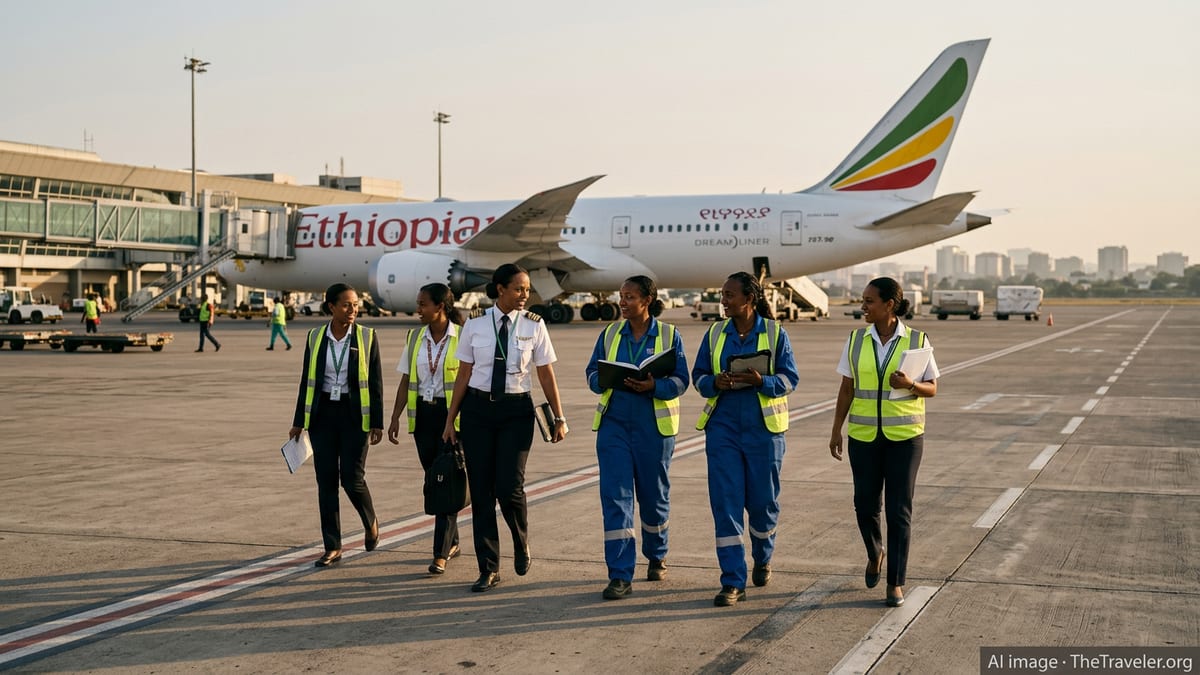
Eight All-Women Flights Span Three Continents
The flights departed from Addis Ababa on March 8 to Accra, Cairo, Djibouti City, Frankfurt, Mumbai, Nairobi, Windhoek and the domestic city of Dire Dawa, symbolically matching eight destinations to the airline’s eight decades in operation. Each service was staffed entirely by women across the operation, from cockpit and cabin crew to ground handling, dispatch, load control and ramp operations.
Ethiopian Airlines said the initiative was designed not only as a celebration but also as a visible demonstration of what women are already achieving in highly technical and leadership roles across the group. Passengers on the flights were informed that every stage of their journey, from check-in to landing, was being overseen by female aviation professionals.
The 2026 edition expands on previous years’ International Women’s Day flights, which initially focused on a smaller number of destinations. This year’s network, stretching across Africa, Europe and Asia, aims to highlight both the airline’s global reach and the scale of its women-centered workforce.
Marking Eighty Years of Ethiopian Aviation History
The all-women flights formed the centerpiece of wider celebrations marking 80 years since Ethiopian Airlines launched its first scheduled service in 1946. The choice of eight destinations was framed by the airline as a direct tribute to that milestone, linking its pioneering past to its ambitions for a more inclusive future.
Executives noted that the anniversary comes at a time when the carrier has grown into Africa’s largest airline group, with a network now spanning more than 160 domestic and international destinations. The IWD flights were positioned as a way to reflect on how far the airline has come since its early regional routes while signaling that gender inclusion will be central to its next chapter.
In Namibia, Ghana and other markets served by the special services, officials and invited guests joined ceremonies welcoming the all-women crews, highlighting Ethiopian’s long-standing role in regional connectivity. In Windhoek, the airline’s presence was also linked to historic ties, including its part in flying Namibian leaders home at key political moments, underscoring the carrier’s broader significance beyond commercial transport.
Expanding Opportunities for Women in the Cockpit and Beyond
Ethiopian Airlines has been operating all-women flights in connection with International Women’s Day since 2015, gradually expanding both the scale of the program and the number of women in technical roles. The carrier reports that it now employs close to 100 female pilots, a significant increase over the past decade, alongside growing numbers of women aircraft technicians, engineers, air traffic professionals and managers.
Leaders at the airline describe the initiative as part of a long-term strategy to mainstream women into critical positions that remain male-dominated globally. Training pipelines have been strengthened at the airline’s aviation academy, with targeted recruitment, scholarships and mentorship programs designed to bring more women into piloting, maintenance and leadership tracks.
For many of the women involved, the March 8 flights were both a professional milestone and a chance to inspire future generations. Young passengers and students invited to observe preflight briefings were able to see women leading safety checks, coordinating ground operations and commanding the cockpit, a visibility that advocates say is vital for changing perceptions of what is possible in aviation careers.
Aligning With Global Calls for Gender Equality
This year’s International Women’s Day took place under a global theme focused on rights, justice and action for all women and girls, a message that resonated strongly in speeches at Addis Ababa Bole International Airport. Ethiopian government officials and airline executives used the occasion to call for continued efforts to dismantle barriers that still limit women’s participation in science, technology and leadership roles.
The airline framed its all-women flights as a practical example of how corporate policies on recruitment, promotion and training can translate into visible change. By putting women at the center of a high-profile operational event, Ethiopian sought to underscore that gender inclusion is not confined to symbolic gestures but embedded in day-to-day decision-making and staffing.
Industry observers note that initiatives like these also carry a wider message for the global aviation sector, where women remain significantly underrepresented among pilots and senior technical staff. As one of Africa’s most high-profile carriers, Ethiopian’s decision to commit aircraft, routes and substantial operational planning to all-women flights signals a level of institutional backing that advocates hope other airlines will emulate.
Implications for Travelers and the Wider Industry
For travelers on the March 8 flights, the most immediate impact was a heightened awareness of who makes their journey possible. Announcements highlighted the role of women not only on board but also behind the scenes, from flight planning and engineering sign-off to catering and customer service. Many passengers described the experience as both routine in terms of operational smoothness and remarkable in its symbolism.
From a commercial perspective, the initiative reinforces Ethiopian Airlines’ brand as a modern, progressive African carrier competing on the global stage. Gender inclusion has become an increasingly important factor in corporate reputation, and airlines that demonstrate tangible progress are likely to strengthen their appeal among international travelers, business partners and prospective employees.
While the all-women flights are limited in number, Ethiopian Airlines has signaled that the broader goal is to make such rosters unremarkable in the years ahead. As more women advance through the airline’s training and promotion pathways, the carrier envisages a future in which diverse crews and leadership teams are simply part of normal operations, even as special events like International Women’s Day continue to spotlight the journey toward full equality.