

Ethiopian Airlines is preparing to launch its first direct flights to Australia by 2028, a move that would link Addis Ababa with one of the last major continents missing from its network and further entrench the Ethiopian capital as Africa’s busiest and most globally connected aviation hub.
A Strategic Leap Toward a Truly Global Network
The planned launch of non-stop services to Australia marks a strategic inflection point for Ethiopian Airlines, which has spent the past decade building one of the world’s most far-reaching route maps from a single African hub. While the carrier already connects Addis Ababa to key gateways across Europe, the Middle East, Asia and the Americas, Australia remains a gap typically bridged through partners in the Gulf or Southeast Asia. A direct operation would close that gap and consolidate Addis Ababa’s role as a one-stop gateway between Africa and Oceania.
Executives and aviation analysts say the timing aligns with the airline’s long-term “Vision 2035” roadmap, which targets more than 200 destinations worldwide and tens of millions of annual passengers. Australia is viewed as both a high-potential leisure market and an important corporate and diaspora corridor, particularly for communities from East Africa and the Horn of Africa who currently face lengthy multi-stop journeys. A non-stop Addis Ababa to Australia route is expected to cut several hours off travel times while simplifying connections across the continent.
The move also reflects a broader trend of African carriers seeking to bypass traditional transfer hubs in Europe and the Middle East. By operating directly to long-haul markets such as Australia, Ethiopian Airlines aims to capture more origin-and-destination traffic, retain higher-yield passengers and reduce dependence on partner networks. For travelers, the result would be a more competitive landscape, with Addis Ababa emerging as a genuine alternative to Dubai, Doha or Istanbul for one-stop journeys between Africa and Australasia.
Addis Ababa’s Ascent as Africa’s Transit Powerhouse
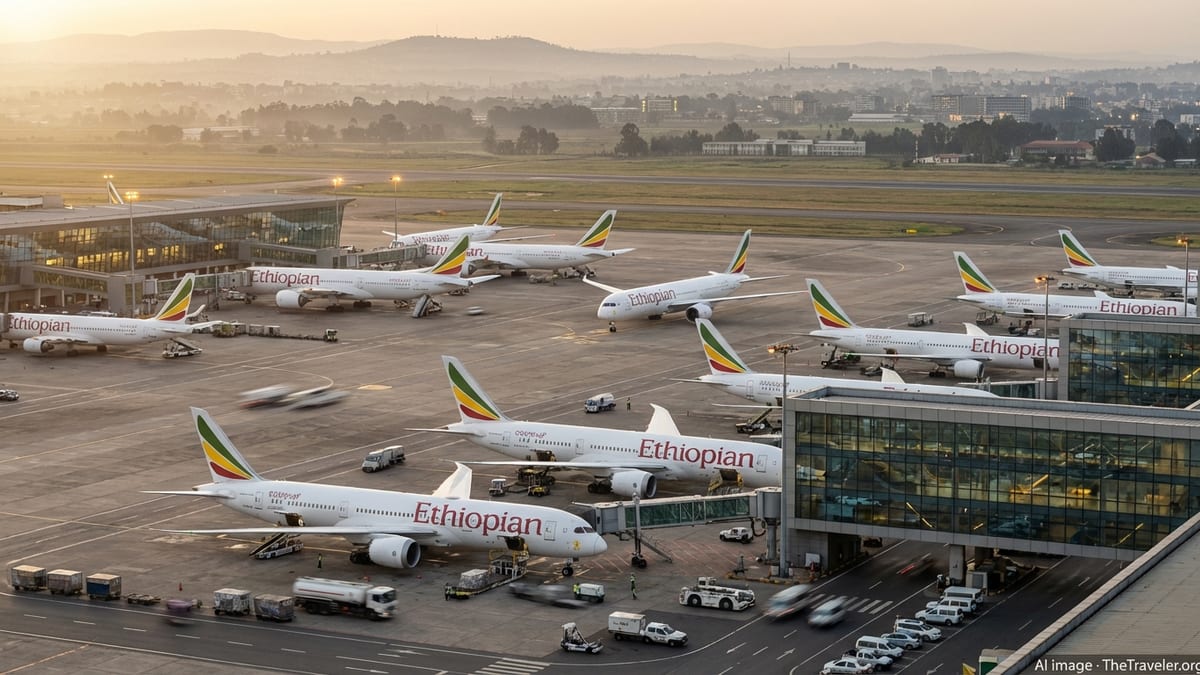
The Australia plan comes at a time when Addis Ababa Bole International Airport is consistently ranked among Africa’s top three busiest hubs by passenger traffic and outbound seats. Recent data show the airport handling around 12 million passengers annually and recording steady year-on-year growth, powered largely by Ethiopian Airlines’ expanding intercontinental network and aggressive connectivity strategy across the continent. Bole now rivals Cairo and Johannesburg in terms of regional influence and long-haul reach.
As a transit platform, Addis Ababa has been carefully engineered to minimize connection times between African cities and long-haul destinations. Ethiopian Airlines banks its flights into coordinated waves, allowing passengers from secondary markets such as Kigali, Lusaka or Harare to connect in under two hours to flights bound for Europe, Asia or North America. This same “waves and banks” model would underpin future Australia services, with schedules likely crafted to dovetail with arrivals from East, West and Southern Africa.
The hub’s growing prominence is evident in its outbound capacity figures, where Addis Ababa regularly places in the top tier of African airports for scheduled seats. Analysts note that Bole’s role has shifted from a primarily regional gateway to a global connector, particularly as Ethiopian Airlines has cultivated strong links into Asia. The addition of a direct Australia operation would further tilt the balance toward truly global transit flows, giving the carrier a unique selling point among African airlines.
Fleet, Range and the Technical Challenge of Africa–Australia Non-Stops
Operating a non-stop route from Addis Ababa to major Australian gateways such as Sydney or Melbourne will require careful fleet and performance planning. The sector length, which can exceed 12 hours depending on routing and winds, demands long-range widebody aircraft with efficient fuel burn and strong hot-and-high performance to cope with Addis Ababa’s elevation. Ethiopian Airlines has already invested heavily in such aircraft, including Boeing 787 Dreamliners and Airbus A350s, which currently anchor its long-haul services to destinations across Asia, Europe and the Americas.
Aviation experts expect the Australia operation to be assigned to the newest and longest-legged jets in the fleet, potentially leveraging future aircraft deliveries to fine-tune capacity and range. Ultra-long sectors also raise questions around crew rostering, onboard service, and product differentiation, particularly in premium cabins where business travelers and higher-yield leisure passengers are most sensitive to comfort and reliability. The airline is understood to be evaluating schedule patterns and aircraft rotations that would allow efficient use of frames without undermining existing trunk routes.
Regulatory and operational hurdles will also need to be cleared in the lead-up to a 2028 launch. Bilateral air service agreements between Ethiopia and Australia, slot access at congested airports, and coordination with air navigation service providers on optimal routings will all play a role. However, Ethiopian’s track record of opening complex long-haul routes, including to destinations in the Americas and deep into Asia, suggests it is accustomed to navigating the multi-year planning horizon such a project demands.
Serving Diaspora, Trade and Tourism Across Two Continents
The commercial logic behind direct flights to Australia rests on a blend of diaspora demand, burgeoning trade ties and a steadily rising tourism profile on both ends of the route. Australia is home to growing communities from Ethiopia, Eritrea, Sudan, Somalia and other nations in the Horn of Africa, many of whom travel regularly for family, business and education. At present, these journeys often involve double connections and long layovers in the Middle East or Southeast Asia. A non-stop service via Addis Ababa would shorten travel, reduce transfers and provide a culturally familiar onboard experience.
On the trade side, Ethiopian officials and business leaders increasingly view Australia as a complementary partner in sectors such as mining services, agribusiness, education, and renewable energy. Improved air connectivity can support delegations, investment missions and specialist labor mobility, particularly for project-based work in both directions. For Australian firms with operations across East and Central Africa, Addis Ababa’s growing network offers a single gateway into dozens of cities that previously required circuitous itineraries.
Tourism flows are also expected to benefit. Ethiopian Airlines has been promoting stopover programs that encourage long-haul passengers to spend time in Addis Ababa or explore heritage sites such as Lalibela and the Simien Mountains. An Australia link would introduce these offerings to a new market, while also positioning the carrier to carry African leisure travelers to Australian cities and natural attractions. Tourism authorities in both countries are likely to watch the route’s development closely, given its potential to underpin marketing campaigns and joint destination promotions.
New Mega-Airport at Bishoftu to Underpin Long-Haul Growth
While Bole International Airport remains the primary hub today, Ethiopian Airlines and the Ethiopian government have already broken ground on a vast new airport complex at Bishoftu, around 25 to 30 miles southeast of Addis Ababa. Designed to ultimately handle up to 110 million passengers a year, Bishoftu International Airport is widely described as a future mega-hub that will eclipse current African facilities in scale and capability. The first phase, targeted for completion around 2030, is expected to deliver capacity for tens of millions of passengers annually with multiple runways and a large, modern terminal.
The new airport project is directly connected to Ethiopian Airlines’ long-range expansion plans, including ultra-long-haul routes such as the proposed non-stop flights to Australia. With more runways, extensive aircraft parking and dedicated long-haul infrastructure, Bishoftu is being conceived as an intercontinental super-hub capable of handling high volumes of connecting passengers with shorter taxi times and more flexible bank structures. The facility is designed to accommodate an overwhelmingly transit-focused traffic mix, reflecting the airline’s ambition to become the primary bridge between Africa and the rest of the world.
In the interim, Bole International continues to undergo incremental enhancements to handle rising traffic until Bishoftu comes online. Investments in terminal upgrades, technology and ground handling are intended to sustain the growth trajectory, even as planners acknowledge that a step change in capacity will only come with the opening of the new airport. For passengers on future Australia services, this means that early operations may run through Bole before gradually shifting to Bishoftu as the mega-hub becomes operational.
Partnerships, Code Shares and the Wider Asia-Pacific Strategy
Direct services to Australia are expected to complement, rather than replace, Ethiopian Airlines’ existing partnerships linking Africa with the Asia-Pacific region. The carrier has entered into a growing number of code-share and interline agreements with Middle Eastern and Asian airlines, which currently carry a significant share of passengers traveling between African cities and destinations in Asia and Oceania. These arrangements provide network breadth and scheduling flexibility, especially in markets too thin to support stand-alone Ethiopian operations.
By adding its own non-stop Australia services into the mix, Ethiopian aims to rebalance that equation, capturing more high-value traffic while still leveraging partners to feed secondary destinations beyond its main Australian gateway. Passengers could, for example, fly non-stop between Addis Ababa and an Australian hub, then connect domestically on local carriers, or travel onward to New Zealand and Pacific Island markets. Likewise, Australian travelers heading to less-served African cities would continue to benefit from Ethiopian’s dense intra-African network.
Industry observers say this layered approach mirrors strategies employed by major Gulf and European hubs, where a combination of own-metal flights and carefully structured partnerships delivers both depth and reach. For Addis Ababa, the result is a more robust position in global aviation flows, with the Australia link serving as a keystone in a broader Asia-Pacific strategy that also targets growth in markets such as India, Southeast Asia and China.
Strengthening Ethiopia’s Role in Africa’s Integration Agenda
The expansion into Australia aligns with Ethiopia’s broader positioning as a diplomatic and economic anchor on the continent. Addis Ababa already hosts the African Union headquarters and is a regular venue for high-level summits focused on integration, trade and mobility. Ethiopian Airlines often features in these discussions as a practical enabler of the African Continental Free Trade Area and initiatives to liberalize skies across the region. By knitting more African cities into intercontinental routes, the carrier supports both policy ambitions and real-world connectivity.
Direct flights to Australia would extend that integrative role beyond Africa’s borders, giving the continent more direct access to Asia-Pacific markets without relying solely on non-African intermediaries. For policymakers, this is about more than passenger numbers: it is a statement about Africa’s ability to carve out its own corridors in global aviation, anchored by homegrown champions. Ethiopian Airlines’ success in growing a profitable long-haul network from a landlocked country with limited historical aviation infrastructure is frequently cited as a case study in how strategic investment and network planning can reshape regional connectivity.
As the 2028 target approaches, attention will focus on how the airline sequences aircraft deliveries, negotiates traffic rights and fine-tunes its hub operations to accommodate the new route. For travelers and the wider industry, however, the significance is already clear. A non-stop bridge between Addis Ababa and Australia would not only fill one of the last remaining gaps in Ethiopian Airlines’ network, it would also signal that Africa’s leading hub is ready to compete head-on in the ultra-long-haul arena, connecting continents more directly than ever before.