

More news on this day
Etihad Airways is set to deepen its North American footprint with a new nonstop service between Abu Dhabi and Charlotte, positioning the fast-growing North Carolina hub as a fresh gateway for travelers moving between the southeastern United States, the Gulf region, and beyond.
Get the latest news straight to your inbox!
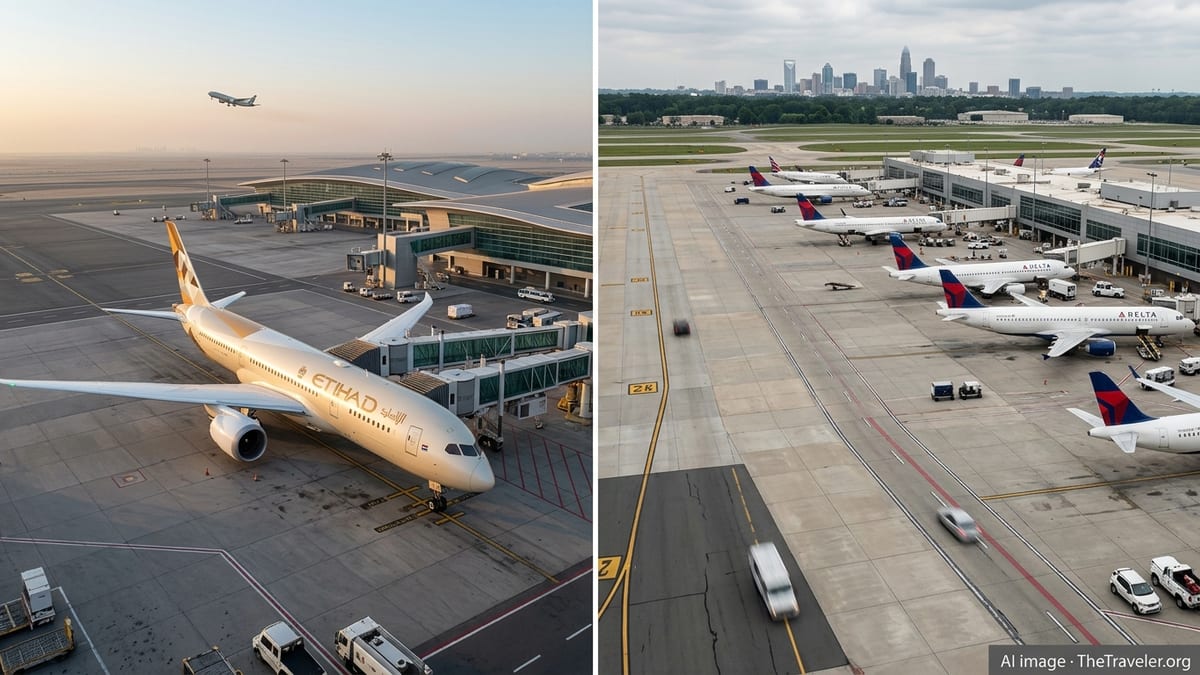
New Nonstop Service Connects Abu Dhabi and Charlotte
Publicly available schedule data indicates that Etihad Airways will introduce nonstop flights between Abu Dhabi’s Zayed International Airport and Charlotte Douglas International Airport in 2026, marking the airline’s entry into the North Carolina market. The new pairing adds another U.S. destination to Etihad’s long-haul network and reflects the carrier’s broader strategy of targeting growth markets outside the traditional coastal gateways.
Airport planning documents and route listings describe Charlotte as a new Etihad destination, with service expected to begin in spring 2026. The route will connect one of the Gulf’s key hubs with a major U.S. banking and business center, creating opportunities for both corporate and leisure travel flows in both directions.
The flight will give travelers in the Carolinas and the broader Southeast region a direct link to Abu Dhabi, reducing the need to connect through more distant hubs such as New York, Washington, or European gateways. For Etihad, the addition helps diversify its U.S. portfolio by tapping into an American Airlines–dominated hub where nonstop links to the Middle East have, until now, been absent.
Strategic Boost for Charlotte’s Growing Global Profile
Charlotte Douglas International Airport has steadily expanded its long-haul portfolio in recent years, leveraging strong domestic connectivity and a robust local economy. The arrival of Etihad’s Abu Dhabi service would represent a milestone in that evolution, adding the United Arab Emirates to the list of nonstop intercontinental destinations alongside major European and Latin American cities.
Industry and municipal reports describe Charlotte as one of the fastest-growing metropolitan areas in the United States, with a concentration of banking, energy, and professional services firms. A direct connection to Abu Dhabi is expected to appeal to corporate travelers heading to the Gulf, the wider Middle East, and key markets in South and Southeast Asia.
For outbound U.S. travelers, the new route also broadens options for reaching leisure destinations reachable via Abu Dhabi, including the Maldives, Sri Lanka, Thailand, and parts of Africa and the Indian Ocean. Travel analysts note that as secondary U.S. hubs attract more long-haul services, passengers increasingly look beyond traditional coastal airports for international departures.
Enhanced One-Stop Connectivity Across Etihad’s Network
Abu Dhabi functions as Etihad’s primary hub, and the forthcoming Charlotte service is expected to feed into a wide range of onward connections throughout the Middle East, Africa, the Indian subcontinent, and Asia-Pacific. Network materials produced by the airline highlight the role of Abu Dhabi as a transfer point linking North America with destinations such as Delhi, Mumbai, Cairo, Riyadh, Bangkok, and Kuala Lumpur.
With Charlotte added to the network, travelers from across the Carolinas, Tennessee, Georgia, and neighboring states could access these destinations with a single connection in Abu Dhabi rather than multiple changes of aircraft. The route is expected to be particularly attractive for travelers heading to South Asian cities with large expatriate and diaspora ties to the United States.
Conversely, inbound passengers from the Gulf, India, and Asia will be able to reach a large swath of the eastern United States through domestic connections at Charlotte. As American Airlines’ second-largest hub, Charlotte offers extensive short-haul coverage across the Southeast and up the Eastern Seaboard, potentially strengthening Etihad’s distribution across smaller and mid-sized U.S. markets.
Implications for Competition in Transatlantic and Gulf Corridors
The Abu Dhabi–Charlotte link also has implications for competitive dynamics on long-haul routes between the United States, the Middle East, and South Asia. Other Gulf-based carriers have focused on larger U.S. gateways such as New York, Atlanta, Houston, and Chicago, while Charlotte has remained more closely tied to transatlantic and Latin American traffic.
By adding Charlotte, Etihad moves into a market where direct competition from other Gulf carriers remains limited, potentially giving the airline a first-mover advantage. Aviation analysts suggest that the route could capture traffic currently routed via European hubs on joint ventures operated by U.S. and European airlines.
Charlotte’s role as a connector for smaller regional U.S. cities means that passengers who previously required multiple stops to reach Abu Dhabi or beyond may now find a more streamlined itinerary. Travel industry observers note that convenience, total journey time, and reliability are key factors that can attract passengers away from entrenched transatlantic routings.
What the New Route Means for Travelers
For travelers in the Carolinas and surrounding states, the nonstop Abu Dhabi service offers a new way to reach both the United Arab Emirates and a broad range of onward destinations. Leisure travelers gain more choice for reaching popular beach, city, and cultural locations across the Middle East and Asia, often with competitive one-stop journey times compared with itineraries through Europe.
Business travelers may benefit from schedules designed around key connection banks in Abu Dhabi, linking Charlotte to commercial centers in the Gulf region and India. Publicly available information on Etihad’s wider U.S. operation indicates that cabin products typically include a mix of economy, premium economy or extra-legroom seating, and business class with lie-flat seats on long-haul aircraft, which is expected to appeal to corporate accounts and high-yield passengers.
As launch dates approach, attention is likely to focus on final schedules, operating aircraft, and how the new route integrates with existing domestic connections at Charlotte. For now, the planned nonstop service underscores both Etihad’s ambitions in the U.S. market and Charlotte’s emergence as a more globally connected hub in the international aviation landscape.