

More news on this day
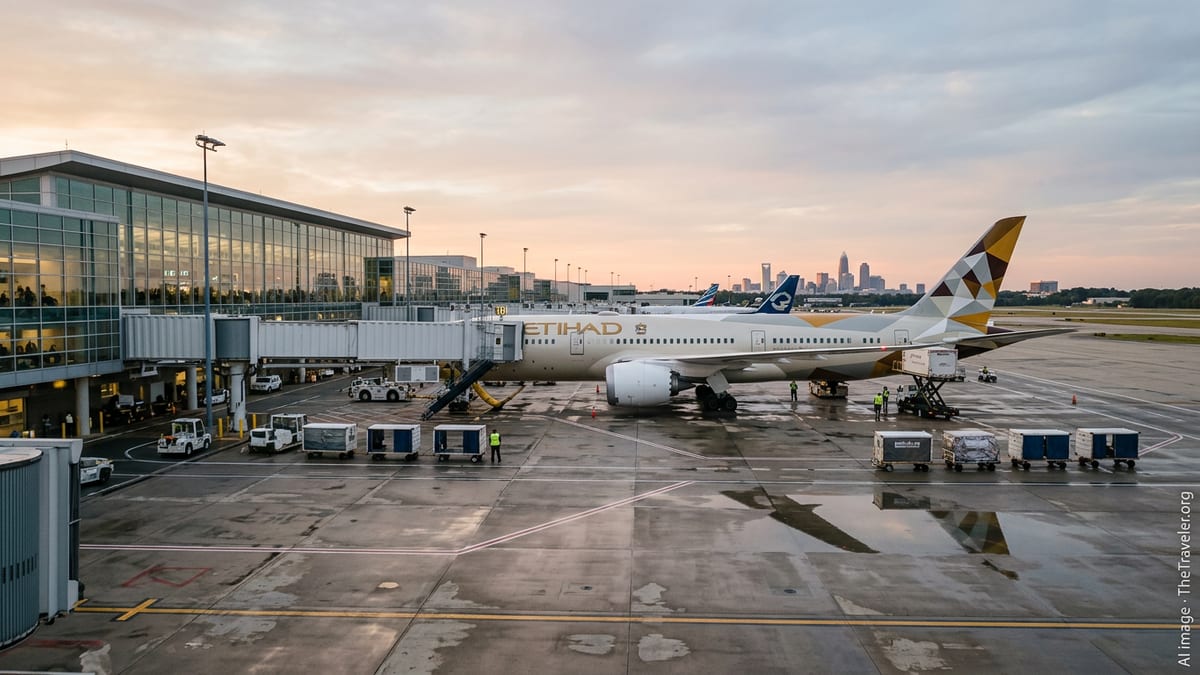
Etihad Airways is expanding its presence in the United States with the launch of nonstop flights between Abu Dhabi and Charlotte in May 2026, adding North Carolina’s largest city to its growing transatlantic network and creating the longest route ever operated from Charlotte Douglas International Airport.
Details of the New Abu Dhabi–Charlotte Service
Etihad’s new route will link its Abu Dhabi hub with Charlotte from 4 May 2026, subject to regulatory approvals. The service is scheduled to operate four times a week, connecting the United Arab Emirates capital with one of the fastest-growing metropolitan areas in the United States.
The flights will be operated by Etihad’s Boeing 787-9 Dreamliner aircraft, configured with a two-class cabin offering fully flat business-class seats and a modern economy cabin. The flight distance of roughly 7,400 miles, or about 11,900 kilometers, will make the Abu Dhabi–Charlotte service the longest route currently operated from Charlotte Douglas International Airport.
Schedules have been designed to connect into Etihad’s broader network across the Middle East, Indian subcontinent, Africa and Asia, while also arriving into Charlotte at times suited to onward domestic connections. The carrier is positioning the new route as a gateway in both directions, targeting business, leisure and visiting-friends-and-relatives traffic.
Abu Dhabi’s Zayed International Airport, which became Etihad’s consolidated base in Terminal A, offers United States border preclearance on Etihad-operated services to the U.S. For eligible passengers, that means completing immigration and customs formalities in Abu Dhabi and arriving in Charlotte as domestic travelers, reducing queues and simplifying onward journeys.
Charlotte Becomes Etihad’s Sixth U.S. Destination
With Charlotte’s addition, Etihad’s American footprint continues to grow beyond its established coastal gateways. The airline already serves New York, Chicago, Washington Dulles and Boston, and recently inaugurated flights to Atlanta, positioning itself more firmly in the eastern and southeastern U.S. markets.
Charlotte will become Etihad’s sixth U.S. destination, underlining both the strength of demand for Gulf carrier services and Abu Dhabi’s ambitions as a global aviation hub. The move reflects a broader strategy of tapping into large connecting markets that have historically relied on other coastal hubs for long-haul international flights.
Industry analysts note that Etihad’s growth in North America comes as the airline posts strong passenger numbers and expands its fleet. The carrier reported double-digit year-on-year increases in traffic through 2025, supported by a steady rollout of new destinations and additional aircraft. New long-haul routes such as Charlotte are seen as a natural extension of that growth trajectory.
The route is also expected to reinforce Abu Dhabi’s profile among U.S. travelers as both a destination and a stopover point. The emirate has invested heavily in tourism infrastructure, museums and cultural attractions, and Etihad’s network strategy is designed to funnel more visitors through its home base.
Strategic Boost for Charlotte’s Global Connectivity
For Charlotte Douglas International Airport, the Etihad announcement is a significant milestone. The hub is dominated by domestic and transatlantic services from legacy U.S. carriers, and its long-haul international network has historically been limited compared with larger coastal gateways.
The new Abu Dhabi nonstop dramatically extends Charlotte’s global reach, offering one-stop access from the Carolinas and neighboring states to destinations across the Gulf, the Indian Ocean, South Asia and parts of East Asia via Etihad’s network. Airport officials and local business groups have long argued that more direct links to the Middle East and Asia would support trade, investment and tourism growth in the region.
Economic development leaders are expected to leverage the new route in pitches to international companies considering investment in North Carolina. Direct access to a major global hub can be a deciding factor for firms with supply chains, regional headquarters or talent pipelines spanning multiple continents.
The service also strengthens Charlotte’s status among U.S. secondary hubs that attract long-haul operations from foreign carriers. As global airlines reassess network strategies, cities like Charlotte, Austin and Raleigh-Durham are increasingly viewed as viable points for high-demand, high-yield long-haul connectivity.
Passenger Demand, Tourism and Network Implications
Etihad’s entry into the Charlotte market is aimed at several overlapping customer segments. The carrier is targeting corporate travelers linked to finance, manufacturing, energy and technology firms in the Carolinas and neighboring states, many of which maintain operations in the Middle East, India and Asia-Pacific.
Leisure demand is another pillar, as more U.S. travelers seek multi-stop itineraries combining the Gulf with destinations such as the Maldives, Sri Lanka, Thailand and Indonesia. Etihad plans to market Abu Dhabi as both a standalone break and a convenient stopover option on longer trips, emphasizing the city’s beaches, culture and modern attractions.
The new route also serves visiting-friends-and-relatives traffic, particularly for communities with ties to South Asia and the wider Middle East who currently rely on multiple connections to reach home markets. A single connection over Abu Dhabi can cut travel times and add schedule flexibility across peak travel periods.
For Etihad’s network planners, Charlotte represents another step in balancing capacity between established trunk routes and emerging markets. By operating a four-weekly service with a fuel-efficient 787-9, the airline can test and grow demand while limiting exposure on a very long sector that requires careful yield management.
Operational Context Amid Regional Volatility
The announcement of the Charlotte route comes against a backdrop of both expansion and operational complexity for Gulf carriers. Regional airspace closures in late February and early March 2026 temporarily disrupted flights to and from Abu Dhabi, forcing Etihad to suspend departures before gradually resuming operations once authorities reopened parts of the airspace.
While those events underscored the exposure of Middle Eastern aviation to geopolitical tensions, Etihad has continued to position itself as a resilient carrier with diversified routes spanning Europe, Asia, Africa and the Americas. The decision to proceed with new long-haul plans such as Charlotte underscores the airline’s confidence in long-term demand despite short-term volatility.
Operationally, the use of modern widebody aircraft and the concentration of services at Zayed International Airport are central to Etihad’s ability to manage disruptions and scale up quickly when conditions allow. The Charlotte service will tap into that infrastructure, including coordinated connections and ground services designed for seamless transfers.
For travelers in the southeastern United States, the new Abu Dhabi connection adds both opportunity and complexity to trip planning in the near term, but industry observers expect demand for the route to be driven primarily by long-term structural links in business, tourism and diaspora travel that extend well beyond temporary regional disruptions.