

More news on this day
Etihad Airways and Emirates are beginning to restore a limited number of flights from Abu Dhabi and Dubai after unprecedented airspace closures brought Gulf aviation to a near standstill amid a rapidly escalating regional conflict involving US and Israeli strikes on Iran.
Airspace Reopens Cautiously After Weekend Shutdown
After a weekend in which skies across much of the Gulf effectively closed, aviation in the United Arab Emirates is edging back to life, though far from normal. Partial reopening of key air corridors has allowed Etihad and Emirates to begin operating a restricted schedule from their Abu Dhabi and Dubai hubs, with airlines stressing that services remain highly subject to change at short notice.
Etihad had suspended all flights to and from Abu Dhabi until 02:00 UAE time on Monday 2 March, citing regional airspace closures triggered by waves of missile and drone strikes linked to the US and Israel’s campaign against Iran. The carrier is now prioritising essential routes and repositioning aircraft and crews to gradually rebuild its network, while warning that some flights may still be rerouted or cancelled as the security picture evolves.
Emirates, which halted departures and arrivals in Dubai until 15:00 UAE time on Monday, has similarly started phasing back operations. Early departures are focusing on high-demand trunk routes and long-haul connections, with updated schedules being released in rolling batches. The airline is flagging that slot constraints, crew duty limits and complex rerouting around closed or restricted airspace will limit capacity for several days.
Authorities and airline executives are describing the current phase as a tightly managed restart rather than a full reopening, with priority given to safety assessments, coordination with regional air navigation providers and clearing backlogs of stranded passengers.
Regional Conflict Sends Shockwaves Through Gulf Aviation
The cautious resumption follows one of the most severe disruptions to Middle East aviation in decades. Following coordinated US and Israeli strikes on Iran and retaliatory attacks across the region, countries including Iran, Iraq, Israel, Jordan, Kuwait, Qatar and the UAE imposed at least partial closures of their skies, triggering widespread cancellations and diversions.
Flight-tracking and aviation analytics data over the weekend pointed to thousands of cancellations and delays across the region, with Dubai and Abu Dhabi among the hardest-hit hubs. At the height of the disruption, more than a third of scheduled services by major Gulf carriers were reportedly grounded as aircraft diverted away from key air corridors over the Gulf and Iran, forcing longer routings around the conflict zone.
The UAE was directly impacted by security incidents, including a drone attack at Abu Dhabi’s Zayed International Airport and damage reported at Dubai International. The UAE’s General Civil Aviation Authority imposed additional restrictions on low-altitude activity, including temporary suspensions for drones and light sports aircraft, underscoring heightened concerns over airspace safety.
With tensions still elevated and regional actors trading threats over further escalation, airline planners are working scenario by scenario, building in greater route and schedule flexibility while they track both military movements and regulatory notices affecting Gulf skies.
Passengers Face Backlogs, Rebookings and Uncertain Timelines
For travellers, the partial restart offers a measure of relief but not an immediate return to normal. Both Etihad and Emirates have rolled out flexible rebooking and refund policies for affected passengers, reflecting the scale of disruption since late last week and the likelihood of continued irregular operations in the days ahead.
Etihad has said guests holding tickets issued on or before 28 February for travel in the early March window can change their itineraries free of charge within a defined period or request refunds, while warning that its contact centres are contending with unusually long wait times. Emirates is offering rebooking within a set number of days from the original departure date, alongside refund options for those no longer wishing to travel.
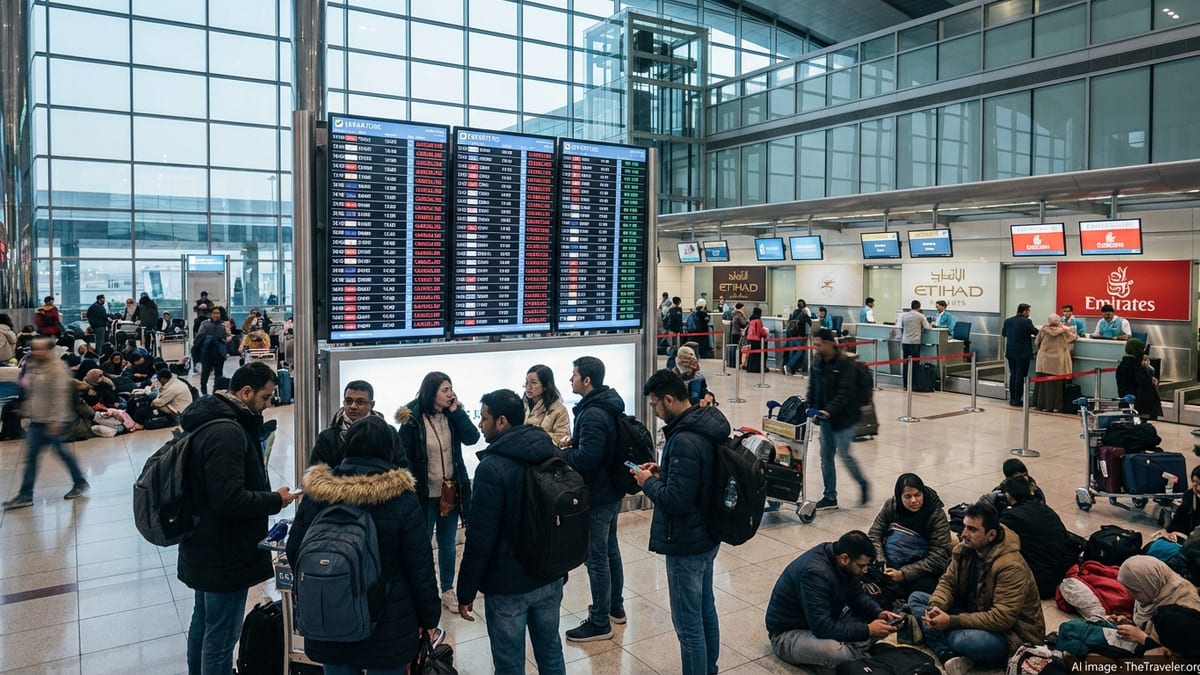
Airport terminals in both Dubai and Abu Dhabi have seen surges of stranded passengers, many of whom were in transit when airspace closures rippled across the Gulf. Airline staff and ground handlers are working to re-accommodate customers on the limited services now operating, with some travellers facing multi-day waits before onward connections become available.
Travel agents in key feeder markets, from Europe and North America to South and Southeast Asia, report a spike in calls from customers seeking clarity on whether to proceed with upcoming trips, reroute via alternative hubs or postpone travel altogether until the security situation stabilises.
UAE’s Status as Global Hub Tested by Geopolitical Risk
The disruptions have highlighted the strategic vulnerability of the UAE’s role as a global aviation crossroads. Dubai and Abu Dhabi together link more than 250 destinations, funnelling traffic between Europe, Asia, Africa and the Americas. Any sustained interruption to operations in the Emirates reverberates quickly through global airline networks, code-share partnerships and cargo supply chains.
Industry analysts note that while Gulf carriers have built sophisticated contingency plans for regional instability, the current conflict is testing those playbooks. The combination of direct attacks, widespread airspace closures and the potential for further escalation raises questions about how much risk airlines and regulators are prepared to absorb in the short term.
For now, aviation authorities appear focused on a stepwise approach, reopening select routes where radar coverage, military coordination and threat assessments support the safe passage of commercial aircraft. But the path back to a full schedule is likely to depend on developments far beyond the control of airline managers: ceasefire efforts, diplomatic pressure and the trajectory of the conflict itself.
The situation also raises broader questions for travellers and the tourism sector about perceived safety in the Gulf. While the UAE has long marketed itself as a secure and predictable hub for international visitors, the images of grounded aircraft and shuttered departure boards this week will linger in the minds of many would-be visitors.
What Travellers Should Do If They Are Booked to the UAE
With Etihad and Emirates only partially restoring services, travel advisers are urging passengers with imminent trips to the UAE or through Gulf hubs to maintain a flexible mindset. Travellers are being encouraged to monitor their booking status frequently, stay attentive to airline notifications and allow generous buffers for connections, particularly when linking long-haul flights.
Those who have not yet started their journey may find it easier to adjust itineraries now rather than wait until they reach a transit hub. Options include rerouting via alternative gateways in Europe or Asia where services remain more stable, or shifting travel dates into mid or late March when airlines hope schedules will be less volatile.
Passengers already in the UAE or stranded in transit are advised to remain in close contact with airline staff at the airport, as in-person teams often have the most current information on seat availability and short-notice aircraft deployments. Hotels and tourism authorities in Dubai and Abu Dhabi have begun coordinating with carriers to provide discounted accommodation for those facing overnight delays.
For many travellers, the coming days will be a test of patience as the UAE’s flagship airlines work to balance safety, international connectivity and mounting passenger frustration. While the resumption of limited flights marks an important step forward, the region’s aviation heartbeat is still far from its usual rhythm.