

More news on this day
Etihad Airways’ rise into the top tier of global safety rankings is strengthening a powerful alliance of Middle Eastern and Asia-Pacific carriers that are driving record tourism flows to the United Arab Emirates, Qatar and Singapore, underpinning a parallel boom for major hotel groups as the industry looks beyond 2026.
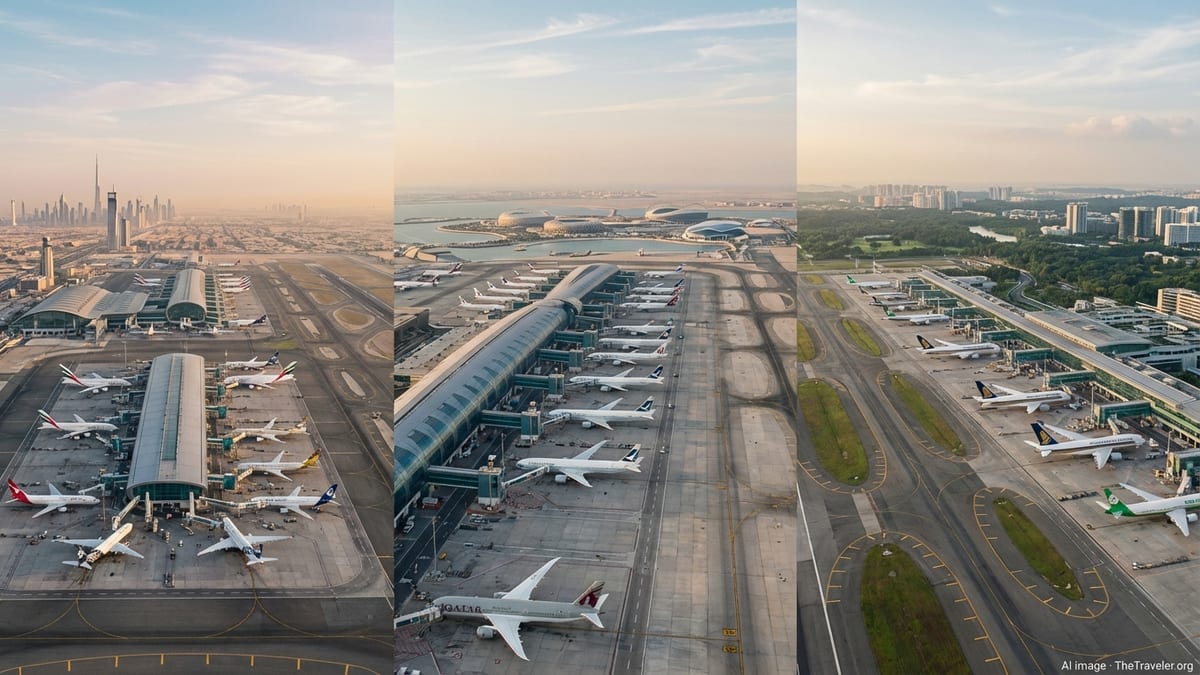
Etihad’s Safety Climb Cements Abu Dhabi’s Global Hub Ambitions
Etihad Airways has solidified its position among the world’s safest airlines, reinforcing Abu Dhabi’s strategy to compete head-to-head with regional heavyweights Qatar Airways and Emirates for long-haul premium traffic. Independent aviation safety assessors now place Etihad inside the global top 10, alongside Air New Zealand, Qantas, Cathay Pacific, EVA Air and Korean Air, after several years of fleet renewal and operational tightening. In widely followed 2025 league tables, the Abu Dhabi carrier is ranked just behind the three-way tie of Qatar Airways, Emirates and Cathay Pacific, a sign of how quickly it has closed the gap with longer established rivals.
Etihad also retains a maximum seven out of seven safety score from specialist rating agencies, reflecting its clean recent accident record and adherence to international audit standards. Analysts say this consistency is helping the airline reposition itself after a restructuring that cut loss-making routes and focused on reliability and service. For high-spending leisure and business travelers weighing multiple one-stop options between Europe, Asia and Australasia, safety rankings are becoming a differentiator in their choice of hub.
The airline’s elevated safety profile dovetails with Abu Dhabi’s broader tourism plans, including new cultural districts, expanded beach and island resorts, and a growing portfolio of global hotel brands. Etihad’s network strategy increasingly mirrors those priorities, adding frequencies to key source markets in Europe, India and East Asia in step with destination marketing efforts. For the emirate, a top-tier flag carrier that can credibly claim world-class safety is central to its pitch as a seamless, low-stress gateway to the wider UAE.
Industry consultants note that Etihad’s progress also raises competitive pressure on smaller regional airlines that lack the resources to match such intensive safety investment. As the market shifts toward data-driven safety rankings updated in real time, carriers with older fleets or patchy audit histories risk being sidelined by risk-averse travelers and corporate travel buyers, further concentrating high-yield demand around the Gulf’s biggest brands.
Qatar Airways, Emirates and Singapore Airlines Anchor a New Tourism Super-Corridor
Alongside Etihad, Qatar Airways, Emirates and Singapore Airlines sit at the heart of an emerging tourism super-corridor stretching from the Arabian Gulf to Southeast Asia. These hub carriers, together with oneworld and Star Alliance partners such as Cathay Pacific, EVA Air, Korean Air and Qantas, now form a tightly interlinked network that offers one-stop access between Europe, Africa, the Americas and the Asia-Pacific. Safety rankings underpin that proposition; both specialist aviation consultancies and consumer-focused indices consistently place the group among the world’s safest and most reliable airlines.
Dubai’s Department of Economy and Tourism reported 9.88 million international overnight visitors in the first half of 2025, a figure that pushed the emirate closer to its ambition of securing a place among the world’s top three city destinations. That momentum follows a record 18.72 million visitors in 2024, underscoring how Emirates’ vast long-haul network and fleet of Airbus A380s continues to funnel traffic into the city at unprecedented scale. Hotel occupancy across the UAE has climbed above 79 percent for 2025 to date, with room revenues rising at a faster pace than guest numbers as higher-spend visitors return.
Qatar has charted a similar trajectory, albeit from a smaller base. Qatar Tourism disclosed that the country welcomed more than 5 million visitors in 2024 and over 1.5 million in the first quarter of 2025 alone, supported by a busy calendar of sports, cultural and business events. Doha’s Hamad International Airport, home to Qatar Airways, has become a critical alternative hub for Europe to Asia flows, especially for travelers prioritizing the airline’s high safety rankings and on-time performance record. Qatar Airways consistently appears in the top tier of global safety and quality indices, bolstering the country’s bid to sustain the post-World Cup tourism uplift.
Farther east, Singapore Airlines remains a linchpin of Southeast Asian connectivity despite temporarily dropping out of some 2025 top 25 safety lists after a rare but high-profile turbulence incident in 2024. Aviation analysts stress that the carrier still holds the maximum safety rating from major agencies and has responded with additional cabin safety briefings and turbulence avoidance protocols. With Changi Airport resuming its role as a premier intercontinental hub, Singapore is benefiting from rising transit-to-stayover conversion as travelers extend stopovers to sample the city’s dining, retail and cultural offerings.
Tourism Surges in the UAE, Qatar and Singapore Reshape Hotel Demand
The combined effect of these high-profile carriers has been to turbocharge tourism flows into the UAE, Qatar and Singapore, reshaping the region’s hotel and real estate markets. In the UAE, government figures for the first nine months of 2025 show 23.27 million hotel guests, a 4.9 percent rise year on year, with more than 79 million room nights sold and sector revenues exceeding 35.9 billion dirhams. Average occupancy rates topped 79 percent across a growing inventory of more than 216,000 keys, signalling that new hotel supply is being quickly absorbed.
Qatar’s hotel sector has followed suit, recording average occupancy of 71 percent in 2024 as the country surpassed its visitor target and approached 10 million annual room nights. Major events such as the AFC Asian Cup, Formula 1 races and Web Summit Qatar have stretched peak-period capacity, prompting accelerated hotel development along Doha’s waterfront and in new mixed-use districts. Visitor arrivals by air remain the dominant channel, highlighting the outsized role of Qatar Airways, but cruise and land arrivals are also climbing as the destination diversifies its access points.
Singapore’s hospitality industry, meanwhile, has capitalised on a rapid rebound in both leisure and corporate travel, with visitor numbers closing in on pre-pandemic levels and average daily rates among the highest in Asia. The city-state’s tight land supply and preference for quality over quantity in hotel development have supported strong pricing power for global chains and independent luxury brands. Network growth by Singapore Airlines and partner carriers such as Scoot, coupled with the return of major conferences and trade shows, has helped restore midweek occupancy and group business, critical segments for the city’s upscale and meetings-focused properties.
Tourism authorities across the three markets are now pivoting from volume-led recovery to a focus on yield, sustainability and visitor experience. That shift plays to the strengths of top-ranked airlines that emphasise safety, service and premium products, attracting higher-spend travelers who are more likely to upgrade cabins, stay longer and book branded hotels. As competition intensifies, destinations without similarly strong flag carriers may struggle to capture comparable high-value demand, even with aggressive marketing.
Marriott, Hilton, Accor and Hyatt Ride the Wave of Aviation-Led Growth
Global hotel groups Marriott International, Hilton, Accor and Hyatt are among the biggest corporate beneficiaries of the aviation-fuelled tourism boom. All four companies have flagged the Middle East and Asia-Pacific as strategic growth regions in recent earnings updates, citing robust performance in the Gulf and Singapore and strong forward booking trends beyond 2026. Development pipelines for branded midscale, lifestyle and extended-stay hotels have expanded sharply, particularly in and around major hub airports and adjoining business districts.
Dubai and Abu Dhabi have emerged as focal points for new upper-upscale and luxury openings, with Marriott adding further St. Regis and W brands, Hilton expanding its Conrad and Waldorf Astoria footprint, Accor rolling out additional Fairmont and Sofitel properties, and Hyatt deepening its presence through Park Hyatt and Andaz. Many of these projects are tightly integrated with new terminal expansions, free trade zones and entertainment precincts, enabling seamless transfers for passengers arriving on Emirates, Etihad and partner airlines. Similar patterns are evident in Doha’s Lusail and West Bay districts, where global chains are anchoring mixed-use towers and waterfront promenades in anticipation of sustained event-led demand.
In Singapore, international brands are leaning into lifestyle concepts and smaller, design-led properties that cater to younger, tech-savvy travelers drawn by low-cost connections and competitive premium fares. Loyalty partnerships between airlines and hotel groups are becoming increasingly important, as cross-earning and status matching encourage passengers flying on carriers such as Singapore Airlines, Cathay Pacific, EVA Air and Korean Air to consolidate their stays with a handful of preferred hotel brands. Executives say these partnerships will be a key driver of repeat business in a more competitive post-2026 landscape.
Developers and investors are also betting on secondary and tertiary cities linked into the hubs of Dubai, Doha and Singapore by the region’s safest carriers. Branded hotel projects along emerging leisure corridors in Saudi Arabia, Oman, Indonesia and Vietnam are frequently marketed around direct or one-stop access with major Gulf and Asian airlines. The assumption, increasingly supported by booking data, is that travelers will follow the paths of least risk and maximum convenience identified by leading safety and reliability rankings.
Safety Rankings Become a Strategic Asset for Airlines and Destinations
The proliferation of annual airline safety surveys and real-time risk dashboards has transformed safety performance from a regulatory baseline into a powerful marketing tool. Specialist sites that track incident data, fleet age, audit results and operational discipline now publish rankings that are closely watched by travelers, corporate travel managers and insurers. In 2025 lists compiled by leading aviation analytics firms, Qantas, Qatar Airways, Air New Zealand, Cathay Pacific, Emirates, Etihad, EVA Air and Korean Air all feature within the global top 15, often separated by only marginal differences in scoring.
Crucially for tourism boards in the UAE, Qatar and Singapore, these rankings reinforce the perception of their hubs as low-risk gateways in an era of heightened traveler sensitivity to safety. Surveys conducted after several high-profile aviation incidents and episodes of extreme turbulence in 2024 show that passengers are increasingly willing to pay a premium, or to accept a slightly longer routing, in exchange for flying with carriers that appear at the top of safety and reliability lists. That trend disproportionately benefits well-capitalised airlines operating under rigorous regulatory regimes and with the scale to invest in training, maintenance and fleet renewal.
The shift toward dynamic, data-driven safety evaluations has also raised the bar for transparency. Platforms that update their scores daily based on incident reports and operational metrics leave little room for airlines to rest on historic reputations. For hubs like Dubai, Doha and Singapore, where national brands are directly associated with the state, sustained strong showings in such rankings support broader narratives around governance, infrastructure quality and investor confidence. Conversely, any slippage would have reputational implications well beyond the aviation sector.
Destinations are beginning to weave safety credentials explicitly into their marketing. Tourism campaigns increasingly highlight not just connectivity and service quality but also the safety accolades of their home carriers and airports. In competitive long-haul markets such as Europe, North America and Northeast Asia, where travelers may be choosing between multiple one-stop routes to Asia or Africa, a top-tier safety ranking can be the deciding factor in favour of a Gulf or Singapore hub, feeding directly into hotel and tour bookings.
Beyond 2026: Capacity, Sustainability and the Next Phase of Growth
Looking beyond 2026, the interplay between aviation safety leadership and tourism expansion raises questions about capacity, sustainability and competitive dynamics. Gulf and Asian hub carriers have placed substantial orders for next-generation widebody aircraft, aiming to increase seats while cutting fuel burn per passenger. As these fleets enter service, airlines will be under pressure to maintain or improve their safety metrics even as they ramp up frequencies on already busy routes and open new city pairs in emerging markets.
On the ground, airports in Dubai, Abu Dhabi, Doha and Singapore are pushing ahead with terminal expansions, automated check-in and baggage systems, and more advanced air traffic management technology. Regulators and safety agencies are closely monitoring how the introduction of artificial intelligence into scheduling, predictive maintenance and crew rostering affects risk profiles. Industry experts caution that while AI can flag anomalies earlier and optimise operations, it also introduces new dependencies that must be managed with robust oversight and human-in-the-loop safeguards.
For the hotel sector, the challenge will be matching aviation-led demand with sustainable, resilient growth. Major groups are committing to stricter emissions targets, greener construction and more efficient water and energy use, particularly in heat-stressed Gulf cities. As travelers become more conscious of their environmental footprint, airlines and hotels that can pair strong safety reputations with credible sustainability strategies may gain an additional edge in attracting high-value guests.
At the destination level, policymakers in the UAE, Qatar and Singapore are working to ensure that the tourism boom does not overwhelm local infrastructure or erode resident quality of life. That means spreading visitor flows more evenly through the year, promoting lesser-known attractions, and encouraging longer stays rather than pure transit traffic. In doing so, they will continue to lean heavily on the global trust placed in their home carriers, from Etihad and Emirates to Qatar Airways and Singapore Airlines, to keep the skies safe while opening new horizons for travel and hospitality in the decade ahead.