

More news on this day
An Etihad Airways service from Abu Dhabi to Washington Dulles has become the focus of an international aviation and legal drama, after a US citizen allegedly assaulted cabin crew mid-flight and now faces federal charges that could put her behind bars for up to 20 years.
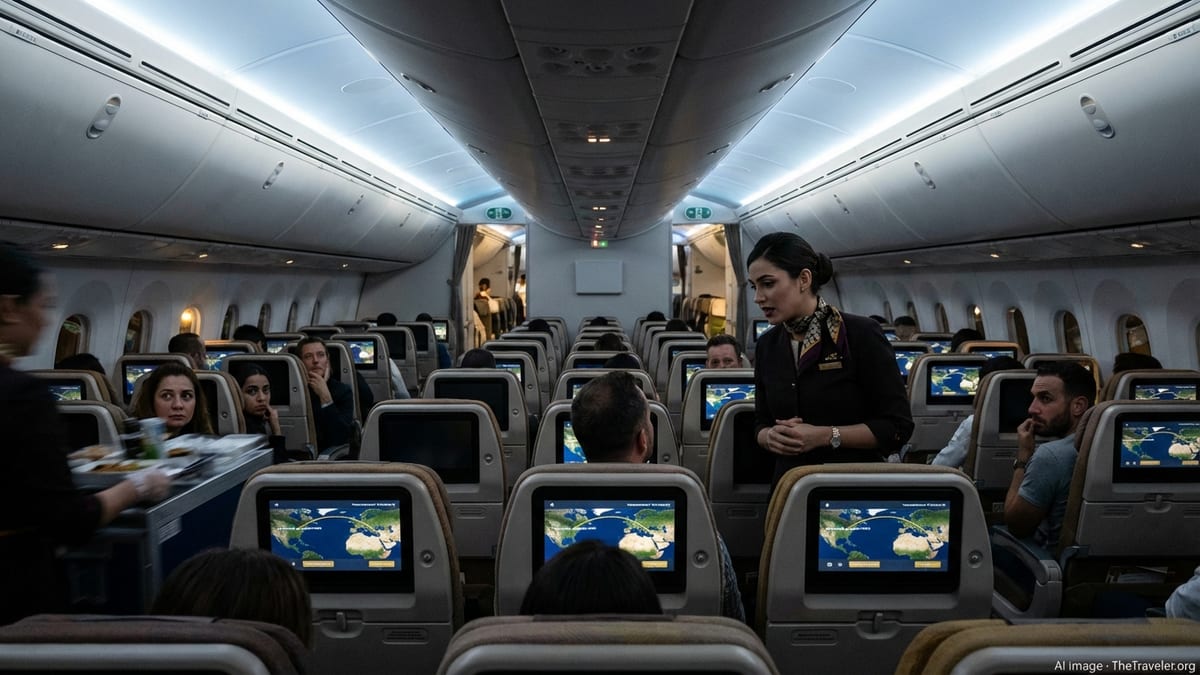
Mid-Atlantic Disturbance on Ultra-Long-Haul Etihad Service
The incident unfolded on February 13 aboard Etihad flight EY5, a nonstop 15-hour service linking Abu Dhabi in the United Arab Emirates with Washington Dulles International Airport, one of the principal US gateways for traffic between the Gulf, Australia and North America. According to an FBI affidavit filed in federal court in Virginia, the disturbance began roughly seven hours into the journey as the Boeing 787 crossed the North Atlantic.
Investigators say the 40-year-old passenger, identified in court documents as Sophiyaa Sahu, became verbally aggressive toward a flight attendant during a meal and beverage service. When crew members attempted to de-escalate the situation and move a service cart away from her seat area, she allegedly responded by kicking the flight attendant in the hip and lower back region while wearing heavy black boots.
Crew reports contained in the complaint describe an escalation in which the passenger is said to have stood on her seat, shouted obscenities audible across the cabin and physically pushed a senior flight attendant several times. The episode, which witnesses estimated lasted up to half an hour, prompted the cockpit crew to request law enforcement meet the aircraft on arrival in Washington.
The flight continued to Dulles without diversion, but the severity of the alleged interference triggered a criminal investigation on the ground. The case now places a spotlight on the intersection of aviation safety, passenger conduct and the strict legal framework that governs behavior on aircraft bound for the United States.
From Cabin Outburst to Federal Courtroom in Virginia
Upon landing at Washington Dulles, Etihad EY5 was met by officers from the Metropolitan Washington Airports Authority Police and federal agents. Sahu was taken into custody at the airport and subsequently interviewed. According to the affidavit, she denied kicking or assaulting crew but admitted she had stood on her seat and delivered what she called a public speech to the cabin.
In her account to investigators, Sahu claimed she had been provoked by inappropriate comments from a crew member and insisted she did not intend to harm anyone. However, statements collected from multiple witnesses, including other passengers seated nearby, reportedly corroborated the crew’s description of the altercation and the physical contact alleged.
Federal prosecutors have charged Sahu with assault and with interference with flight crew members, a serious offense under US aviation law. She has remained in custody since her arrest and is scheduled to appear in a federal district court in Virginia, where the case will move through preliminary hearings before any potential trial.
The proceedings will scrutinize not only the passenger’s conduct but also the crew’s response and the airline’s handling of the incident. For Etihad, which markets its Abu Dhabi to Washington route as a key connector for traffic originating as far away as Australia, the case is an unwelcome test of onboard safety protocols at a time of heightened scrutiny of disruptive behavior on long-haul flights.
What US Law Says About Interference With Flight Crews
At the heart of the case is a statute that has become central to how US authorities police disruptive passengers: interference with flight crew members. Under federal law, it is a crime to intimidate or assault pilots, flight attendants or other crew in a way that interferes with their duties or diminishes their ability to ensure the safety of the aircraft and passengers.
The offense carries a maximum penalty of 20 years in federal prison, with even harsher potential sentences if a dangerous weapon is used or if the interference places the aircraft in jeopardy. While the law is written broadly, prosecutors typically reserve it for cases that involve physical confrontation, sustained intimidation or behavior that forces flight crews to divert or significantly alter their operations.
In recent years, US authorities have pursued a series of high-profile cases involving unruly passengers, reflecting concerns about a surge in reported incidents ranging from mask disputes to alcohol-fueled altercations. Regulators and airline unions have consistently argued that tough enforcement and the threat of long prison terms are necessary deterrents for behavior that can rapidly escalate at 11,000 meters with limited options for intervention.
Legal experts note that not every conviction under the interference statute results in the maximum penalty. Sentencing typically takes into account the duration and severity of the incident, any prior criminal history, whether the aircraft had to divert and the degree of physical injury sustained by crew. Nonetheless, the fact that a routine commercial flight between the UAE and the United States can end with a passenger facing a decades-long sentence underscores how seriously authorities treat cabin safety.
Etihad’s Safety Obligations on Strategic Long-Haul Routes
Etihad Airways, the national airline of the United Arab Emirates, has positioned Abu Dhabi as a global hub connecting Australia, the broader Asia-Pacific region, the Middle East and North America. Its Washington Dulles service is a linchpin in that network, often forming the final leg of journeys that start in cities such as Sydney, Melbourne or Brisbane via Abu Dhabi.
Onboard safety procedures on such ultra-long-haul flights are designed to anticipate not only medical events and technical issues but also behavioral incidents that can become more likely as passengers contend with fatigue, jet lag and confined spaces. Cabin crew are trained to identify early signs of agitation, apply de-escalation techniques and, where necessary, use onboard restraint equipment.
In this case, crew testimony suggests they prepared a restraint kit but did not ultimately deploy it after the passenger appeared to calm down and remained seated for the remaining hours to Washington. That decision will likely be examined in court, along with whether the airline followed its internal guidelines and international standards for managing disruptive behavior.
Etihad has not publicly detailed its internal review of the episode, but like other major carriers it emphasizes a zero-tolerance approach to violence or threats against staff. The airline also participates in information-sharing arrangements and safety committees that span the UAE, Australian and US aviation systems, reflecting the cross-border nature of the flights it operates.
Australia–UAE–US Travel Corridor Under the Microscope
Although the passenger at the center of the case is a US citizen, the incident resonates across the Australia–UAE–United States travel corridor, where Etihad and other Gulf carriers play a critical role in connecting Australian travelers with North America. Many itineraries between Australian capitals and US East Coast cities rely on single-stop connections in Abu Dhabi, Doha or Dubai.
Australia’s growing reliance on Middle Eastern hubs has already triggered debate about consumer protections, rerouting options and safety assurances, particularly during periods of regional tension. Previous disputes between Australian passengers and carriers over route changes and perceived security risks have highlighted gaps between marketing promises of seamless journeys and the complex realities of multi-jurisdiction air travel.
Events on board EY5 serve as a reminder that once an aircraft leaves UAE airspace on a US-bound leg, US federal law becomes a defining authority over passenger behavior, even if the journey began in Australia or another third country. Travelers may board in Sydney under one legal framework, transit in Abu Dhabi under another and then become subject to US criminal law at cruise altitude over the Atlantic.
For Australian passengers, many of whom use Abu Dhabi as their first entry point to US preclearance facilities, the case underscores the importance of understanding the jurisdictional patchwork that governs every segment of a long-haul itinerary. Actions taken in the cabin on a final US-bound leg can carry consequences far beyond missed connections or denied boarding.
Jurisdiction, Passenger Rights and Airline Responsibilities
The EY5 incident also highlights the complex question of jurisdiction that arises when something goes wrong on an international service spanning multiple countries. As a UAE-based carrier, Etihad is regulated by authorities in Abu Dhabi and must comply with national aviation requirements. Once its aircraft traverse international airspace and land in Washington, however, US jurisdiction governs criminal allegations arising from events onboard.
In practice, that means cabin crew and airline representatives must be prepared to document incidents in a manner that satisfies both their national regulators and foreign prosecutors. Written reports, witness statements and, increasingly, digital evidence such as cabin video can all become part of a cross-border investigation.
From the passenger’s perspective, protections and obligations are equally layered. Carriage contracts, airline conditions of travel, UAE regulations and US federal law may all apply at different moments of a single journey. While passengers enjoy rights related to care during delays, rerouting in case of cancellations and redress for lost baggage, those civil entitlements sit alongside stringent obligations not to jeopardize safety or disrupt crew.
Consumer advocates say incidents like this one reinforce the need for clearer communication to long-haul travelers, including those originating in Australia, about the legal environment on US-bound flights. Briefings during check-in, boarding announcements and preflight information could help reduce misunderstandings about the potential consequences of arguments, intoxication or refusal to follow crew directions.
Growing Global Focus on Unruly Passenger Behavior
The case comes at a time when airlines and regulators worldwide are grappling with a steady stream of reports about unruly passengers across international networks. Carriers in the Middle East, Australia and North America have all tightened their policies, from restricting alcohol service to encouraging crew to report every significant disturbance to authorities.
Industry associations have called for harmonized rules that make it easier to prosecute serious cases regardless of where an airline is based or where an incident occurs en route. While conventions such as the Montreal Protocol provide a framework, enforcement still depends heavily on cooperation between national authorities and the willingness of airlines to press charges.
Etihad’s Washington flight is hardly the first to see a midair confrontation end in arrest at Dulles, but the possibility of a 20-year sentence gives this case particular visibility. It may influence how airlines brief their staff and passengers, as well as how courts in destination countries weigh deterrence against individual circumstances when imposing penalties.
For global travelers, especially those stitching together journeys from Australia through Gulf hubs to North America, the message is increasingly clear. International aviation is not only a network of routes and alliances but also a web of legal obligations that can follow a passenger long after the cabin lights dim and the aircraft crosses another invisible border.