

More news on this day
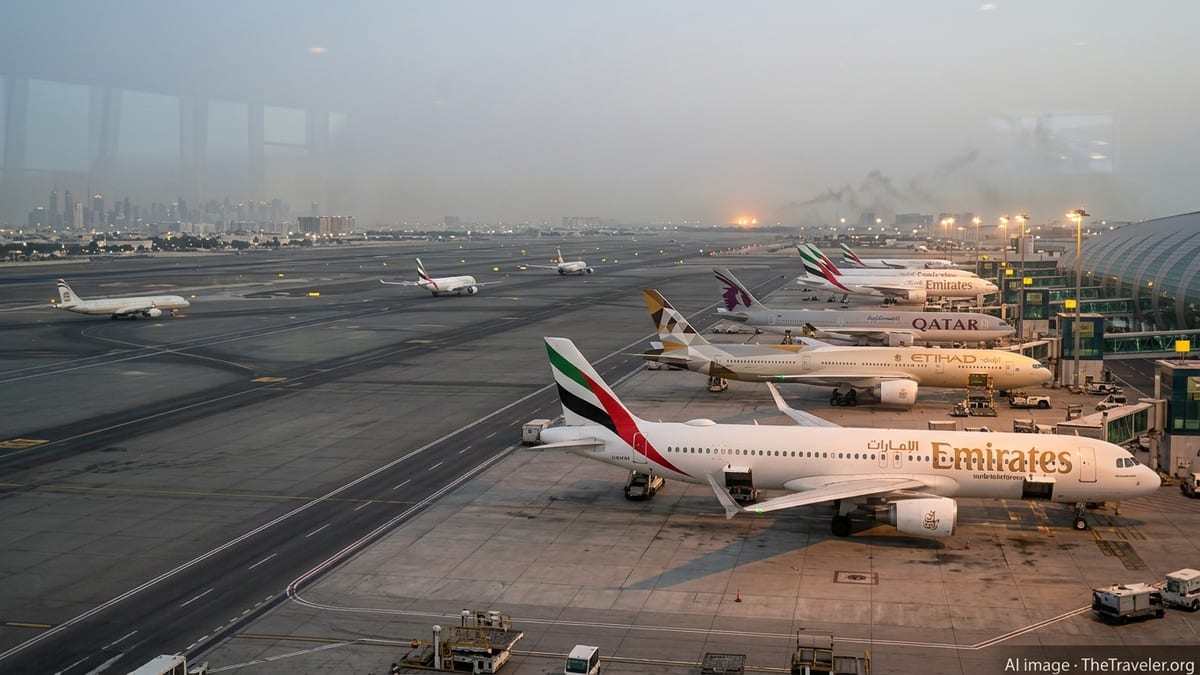
Four weeks after the outbreak of the Iran war triggered cascading airspace closures across the Gulf, the region’s three megahub carriers Etihad Airways, Emirates and Qatar Airways are still running constrained, constantly shifting schedules as they navigate missile threats, emergency restrictions and a historic collapse in east–west connectivity.
Get the latest news straight to your inbox!
From Sudden Shutdowns To Patchy Reopenings
The first strikes on February 28 led to an almost immediate halt in routine civil aviation over Iran and much of the surrounding region. Airspace closures rapidly spread to Iran, Iraq, Israel, Kuwait, Qatar, Bahrain and the United Arab Emirates, freezing traffic at the key connecting hubs of Dubai, Abu Dhabi and Doha and cancelling thousands of flights in a matter of days, according to aviation and government advisories.
Publicly available data from aviation analytics firms shows that on the initial weekend alone, more than 3,000 flights were cancelled worldwide, with Gulf hubs at the epicentre. Coverage in international outlets reported that Emirates, Etihad and Qatar Airways typically move close to 90,000 passengers per day through their hubs in normal times, underscoring the scale of the abrupt stoppage.
By the second week of March, the blanket shutdown had eased into a patchwork of reopenings and restrictions. Reports from risk consultancies and logistics providers describe Iranian airspace as effectively closed, with Kuwaiti and Bahraini airspace also shut, while the UAE and Qatar introduced tightly controlled corridors and emergency traffic management rules. Within this framework, the three major Gulf carriers began cautiously restoring limited services.
Etihad Airways: Limited Network Out Of Abu Dhabi
Abu Dhabi based Etihad was among the first Gulf carriers to signal a path back to scheduled operations. Travel advisories from global freight and security firms note that Etihad resumed a restricted commercial passenger schedule from March 6, prioritising key trunk routes to Europe and Asia that could avoid the most heavily militarised zones.
Public information indicates these flights are operating under Emergency Security Control of Air Traffic procedures in Emirati airspace, with defined corridors that keep aircraft away from active missile and drone interception areas. Intelligence briefings highlight that parts of UAE airspace remain subject to rapid, short notice closures when incoming projectiles are detected, forcing dynamic rerouting and occasional last minute diversions or returns to origin.
For travellers, this has translated into unpredictable delays, elongated routings and short term cancellations. Travel alerts from corporate mobility providers advise that Etihad is focusing capacity on repatriation, essential business travel and connecting flows that do not require overflight of Iran or Iraq, while maintaining flexible rebooking policies as the situation evolves day by day.
Emirates: Flagship Hub Under Missile Shadow
Dubai based Emirates, the largest of the three Gulf super-connectors, has faced some of the most visible disruption. Early in the conflict, publicly available statements cited in international coverage show that Emirates suspended regular scheduled services for a period, operating only limited evacuation and special flights as air defences around Dubai intercepted waves of drones and missiles.
Subsequent reporting from regional media and security advisories indicates that Dubai International Airport has since reopened on a reduced basis, with Emirates progressively rebuilding its route map. However, the carrier continues to work within a constrained airspace environment, with some departures temporarily grounded during interception events and others rerouted along longer southern tracks via Saudi Arabia and Oman.
Aviation analysts quoted in specialist transport coverage point out that these detours can add two to five hours to typical Europe Asia itineraries. That has immediate implications for aircraft utilisation, crew duty times and fuel costs, which in turn are beginning to pressure Emirates’ traditionally strong margins. For passengers, longer block times and irregular operations are resulting in missed connections, overnight stays and mounting backlogs at Dubai hotels and transit facilities.
Qatar Airways: Designated Contingency Routes Around A Closed Iran
In Qatar, the Civil Aviation Authority has announced that flights are using designated navigational contingency routes with limited capacity, coordinated with national defence forces. Publicly available situation reports describe Hamad International Airport in Doha as operational but heavily constrained, with Qatar Airways funnelling traffic through narrow, preapproved corridors that skirt Iranian airspace and avoid other high risk areas.
Industry bulletins note that aircraft on some routes are departing with transponders off for parts of their journeys as a precaution, making them less visible on commercial tracking platforms even as they remain under air traffic control. Capacity through Doha remains significantly below prewar levels, and priority is being given to repatriation, essential government related travel and cargo flows that cannot easily shift to sea.
For transit passengers, Doha’s role as a global connection point has been sharply reduced. Travel risk consultancies advise that itineraries involving multiple Gulf transfers are particularly vulnerable to rolling disruption, and recommend that corporate travellers route via alternative hubs in Europe or Asia where possible while the contingency routing regime remains in place.
Detours, Delays And The Wider Travel Picture
Four weeks into the conflict, the combined effect of closures over Iran, Iraq and parts of the Gulf has redrawn the map of east west aviation. Route mapping compiled by aviation specialists shows a heavy concentration of traffic along remaining corridors over Saudi Arabia, Egypt and the eastern Mediterranean, pushing air traffic controllers to manage many more aircraft in limited airspace and contributing to secondary delays well outside the immediate conflict zone.
According to open source estimates referenced in economic analyses of the war, total daily flight cancellations linked to Middle Eastern airspace restrictions have at times exceeded 4,000, with hundreds of thousands of travellers either stranded or forced into complex rerouting. Etihad, Emirates and Qatar Airways, normally among the most reliable global connectors, have become emblematic of a broader loss of predictability in international travel through the region.
Travel advisories from governments and security firms continue to urge caution for nonessential journeys to or through the Gulf. Many point out that while technical safety standards remain high, the operational environment is volatile, with the possibility of sudden escalations prompting new closures or changes in routing at short notice. For now, the three major Gulf carriers are operating in a holding pattern, balancing their role as critical connectors against the realities of a war that has fundamentally altered the skies above them.