

More news on this day
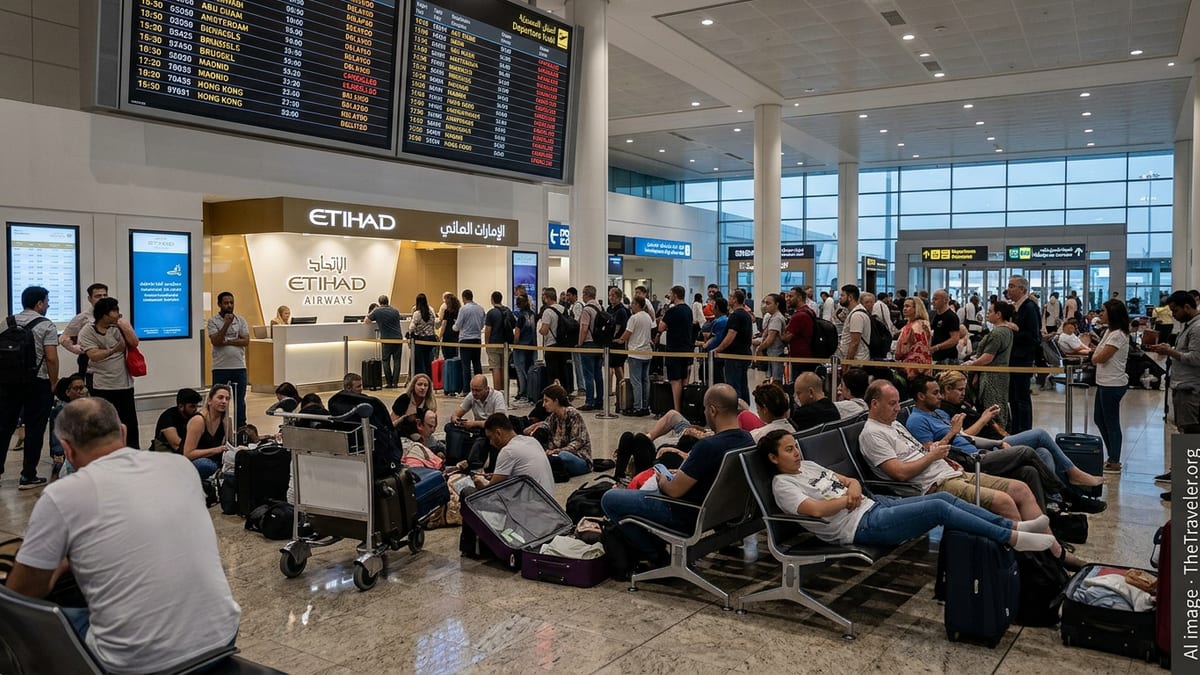
Etihad Airways passengers across Saudi Arabia, Spain, the Netherlands and Hong Kong are facing severe travel disruption this week, as a wave of cancellations and lengthy delays has left travelers stranded in Abu Dhabi, Amsterdam, Brussels and other major hubs amid ongoing airspace and operational upheaval.
Limited Schedule Struggles to Contain Widespread Disruption
The disruption follows days of airspace closures and capacity constraints that forced Etihad to ground most of its network before gradually resuming a reduced commercial schedule from March 6. The Abu Dhabi based carrier is now operating a trimmed list of around 70 destinations, but a backlog of passengers and constrained aircraft rotations continue to trigger cancellations and rolling delays across its system.
Operational data and passenger reports point to at least 17 Etihad flights cancelled and 29 delayed over recent days, affecting key routes between Abu Dhabi and cities in Saudi Arabia, Spain, the Netherlands and Hong Kong. The pattern has been particularly acute on services linking Abu Dhabi with Amsterdam and Brussels, where multiple rotations have been pulled or retimed at short notice as the airline reshuffles aircraft and crew.
Etihad has urged travelers not to go to the airport unless they have a confirmed booking on one of the limited flights now operating and have received direct confirmation that their service is running. The airline continues to stress that its reduced schedule, currently published through March 19, remains subject to change as airspace conditions and operational constraints evolve.
Despite the resumption, many passengers who were due to travel earlier in March remain displaced around the network, relying on rebookings, ad hoc relief flights and alternative routings. Large numbers of transit passengers in Abu Dhabi are still trying to complete journeys to Europe and Asia, putting additional pressure on the truncated timetable.
Abu Dhabi Hub Under Strain as Transit Passengers Pile Up
Abu Dhabi’s Zayed International Airport, Etihad’s primary hub, has become a focal point of the disruption as thousands of transit passengers find themselves stranded between legs of long haul itineraries. Travelers bound for destinations such as Madrid, Barcelona, Amsterdam, Brussels and Hong Kong have described long waits for rebooking, limited onward options and uncertainty over when normal connections will resume.
With aircraft and crew out of position following earlier blanket suspensions, Etihad’s priority has been to re establish core trunk routes while gradually re accommodating passengers on a first available basis. Airline representatives have acknowledged that some travelers are being offered alternative departure dates many days ahead, reflecting the limited seat availability on the reduced schedule.
Airport staff in Abu Dhabi have been working to manage crowded transfer areas and provide meal vouchers and hotel accommodation where possible, but demand has frequently outstripped capacity. Travelers transiting from Saudi Arabia and other Gulf states have reported overnight stays and multiple missed onward flights as rolling delays cascade through the network.
The situation has been complicated further by discrepancies between flight status information on airline and airport systems, with some passengers discovering cancellations via airport departure boards or third party trackers before receiving official airline notifications. This has fueled frustration among travelers already grappling with long queues at service desks and extended waits for call center assistance.
European Gateways Amsterdam and Brussels Hit Hard
In Europe, Amsterdam Schiphol and Brussels Airport have emerged as two of the hardest hit Etihad destinations. Multiple passengers booked on services between these airports and Abu Dhabi report repeated cancellations or significant retimings, leaving them with limited rerouting options at the start of the busy spring travel period.
Travelers departing from the Netherlands and Belgium have described arriving at the airport to find their Etihad flights marked as cancelled or substantially delayed, sometimes while the carrier’s own digital channels still showed them as scheduled. In several cases, passengers say they waited hours at check in counters only to be informed that the next available Etihad seat to Abu Dhabi or beyond would not be for several days.
The knock on effects have been particularly acute for long haul itineraries using Amsterdam or Brussels as gateways to destinations in Asia and the Middle East. Passengers bound for Saudi Arabian cities, Southeast Asia and Australia via Abu Dhabi have had to scramble for last minute alternatives on other carriers, often at significantly higher fares as regional capacity tightens.
Airports and local travel agents in both cities are fielding a surge in inquiries from affected Etihad customers seeking guidance on refunds, rebookings and accommodation. While the airline has expanded eligibility for free changes and refunds on tickets issued before the disruption, many travelers remain confused about their rights under different jurisdictions and fare types.
Spain, Saudi Arabia and Hong Kong Feel the Ripple Effect
The shockwaves from Etihad’s curtailed schedule are also being felt strongly in Spain, Saudi Arabia and Hong Kong, which all rely on Abu Dhabi as a key connecting point. Services to Madrid and Barcelona are operating on a reduced basis, and with many seats already allocated to previously stranded passengers, new disruptions can quickly leave travelers with limited alternatives.
Saudi Arabia, which has close religious and business ties with the United Arab Emirates, has seen significant knock on impacts from the reduced connectivity. Pilgrims and workers traveling between Saudi cities and long haul destinations via Abu Dhabi have faced last minute changes, unexpected overnight stops and the risk of missing time sensitive commitments. Local travel agencies report high demand for seats on any remaining services operated by rival Gulf carriers.
In Hong Kong, where Etihad normally provides a key link to Abu Dhabi and onward to Europe and the Middle East, disruptions have forced some passengers to reroute via alternative Asian or Gulf hubs. Industry observers note that reduced frequencies and irregular operations are putting pressure on hotel availability and raising trip costs for travelers who suddenly find themselves needing multi night stays while waiting for seats to open up.
Across these markets, corporate travel managers are revisiting itineraries and contingency plans for employees due to transit through Abu Dhabi in the coming weeks. Many are advising business travelers to allow extra buffer days for critical meetings or to consider routings that avoid the most heavily affected corridors until reliability improves.
Airline Response, Passenger Rights and What Travelers Can Do
Etihad has issued a series of operational updates and travel advisories, encouraging customers to check flight status frequently and to avoid heading to the airport without confirmation that their service will operate. The airline is offering fee free rebooking and refunds for many affected tickets issued before the disruption period, and has extended travel validity for customers willing to postpone their journeys.
Passenger rights in this situation vary depending on point of departure and applicable regulations. Travelers departing from European Union airports such as Amsterdam and Brussels may be entitled to assistance, refunds or rerouting under European air passenger rules in certain circumstances, although airlines can invoke extraordinary circumstances to limit monetary compensation when disruptions stem from airspace closures or security concerns.
Consumer advocates are urging passengers to document communications with the airline, keep receipts for hotels, meals and alternative transport, and to seek written confirmation of any waivers or special policies offered. Travel insurance policies may provide additional cover for extended delays or forced itinerary changes, but benefits differ widely between providers.
For those yet to travel, industry experts recommend monitoring airline channels closely, ensuring contact details are up to date in bookings, and considering flexible fares or alternative routings where possible. With Etihad’s reduced schedule currently planned to run at least through mid March, travelers connecting through Abu Dhabi, Amsterdam, Brussels, Hong Kong and affected cities in Saudi Arabia and Spain should be prepared for further last minute adjustments as the carrier continues to stabilize its network.