

More news on this day
Etihad Airways passengers are navigating a turbulent period marked by reduced flight options across parts of the Middle East, evolving refund and rebooking waivers, and a spike in online scams impersonating the airline and its partners.
Get the latest news straight to your inbox!
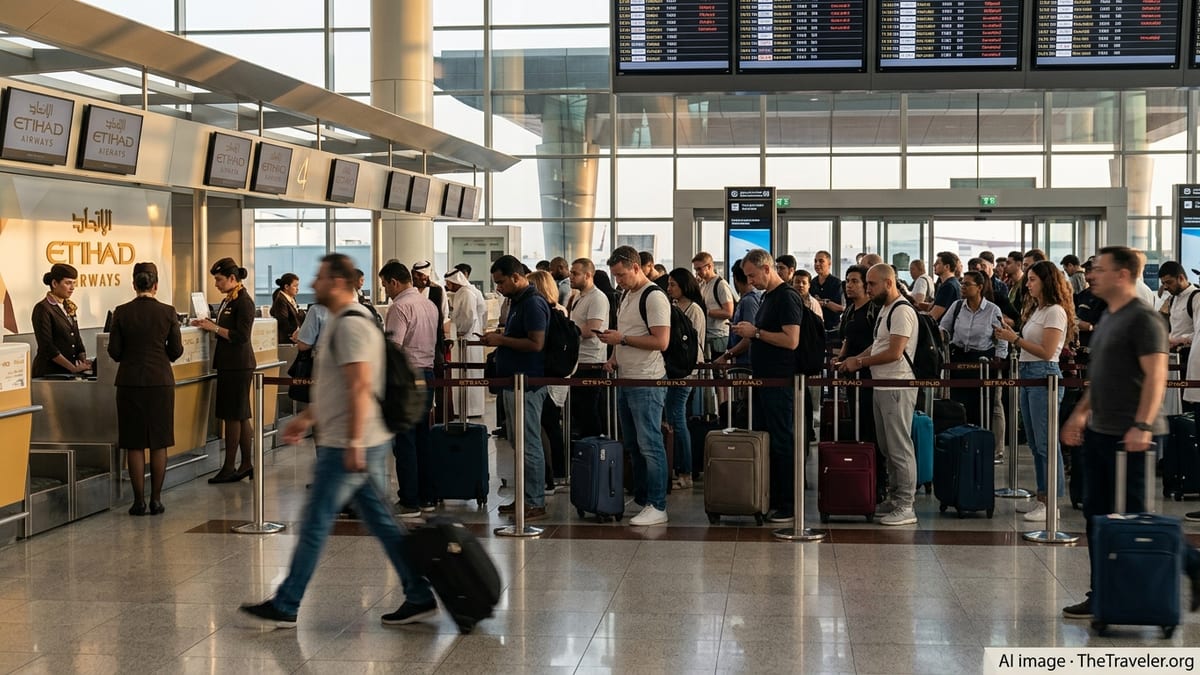
Why Etihad Flights Are Limited and Who Is Affected
Flight schedules operated by Etihad Airways remain under strain as airspace restrictions and wider regional instability continue to affect routes across parts of the Middle East. Publicly available information shows that airspace closures and reroutings over countries such as Iran, Iraq, Israel and Syria have disrupted thousands of services in recent months, forcing Gulf carriers to thin out schedules, consolidate flights and suspend certain destinations altogether.
Etihad’s network has been particularly impacted on routes that either overfly or connect through these affected corridors. Reports from travel industry bulletins and passenger accounts indicate that cancellations and significant schedule changes have hit long haul itineraries linking North America, Europe and Asia via Abu Dhabi, as well as point to point flights within the wider region. Some travelers departing or transiting Abu Dhabi have described last minute changes, rolling delays and aircraft substitutions as the airline reacts to rapidly changing operational conditions.
These disruptions are not uniform across the network. Many Etihad routes remain operational, but passengers with travel dates in late February and March 2026, especially those ticketed before the current crisis escalated, appear to face the greatest uncertainty. Travelers with multi segment journeys, separate tickets or onward low cost connections are particularly exposed, since a cancellation or schedule shift in one segment can unravel an entire itinerary.
Published coverage from aviation and travel advisory outlets stresses that further adjustments remain possible if the security and airspace situation develops. Passengers are being encouraged to monitor their booking status closely in the days leading up to departure, rather than assuming that a previously confirmed itinerary will operate unchanged.
Free Rebooking, Refunds and What Current Waivers Offer
In response to ongoing disruption, Etihad has activated a specific waiver for guests affected by the “Middle East situation.” According to guidance published on the airline’s trade and agency portal, customers holding Etihad tickets issued on or before 28 February 2026, with original travel dates from 28 February to 31 March 2026, may rebook free of charge onto Etihad operated flights up to mid May 2026, subject to availability and certain fare rules. Industry documentation refers to this as a structured waiver linked to a dedicated code that must be inserted into the booking by agents processing changes.
Reports from passengers and travel agents suggest that where a flight is cancelled due to airspace restrictions or operational decisions, Etihad is offering either free rebooking within the waiver window or a refund of the unused portion of the ticket. Standard conditions published in the airline’s rules and notices state that guests are entitled to a refund if a flight is cancelled and they choose not to travel, with compensation or alternative transport depending on the cause of disruption, the length of delay and local regulations.
However, experiences shared by travelers show that the process is not always straightforward. Customers who booked through online travel agencies or credit card portals often need to request rebooking or refunds via the original booking channel, even when airline waivers are in place. Some passengers report being quoted cancellation fees that appear inconsistent with the published Etihad policy, until agents are provided with the relevant waiver details. Others describe long wait times on phone lines and chat services as call centers contend with high volumes.
Travel experts recommend that affected passengers keep detailed records including booking references, original and new flight details, screenshots of airline advisories, and any written confirmation of waivers. When dealing with intermediaries, presenting the exact wording of the current Etihad waiver and politely insisting on its application can help align outcomes with what the airline has publicly committed to offer.
Rising Online Fraud Targeting Etihad Customers
As disruption has intensified, cybercriminals have increasingly targeted travelers searching for help with their Etihad bookings. Recent reporting by European and Middle Eastern travel media describes an uptick in fake social media accounts replying to public posts directed at Gulf carriers, including Etihad. These impostor profiles often use logos and profile images resembling official airline branding, and then attempt to move conversations to private messages or external platforms where victims are asked to share personal data or payment details.
Security firms also highlight a wave of phishing emails and fake websites that misuse major airline names such as Etihad to impersonate supplier portals, vendor registration platforms or customer service channels. Some fraudulent domains are configured to redirect to the genuine airline site after a short delay, creating the impression of legitimacy while still harvesting user data or encouraging downloads of malicious attachments. Generic “helpline” numbers embedded in unsolicited policy documents or pop up sites are another frequent tactic, particularly targeting passengers seeking urgent rebooking assistance.
Travel risk specialists warn that heightened anxiety around cancellations and visa deadlines makes passengers more likely to respond quickly to unsolicited messages that appear to offer solutions. Scammers exploit keywords such as “urgent,” “refund approved,” or “free rebooking” to encourage immediate action before travelers verify the authenticity of the communication.
Industry guidance from aviation bodies emphasizes that online fraud attempts routinely spike during major travel disruptions, when large numbers of passengers are simultaneously trying to change plans. As Etihad’s situation evolves, this pattern appears to be repeating, with a growing ecosystem of fraudulent accounts, lookalike websites and misleading phone numbers circulating on social platforms and search results.
How to Safeguard Your Etihad Bookings and Personal Data
Specialists in cyber security and consumer protection outline several practical steps for Etihad customers trying to protect their bookings and personal information. First, travelers are urged to rely only on contact details and digital channels listed directly on the official Etihad website or mobile app. That includes customer service numbers, live chat functions and social media handles. Searching for “Etihad hotline” or “Etihad rebooking number” on general search engines can surface sponsored links and search results that belong to third party call centers or outright scams rather than the airline itself.
Second, passengers are advised to approach unsolicited messages with caution, even when they appear to reference genuine disruption. If a direct message or email about your flight arrives without you first contacting the airline, verifying its authenticity is essential. Cross checking the sender’s address, social media handle, spelling of the airline name and the domain of any links can help uncover impostors. Security experts recommend navigating to the airline’s website manually instead of clicking embedded links, and entering your booking reference only via the official “manage booking” or app interface.
Third, travelers should be wary of anyone requesting payment via informal channels such as money transfer apps, cryptocurrency or vouchers in exchange for “priority rebooking” or “guaranteed refunds.” Published warnings from regulators and consumer agencies consistently note that legitimate airlines, including Etihad, process changes and refunds through standard payment gateways and do not request sensitive information like full card details or account passwords over social media or messaging apps.
Finally, passengers who suspect they have interacted with a fraudulent Etihad related account or website are encouraged by cyber security guidance to immediately stop communication, avoid sending further information, and contact their bank or card issuer if any payment data was shared. Saving screenshots and transaction records can assist later if a dispute or investigation becomes necessary. While these steps do not undo the disruption to travel plans, they can help limit financial and identity theft risks during an already stressful period.
Planning Ahead Amid Ongoing Uncertainty
With regional airspace conditions still fluid as of late March 2026, travel analysts expect Etihad’s schedules and waivers to remain under review. Passengers planning new trips via Abu Dhabi in the coming weeks are being encouraged by industry commentators to build additional flexibility into itineraries. That may include longer connection times, fully refundable or changeable hotel bookings, and careful attention to visa conditions in case delays or reroutings extend time spent in transit countries.
For travelers who already hold Etihad tickets within the affected period, regularly checking booking status and airline advisories is becoming a routine pre departure task. Many customers are logging into their reservation multiple times in the week before travel to monitor schedule changes, seat assignments and aircraft type updates that may hint at consolidation of flights or load management efforts by the airline.
More broadly, travel professionals suggest that events affecting Etihad underscore the value of understanding airline terms at the time of purchase. Knowing in advance how a carrier handles cancellations, involuntary changes and overbooking, and whether travel insurance or credit card protections apply to regional instability, can significantly influence how exposed a passenger feels when conditions worsen. For now, Etihad customers are balancing the allure of global connectivity through Abu Dhabi with a new level of vigilance about policy fine print and online safety.