

More news on this day
Etihad Airways has suspended all flights to and from Abu Dhabi until the early hours of Monday, 2 March 2026, after sudden regional airspace closures linked to escalating military tensions forced the Gulf carrier to halt operations at its Zayed International Airport hub.
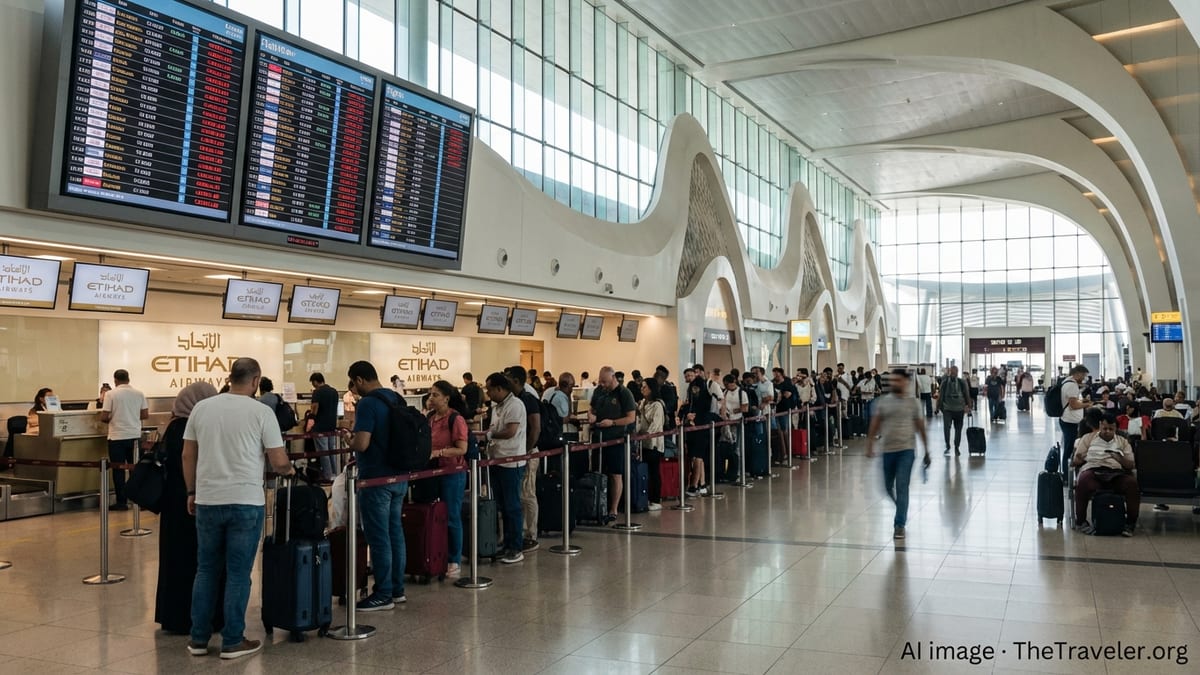
Etihad Confirms Full Suspension of Abu Dhabi Operations
In a statement issued on Sunday, 1 March, Etihad Airways said that ongoing regional airspace closures were continuing to disrupt its network, prompting the airline to extend an earlier partial suspension into a full halt of passenger services to and from Abu Dhabi. All Etihad flights operating in and out of the UAE capital are now on hold until 02:00 UAE time on Monday, 2 March.
The airline stressed that the measure was necessary in light of evolving security conditions across the region and the closure of key flight corridors used by Gulf carriers. Services already en route have been diverted or returned to their origin airports where required, while departures from Abu Dhabi remain grounded.
The decision follows a series of stepwise restrictions over the weekend, when Etihad initially suspended departures and cancelled arrivals into Abu Dhabi up to Sunday afternoon before extending the shutdown as airspace restrictions widened. The carrier said it would restart operations only when authorities confirm that routes can be safely reopened.
Etihad reiterated that the safety of passengers and crew is its highest priority and apologised for the disruption to travel plans, acknowledging that schedules may continue to change at short notice as the situation develops.
Regional Conflict Triggers Widespread Airspace Closures
The suspension comes amid a sudden deterioration in regional security following coordinated strikes involving the United States, Israel and Iran, which have led multiple Middle Eastern states to close their airspace to civilian traffic. Authorities in the United Arab Emirates, along with several neighbouring countries, have temporarily shut key flight corridors, forcing airlines to halt or reroute services across the Gulf.
Hub airports in Abu Dhabi, Dubai and Doha have been particularly affected, with hundreds of flights cancelled or diverted and knock-on delays reported across Europe, Asia and Africa. Analysts say the closures are among the most severe disruptions to Gulf aviation in recent years, affecting tens of thousands of passengers who rely on the region’s carriers and airports as vital long-haul transit points.
Local authorities reported at least one drone interception near Abu Dhabi’s Zayed International Airport over the weekend, with debris falling in the vicinity of the airfield and causing casualties. The incident heightened security concerns and reinforced the decision to keep airspace tightly controlled while assessments continue.
Aviation experts warn that even after airspace begins to reopen, airlines may face days of operational challenges as aircraft and crews are repositioned and backlogs of passengers cleared. Carriers are expected to prioritise safety-driven route planning over schedule recovery in the immediate term.
What Affected Etihad Passengers Can Expect
Etihad has advised all customers booked to travel to, from or through Abu Dhabi up to the suspension deadline to check the status of their flights before leaving for the airport. The airline is asking guests to ensure their contact details are updated in their bookings so they can receive real-time notifications of cancellations, delays and rebooked itineraries.
Passengers holding tickets issued on or before 28 February 2026 for travel up to 2 March are being offered flexible options, including complimentary rebooking on Etihad-operated flights through mid-March or the ability to request a full refund via the airline or their travel agent. Those who booked through third-party agencies have been urged to contact their agent directly to manage changes.
Etihad has acknowledged long waiting times on its call centres and has encouraged travellers to use digital self-service channels where possible. Airport staff in Abu Dhabi and at key outstations are assisting stranded customers with re-routing, meal vouchers and hotel accommodation where required, though availability is tight due to the scale of the disruption.
Travel industry observers note that passengers with complex itineraries involving multiple carriers may face additional challenges, as onward flights operated by partner airlines could also be affected by the same airspace closures or by congestion on alternative routes.
Knock-on Impact Across Global Travel Networks
Etihad’s move mirrors similar suspensions and schedule reductions by other Gulf and regional airlines, which have been forced to cancel services or take significantly longer detours around closed airspace. Major carriers based in Dubai and Doha have curtailed operations, while several international airlines in Europe and Asia have temporarily halted flights into the wider region.
The ripple effects are being felt far beyond the Middle East, with airports in India, Turkey and parts of Europe reporting waves of diverted traffic, last-minute cancellations and extended ground delays. Travel agencies in key source markets such as the United Kingdom, Germany and Australia are working to rebook holidaymakers and business travellers stranded mid-journey.
Airlines are also contending with higher fuel burn and crew duty-time limits on lengthened routings, which can force additional unscheduled stopovers or make some services temporarily unviable. Industry analysts say these operational realities may continue to constrain capacity even after some airspace corridors reopen, potentially pushing up fares on certain routes in the short term.
Airports and civil aviation regulators across the region are coordinating closely with military and security authorities to map out safe corridors and phased reopening plans. However, officials have cautioned that rapidly changing security assessments could necessitate further last-minute changes, and that passengers should remain prepared for ongoing uncertainty over the coming days.
Guidance for Travellers Planning Upcoming Trips
For travellers with imminent plans involving Abu Dhabi or other Gulf hubs, aviation and travel experts are advising a cautious, flexible approach. Passengers are being urged to monitor airline communications closely, avoid heading to the airport without a confirmed flight status and build in additional time for connections once services resume.
Those yet to start their journey are encouraged to consider whether their trip is essential, particularly if it relies on multiple connections through affected hubs. Travel agents suggest that, where possible, customers should keep itineraries on a single ticket with one carrier or alliance to simplify rebooking and assistance if further disruptions occur.
Industry sources say that while some regional routes may reopen quickly once authorities give clearance, long-haul schedules could take longer to normalise as airlines gradually restore frequencies and reposition aircraft. Travellers with flexible dates may find it easier to secure seats later in March, when airlines expect operations to be more stable.
With the situation in the region still evolving, Etihad and other Gulf carriers have reiterated that safety and regulatory compliance will govern all decisions on when and how to restart services. Until then, passengers are being advised to stay informed, maintain up-to-date contact details with their airline and be ready for plans to change at short notice.