

More news on this day
Etihad Airways is adjusting its operations and customer policies as regional airspace disruptions and congestion around Abu Dhabi continue to affect parts of its global network, prompting new guidance for travelers on rebooking, refunds and passenger rights.
Get the latest news straight to your inbox!
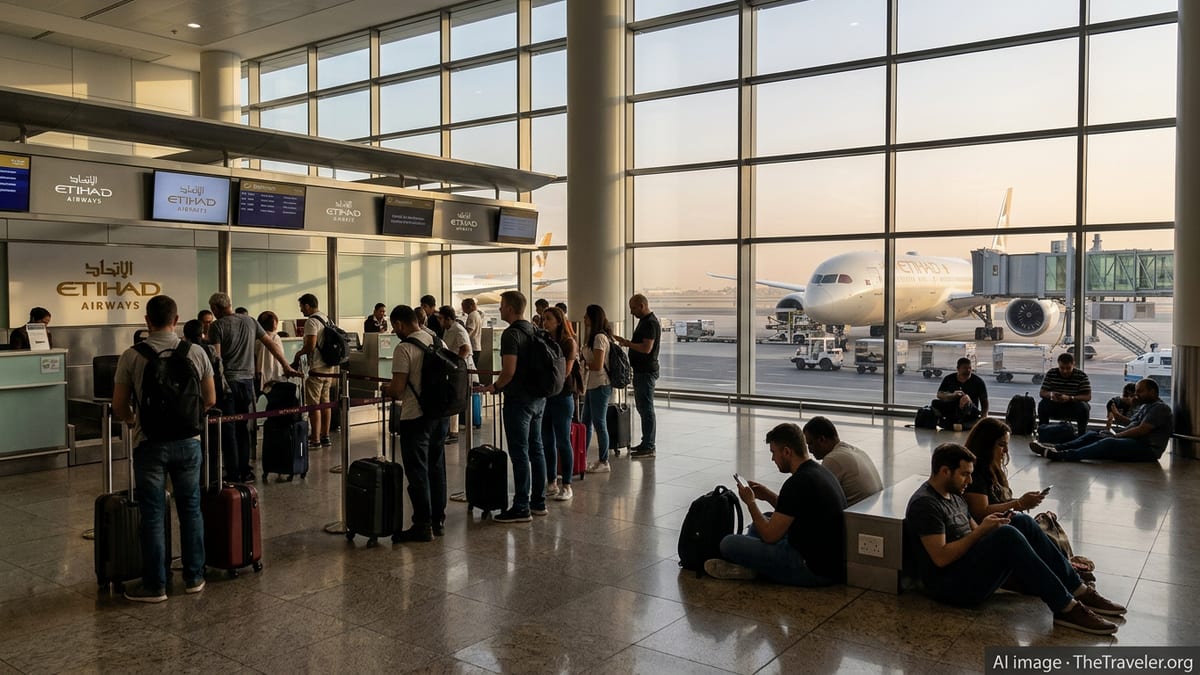
Regional disruption triggers rolling schedule changes
Etihad’s hub in Abu Dhabi remains one of the busiest transfer points between Europe, Asia and North America, with the airline now operating around 300 daily flights and a growing fleet that surpassed 120 aircraft in late 2025. This rapid expansion has coincided with bouts of regional airspace restrictions, weather‑related congestion and knock‑on delays across the Middle East, leading to intermittent disruption on selected routes rather than a full network shutdown.
According to publicly available operational updates, the airline has recently advised that some services across the region remain subject to last‑minute timing changes or temporary suspension, depending on airspace availability and safety clearances. Etihad states that flights will only operate through approved corridors and that safety remains the primary factor in deciding whether to run or reroute a service.
These conditions have produced a pattern of rolling schedule adjustments. On some days, high‑demand long‑haul departures from Abu Dhabi have operated broadly on time, while neighboring flights on the same corridor have been retimed, consolidated or cancelled with relatively short notice. Travelers connecting via Abu Dhabi are therefore being urged to monitor flight status repeatedly in the 24 to 48 hours before departure rather than relying on earlier schedules.
Travel forums and social media posts from recent days indicate that some passengers have experienced multi‑day delays or complex rerouting via third‑country hubs when their original Etihad flights were suspended. Others report that once their particular service was confirmed as operating, flights departed close to schedule. The uneven impact highlights how localized airspace restrictions and capacity constraints can ripple across a global network in unpredictable ways.
What Etihad’s current operational guidance means for passengers
In its latest public advisories, Etihad has encouraged customers to avoid travelling to the airport until their flight is shown as operating on the airline’s official status tools. The carrier has also underlined the importance of keeping contact details up to date in bookings so automated notifications about cancellations, schedule changes or rebooking options can be delivered by email or text message.
For tickets issued on or before late February 2026 with original travel dates in early to mid‑March, Etihad has introduced temporary flexibility measures. Publicly shared summaries of the policy indicate that many affected travellers may rebook once, free of change fees, onto Etihad‑operated services through mid‑May 2026, subject to seat availability in the same cabin. In specific cases, customers whose flights have been cancelled outright are being offered the option of a full refund instead of rebooking.
These measures are framed as limited‑time responses to an exceptional operational situation rather than permanent changes to Etihad’s conditions of carriage. Passengers with future trips later in 2026 are generally being advised to wait until closer to departure unless their flight appears on disruption lists or they receive direct notification that their itinerary has been affected.
Reports from recent days suggest that call centres and digital support channels have at times been heavily congested, with some passengers describing repeated attempts to obtain clearer guidance on options. Travel rights specialists recommend that passengers document all communications and retain confirmations of any rebooking or refund requests made through online forms or travel agents, in case follow‑up is needed.
Understanding passenger rights under UAE and international rules
Beyond airline‑specific goodwill policies, Etihad passengers are covered by a combination of UAE national regulations, international aviation conventions and, in some cases, foreign consumer protection rules at the point of departure. Legal analyses of UAE practice highlight the General Civil Aviation Authority’s Passenger Welfare Programme and the UAE Commercial Transactions Law, alongside the Montreal Convention of 1999, as key frameworks defining carrier obligations during disruptions.
Public guidance from regional consumer outlets notes that for substantial delays and cancellations, UAE‑based airlines are expected to provide basic welfare such as meals, refreshments and communication after a few hours of disruption, and hotel accommodation if an overnight stay becomes necessary. These obligations are generally independent of whether cash compensation is due, and apply even where events such as severe weather or sudden airspace closures are outside the airline’s control.
The Montreal Convention limits and structures claims for proven financial loss linked to delays, baggage issues or damage, and usually requires passengers to show receipts or other evidence of additional expenses. At the same time, the treaty allows airlines to avoid liability if they can demonstrate that all reasonable measures were taken or that the disruption was unavoidable under the circumstances.
Where itineraries start or end in regions with their own air passenger regulations, such as the European Union or United Kingdom, travelers may benefit from additional rights on the affected segment. In those jurisdictions, long delays and cancellations caused by reasons within an airline’s control can trigger fixed compensation payments, while extraordinary circumstances such as airspace closures typically exempt carriers from such payouts but do not remove the obligation to provide care and assistance.
Practical steps for Etihad customers facing disruption
Specialists in travel law and consumer protection suggest that Etihad passengers begin by confirming exactly which legal framework applies to their specific itinerary. This usually depends on the departure and arrival airports, the airline actually operating the flight and where the ticket was purchased, rather than only on the airline’s home country.
Once a disruption occurs, the first priority is to secure a confirmed alternative routing or refund decision in writing. Travelers are advised to use the airline’s official channels and, if booked via an agent, to coordinate closely with that intermediary. Screenshots of flight status pages, booking records and any written notice about cancellations or schedule changes can be useful if later disputes arise over eligibility for reimbursement or compensation.
Passengers incurring extra costs for hotels, meals or replacement transport because of a disruption are generally encouraged to keep itemized receipts, even if the airline is initially unable to confirm whether those expenses will be reimbursed. Under the Montreal Convention and UAE commercial law, documented, reasonable expenses caused directly by a delay or cancellation may form the basis of a later claim, subject to liability limits and time bars.
If disagreements persist, travelers can consider submitting complaints to national enforcement bodies at the point of departure or to dispute resolution schemes where available. Some passengers also turn to specialized claims firms that assist with cross‑border aviation disputes, although consumer advocates advise reading fee structures carefully before engaging third‑party services.
How to prepare for future trips during an unstable period
With regional airspace conditions still fluid, travel planners recommend that Etihad customers building complex itineraries leave longer connection times in Abu Dhabi than they might during fully stable periods. Opting for slightly longer but same‑ticket connections can offer more protection if the first leg is delayed, since the airline is then responsible for re‑accommodating passengers to their final destination.
Travel insurance is also emerging as an important layer of protection, particularly for trips involving multiple carriers or non‑refundable accommodation and tour bookings. Policies that explicitly cover missed connections, additional accommodation and alternative transport in the event of flight disruption can reduce the financial impact when airline‑provided assistance is limited to rebooking on the next available service.
Observers note that Etihad’s recent traffic statistics show sustained demand and ongoing network expansion, suggesting that the airline is likely to keep adjusting schedules and capacity as conditions evolve. For passengers, that means staying informed, checking flight status repeatedly in the days before departure and being prepared with backup plans if a particular route becomes constrained again.
As operational updates continue in the weeks ahead, travelers using Etihad’s network are being encouraged to pay close attention not only to the airline’s flexibility policies but also to the broader set of passenger rights that may apply. Understanding the difference between welfare assistance, reimbursement of expenses and statutory compensation can help passengers navigate disruption with clearer expectations and a stronger basis for resolving problems when they arise.