

More news on this day
Etihad Airways is preparing a fresh expansion of its global network, with new nonstop service between Abu Dhabi and Charlotte and a planned route to Kabul that together signal a strategic push into both the US Southeast and a cautiously re-emerging Afghan market.
Get the latest news straight to your inbox!
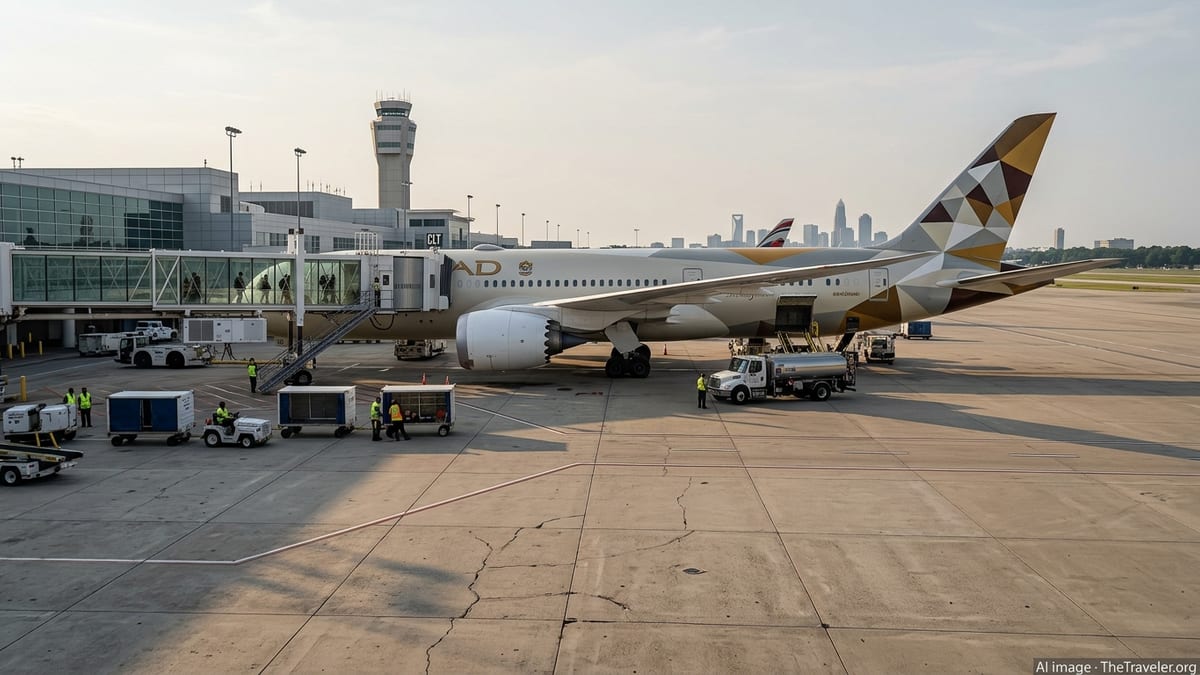
New Abu Dhabi–Charlotte Link Extends Etihad’s U.S. Footprint
Publicly available airport schedule data and aviation industry reporting indicate that Etihad Airways plans to launch nonstop flights between Abu Dhabi and Charlotte Douglas International Airport in 2026. Listings for Abu Dhabi’s Zayed International Airport show Etihad service to Charlotte starting in late May 2026, marking the first time the Abu Dhabi carrier has flown directly to North Carolina’s largest city.
The move extends Etihad’s presence in the United States beyond existing gateways such as New York, Chicago and Washington. For Charlotte, a major hub in the Southeast, the new link provides a direct connection to the Gulf for the first time and offers one-stop itineraries to South Asia, the Middle East and Africa via Etihad’s network. Aviation forums and local media in North Carolina have highlighted the new route as a notable development for both business and leisure travelers in the region.
Capacity details, including aircraft type and weekly frequency, have not yet been widely published, but Etihad’s established pattern on similar long-haul routes suggests a focus on balancing business and visiting-friends-and-relatives traffic. The timing aligns with the carrier’s broader growth plans, with network updates and promotional materials pointing to an expanded role for Abu Dhabi as a connecting hub by the mid-2020s.
Charlotte’s existing long-haul map is dominated by transatlantic links to Europe. The addition of nonstop service to Abu Dhabi shifts the city further into intercontinental territory, positioning it as a new access point for travelers moving between the southeastern United States and key markets in India, Pakistan and the wider Middle East.
Kabul Service Signals Calculated Return to a Complex Market
Alongside its U.S. expansion, industry coverage from regional travel publications reports that Etihad has also announced plans to add Kabul to its route map. Kabul is described as one of the latest additions in a wave of more than two dozen routes slated for 2025, as airlines increasingly reassess the viability of scheduled passenger services to Afghanistan.
Commercial traffic to Kabul has been limited and intermittent in recent years, with a mix of regional carriers and charter operations providing connectivity. New service from a Gulf network airline would represent a significant development, potentially restoring more regular links between Afghanistan and global markets through Abu Dhabi.
Reports indicate that Etihad’s planned Kabul operation is being framed as part of a cautious, phased return of international service to the country. Any launch is expected to depend on operational conditions, including security assessments, airport readiness and overflight permissions along the route. Industry observers note that carriers have generally approached Afghanistan with conservative schedules and adaptable capacity to respond to changing circumstances.
If realized as described, the Kabul route would offer passengers in Afghanistan a new one-stop path to major destinations across Asia, Europe and North America via Abu Dhabi. For Etihad, it would open a niche but symbolically important market that reinforces its role as a bridge between emerging and established aviation regions.
Why Charlotte Matters for Etihad’s North American Strategy
Etihad’s choice of Charlotte reflects shifting priorities in transatlantic and transcontinental aviation. Rather than competing only in saturated coastal markets, Gulf carriers have increasingly targeted large inland hubs with strong local demand and powerful domestic feed. Charlotte fits this profile, with a high concentration of corporate headquarters, a growing technology and finance sector and substantial diaspora traffic to South Asia routed today through Europe or other U.S. gateways.
The Abu Dhabi–Charlotte route positions Etihad to court travelers who currently rely on connections via airports such as London, Frankfurt or New York. By offering a single-stop itinerary from Charlotte to cities across India, Pakistan, Sri Lanka and Africa, the airline can compete both on total travel time and on the appeal of a single-hub connection.
For Charlotte Douglas International Airport, the service underlines its ambition to move beyond its traditional role as a domestic and transatlantic connecting point. Airport planning documents and regional economic development commentary in recent years have emphasized the pursuit of new long-haul partners, particularly to the Middle East and Asia. Etihad’s arrival, if operated as indicated, would give the Carolinas direct access to a major Gulf hub for the first time.
Travel industry analysts point out that such routes can have wider economic implications, encouraging trade missions, tourism campaigns and foreign investment outreach tied to the new connection. The presence of a Gulf carrier may also spur competitive responses or partnership adjustments from other airlines serving the region.
Kabul: Reopening Skies and Humanitarian Connectivity
While Charlotte represents an economic play, Kabul sits at the intersection of geopolitics, humanitarian needs and evolving aviation policy. International organizations and aviation bodies have spent the past several years assessing how and when to restore more regular overflights and commercial services through Afghanistan’s airspace. Working papers from regional air navigation meetings describe proposals for new routings through the Kabul flight information region, reflecting the gradual technical reopening of the skies above the country.
Within this context, a proposed Etihad route to Kabul aligns with efforts to rebuild safe, predictable corridors in and out of Afghanistan. Scheduled flights from a Gulf hub offer more than point-to-point travel; they also restore a measure of connectivity for NGOs, development workers, business travelers and members of the Afghan diaspora returning to visit families.
Public information on Afghanistan’s recent air travel trends points to a slow but noticeable increase in operations as carriers test demand and operational stability. A network airline such as Etihad can potentially offer more consistent schedules and interline options than smaller operators, improving onward access to destinations that matter for Afghan communities, including cities across South Asia, Europe and North America.
At the same time, the Kabul route is likely to be closely watched by insurers, regulators and travelers. Any launch would have to navigate risk assessments, aircraft deployment decisions and contingency planning, underscoring how commercial aviation continues to adapt to a rapidly changing geopolitical environment.
Broader Implications for Etihad and Global Connectivity
Taken together, the Abu Dhabi–Charlotte service and the proposed Kabul operation highlight Etihad’s dual focus on commercially attractive growth and strategically significant, high-profile destinations. The airline has been steadily rebuilding and diversifying its network, and recent route announcements suggest an emphasis on both emerging tourism markets and corridors with strong visiting-friends-and-relatives demand.
Network maps and schedule filings show Etihad adding or restoring cities across Africa, Asia and Europe as it approaches the middle of the decade. Charlotte fits into a pattern of deeper North American penetration, while Kabul underscores the carrier’s willingness to enter complex markets where connectivity has broader social and economic importance beyond simple traffic volumes.
For travelers in the United States, the Charlotte launch would provide a new option to reach the Gulf and onward destinations without backtracking to coastal hubs. For passengers in or traveling to Afghanistan, a new link via Abu Dhabi could reduce reliance on fragmented regional itineraries and offer more predictable schedules.
As these services move from announcement to implementation, booking patterns, load factors and operational performance will determine how firmly they take root in Etihad’s long-term network. For now, they stand as notable markers of an airline using targeted expansion to reshape key corridors between the Middle East, North America and a country whose air links remain a barometer of its engagement with the wider world.