

More news on this day
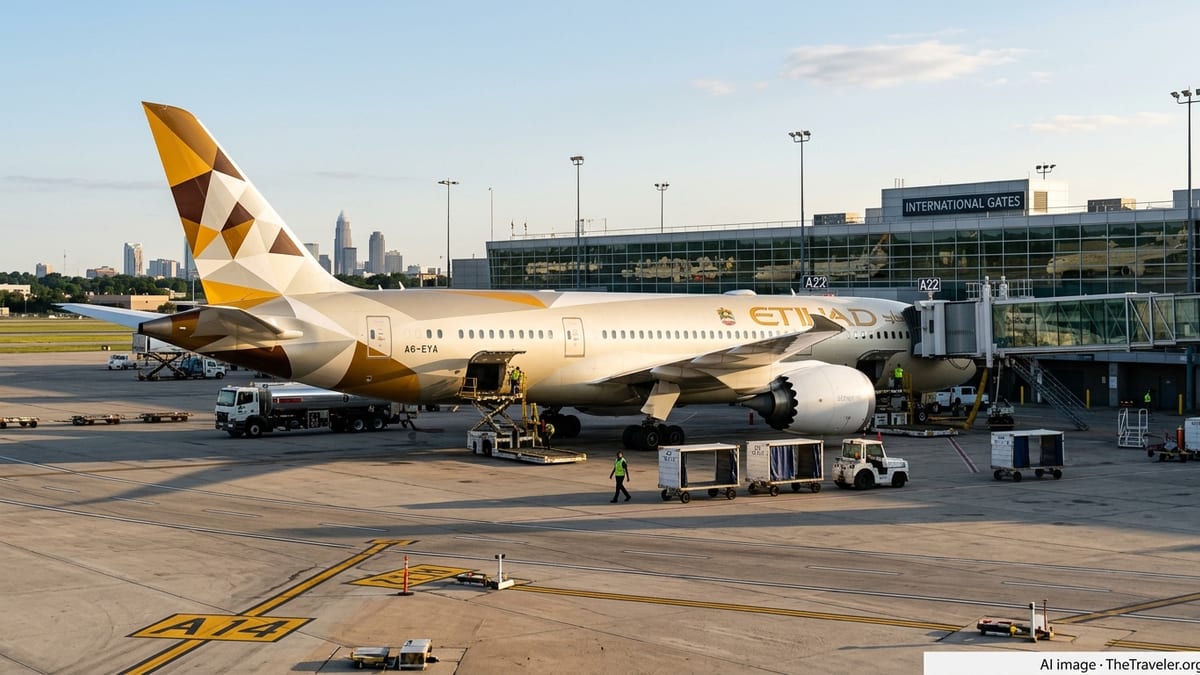
Etihad Airways is preparing to connect Abu Dhabi and Charlotte with a new long-haul service in March 2026, a move that extends the United Arab Emirates carrier’s North American footprint while giving the southeastern United States a direct premium link to the Gulf.
Get the latest news straight to your inbox!
A Strategic New Bridge Between the UAE and the U.S. Southeast
Publicly available information shows that Etihad will inaugurate nonstop flights between Abu Dhabi’s Zayed International Airport and Charlotte Douglas International Airport in March 2026, after the airline advanced the start date from its previously announced launch in May. The connection will be the first direct service between the United Arab Emirates and North Carolina and one of Charlotte’s longest routes by block time.
Reports on the new service indicate that Etihad will initially operate a daily or near-daily schedule, positioning Charlotte as a fresh entry point to the eastern United States for travelers from the Gulf, South Asia, and beyond. The route adds to Etihad’s existing U.S. network, which already includes major hubs such as New York, Chicago, and Washington, and reflects the airline’s broader 2026 expansion strategy across Europe, Asia, and North America.
Industry coverage notes that Charlotte Douglas International Airport has grown into one of the busiest airports in the world by aircraft movements, driven largely by its role as a megahub for domestic traffic. The addition of Abu Dhabi creates a direct long-haul option that plugs this domestic connectivity into Etihad’s global network, effectively turning Charlotte into a new transfer bridge between secondary American cities and destinations across the Middle East, Africa, and the Indian subcontinent.
Analysts observing the announcement suggest that the move also responds to increasing demand from corporate travelers, international students, and leisure passengers in the Carolinas and surrounding states who previously relied on connections through New York, Washington, or European hubs to reach the Gulf.
Aircraft, Cabin Experience, and the Focus on Comfort
While final aircraft assignments remain subject to operational planning, Etihad has consistently emphasized long-haul comfort and premium service as central to its brand, suggesting that widebody aircraft equipped with its latest-generation cabins are likely candidates for the Abu Dhabi–Charlotte route. Recent fleet developments highlight the carrier’s investment in upgraded business-class suites, enhanced economy seating, and refreshed inflight entertainment across long-haul services.
According to published coverage of Etihad’s wider product strategy, the airline has focused on creating a “boutique” experience at scale, incorporating features such as fully flat business-class beds, direct aisle access in premium cabins, and improved privacy elements. Economy cabins on its newer aircraft typically offer adjustable headrests, higher-resolution seatback screens, and power at every seat, aimed at reducing fatigue on flights approaching 15 hours.
Reports on Etihad’s network modernization also point to a renewed emphasis on cabin ambiance, including refined lighting schemes to support circadian rhythms, quieter cabins, and curated dining options that showcase Middle Eastern hospitality. Applied to the Charlotte service, these elements are expected to position the flight as a high-comfort option for both business and leisure travelers making the long journey between the U.S. East Coast and the Gulf.
Travel observers note that the route will compete not only on schedule but also on the overall travel experience, particularly as passengers weigh one-stop itineraries through Abu Dhabi against alternatives via established European and North American hubs. For travelers in markets south and east of Charlotte, the combination of a short domestic hop into CLT and a single long-haul segment to Abu Dhabi may prove compelling.
Charlotte’s Growing Role as a Global Gateway
Charlotte Douglas International Airport has steadily transformed from a primarily domestic hub into an increasingly international gateway, and Etihad’s arrival is viewed by aviation watchers as a milestone in that evolution. Existing long-haul links to Europe and Latin America laid the groundwork; the Abu Dhabi connection adds the Middle East to the airport’s global map, extending its reach into new tourism and trade corridors.
Economic development agencies and business groups in North Carolina have long pointed to the importance of direct international connections in attracting investment. Public information about the new service highlights expectations that companies with ties to the Gulf states, South Asia, and North Africa may find it easier to manage regional operations and corporate travel via Charlotte once the route is in place.
From a tourism perspective, Charlotte gains visibility as a gateway city for inbound visitors from the UAE and connecting markets served by Etihad. Industry commentary suggests that visitors may increasingly combine business travel with leisure stays in the Carolinas, tapping into established tourism draws such as the Blue Ridge Mountains, coastal resorts, and the region’s motorsport and banking attractions.
Aviation analysts note that the route also strengthens Charlotte’s position in the competitive landscape of U.S. secondary hubs vying for new long-haul services. By securing a Gulf carrier with a global network, the airport adds a distinctive option that differentiates it from other regional gateways with more limited international offerings.
Premium Connectivity and Abu Dhabi’s U.S. Preclearance Advantage
One of the most notable features of Etihad’s service pattern from Abu Dhabi to the United States is the use of the U.S. Customs and Border Protection preclearance facility at Zayed International Airport. Available information shows that passengers on eligible Etihad flights can complete U.S. immigration and customs formalities before departure, allowing them to arrive in the United States as domestic passengers.
Industry reports indicate that the new Charlotte flight is expected to be integrated into this preclearance system, offering travelers a streamlined arrival experience at CLT. For connecting passengers heading onward to smaller U.S. cities, this can significantly reduce connection stress by eliminating long queues at the first point of entry and simplifying minimum connection times.
Travel publications covering the Abu Dhabi–Charlotte launch emphasize that this combination of long-haul comfort, premium service, and precleared arrival could make the route particularly attractive to time-sensitive travelers such as executives and high-value leisure passengers. In addition, the ability to check bags through to a final U.S. destination after preclearance may appeal to families and group travelers seeking a smoother journey.
The route is also expected to deepen network synergies between Etihad and its partner airlines in North America. Publicly available partnership information lists several U.S. and Canadian carriers that codeshare with Etihad, expanding the number of destinations effectively linked to Abu Dhabi via a single stop in Charlotte.
Redefining Transcontinental Options for the Carolinas and Beyond
For travelers across the Carolinas, Tennessee, Georgia, and neighboring states, the new Abu Dhabi service represents more than a direct link to the UAE; it effectively reshapes the menu of one-stop options to destinations stretching from the Indian Ocean to East Asia. Instead of backtracking through northeastern hubs or routing via Europe, passengers will be able to reach cities across Etihad’s network with a single connection in the Gulf.
Travel analysts describe this as a quiet but significant shift in transcontinental travel patterns, giving a broader swath of the southeastern United States access to Middle East and Asia connections that were previously concentrated in a handful of coastal gateways. For some markets, total journey times may improve, while others gain added choice and redundancy in case of disruptions at traditional hubs.
The launch also underscores a broader trend of Gulf carriers targeting high-potential secondary cities in North America rather than focusing solely on the largest coastal markets. By placing a bet on Charlotte, Etihad is aligning itself with the region’s long-term growth trajectory and signaling confidence in demand for both premium and economy travel between the Middle East and the U.S. Southeast.
As the March 2026 start date approaches, schedules, equipment details, and final product specifics are expected to be refined. For now, the announced Abu Dhabi–Charlotte link stands out as one of the most closely watched new long-haul routes on the North Atlantic, promising to elevate the role of Charlotte Douglas International Airport in global aviation while extending Etihad’s brand of long-haul luxury deeper into the United States.