

More news on this day
Etihad Airways is positioning Chicago O’Hare International Airport as its leading United States gateway in 2026, with expanded Abu Dhabi services and additional connectivity that strengthen the airport’s role in transatlantic and transpacific travel flows.
Get the latest news straight to your inbox!
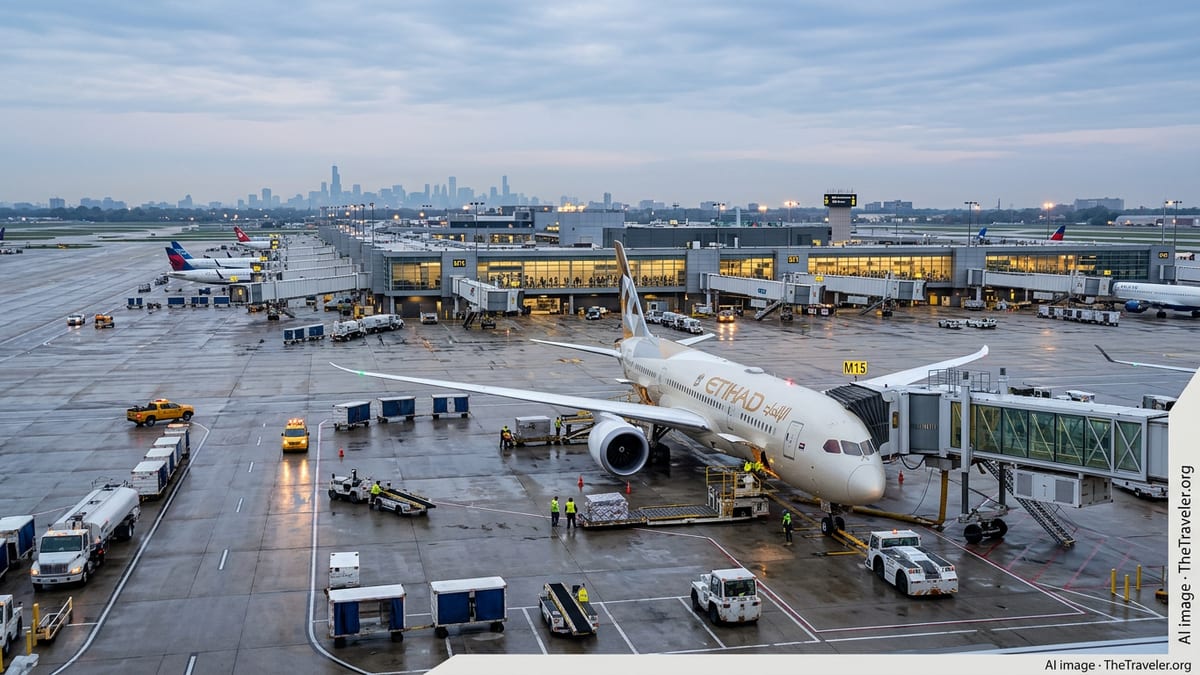
Expanded Abu Dhabi Service Elevates O’Hare’s Role
Publicly available schedule data and industry analysis indicate that Etihad is increasing its Chicago O’Hare operations in 2026 as part of a broader rebuild of its long-haul network. The airline is concentrating more of its US capacity at O’Hare, supported by the full move of its long-haul operations to Zayed International Airport in Abu Dhabi and the opening of enhanced facilities there for US-bound travelers.
Reports on Etihad’s North American network show that by mid 2026 the carrier plans more weekly flights across the United States and Canada, with O’Hare emerging as one of the densest single gateways in terms of frequency and onward connections. This shift reflects both the strategic importance of Chicago in the US aviation system and the airline’s renewed emphasis on connecting traffic between North America, the Gulf region, South Asia and Africa.
Chicago already benefits from Abu Dhabi’s position as a major hub, and the expanded schedule is expected to offer travelers more options in both directions. The additional Etihad capacity will give O’Hare-based passengers greater choice for nonstop travel to the Gulf while increasing the number of one-stop itineraries to destinations that are not currently served nonstop from Chicago.
The move also aligns with O’Hare’s broader resurgence. Recently released aviation statistics show the airport once again handling the highest number of aircraft movements nationwide, underlining its appeal to carriers seeking to grow transfer and origin–destination traffic in the US Midwest.
Chicago Surges Ahead of Other Etihad US Stations
Etihad’s decision to lean into Chicago in 2026 follows several years of incremental growth in the US market, which now includes established routes to New York and Washington and more recent expansions to Boston and Atlanta. Industry coverage tracking Etihad’s network notes that the airline’s US and Canadian flights are projected to exceed fifty weekly services by May 2026, with Chicago among the most prominent beneficiaries of this build-up.
While Etihad continues to open or announce new points such as Charlotte, scheduling data suggests that O’Hare is set to host some of the highest weekly frequencies in the airline’s US portfolio. Analysts highlight that consolidation at a strong Midwest hub can be more efficient than thinly spreading capacity across multiple coastal gateways, particularly when much of the demand is connecting traffic bound for India, Pakistan and other parts of South and Southeast Asia.
Compared with Etihad’s other US airports, Chicago offers a particularly dense grid of domestic and regional connections. This allows the Abu Dhabi carrier to capture traffic from secondary and tertiary US cities via O’Hare rather than adding standalone services elsewhere. As a result, Chicago’s role in the Etihad network is shifting from being one of several US points to becoming the anchor gateway for a wide swath of the country.
Travel industry observers also note that Etihad’s O’Hare build-up coincides with strong financial performance from the airline. Recent financial disclosures show a record profit in 2025, giving the carrier added flexibility to pursue targeted growth in markets where yields and load factors have strengthened.
Connecting Powerhouse for the Midwest and Beyond
Chicago O’Hare’s value for Etihad lies not just in local demand, but in its function as a connection platform. The airport is one of the busiest hubs in the world, with major US carriers using it as a primary transfer point between the coasts, the Midwest and the Great Plains. For Etihad, tapping into this flow allows its Abu Dhabi flights to feed and be fed by dozens of domestic routes without operating additional long-haul sectors.
As United Airlines and American Airlines expand their own schedules at O’Hare in 2026, overall connectivity at the airport is set to rise. Industry reports describing record daily departures and new domestic destinations suggest that more Midwest cities will gain or regain nonstop links to Chicago, indirectly strengthening Etihad’s reach as well. Travelers from smaller communities can connect in O’Hare to reach Abu Dhabi and beyond with a single international transfer.
For passengers, an expanded Etihad schedule typically translates into more choice in departure times, better opportunities for same-day onward connections and potentially more competitive pricing. Travel advisors monitoring the changes point out that additional capacity on a trunk route can ease constraints during peak holiday periods, when flights between North America and South Asia are often heavily booked months in advance.
The shift is also likely to influence cargo flows. Previous announcements from Etihad Cargo have emphasized the importance of Chicago as a freight gateway, and additional passenger flights normally bring extra bellyhold capacity. This can support trade in high-value and time-sensitive goods between the Midwest, the Gulf and key markets in Asia and Europe.
Infrastructure and Operational Constraints at a Busy Hub
Etihad’s O’Hare expansion is taking place against a backdrop of intense activity at the airport. Recent reports from aviation authorities and local media describe concerns over peak-time congestion and the possibility of capping some operations during summer 2026 as airlines race to add flights. O’Hare is undergoing a long-running modernization program, with new gates and concourses being built while certain runways and facilities remain under construction.
These infrastructure works are designed to unlock substantial long-term capacity, but in the short term they can create pressure points. Analysts note that airlines like Etihad must carefully time their arrivals and departures to mesh with O’Hare’s busiest domestic banks and to minimize exposure to potential delays. The airline’s schedule planners are expected to balance the advantages of high-connectivity windows with the operational realities of a heavily utilized airfield.
Travelers using Etihad’s Chicago services in 2026 may therefore see a premium placed on punctuality and schedule resilience. Industry commentary suggests that carriers are increasingly coordinating with airport stakeholders to adjust flight timings, gate usage and turnaround processes in order to maintain reliability during the peak summer season.
Despite these challenges, aviation data released early this year indicate that O’Hare’s overall capacity for passenger movements remains on an upward trajectory. For Etihad, committing more seats and frequencies in this environment signals confidence that the airport’s modernization will continue to support growth over the medium to long term.
Implications for Travelers and the Competitive Landscape
For Chicago-area travelers, Etihad’s decision to make O’Hare its top US gateway in 2026 brings a clearer and more frequent link to Abu Dhabi and onward destinations. The route is expected to appeal not only to the region’s sizeable South Asian and Middle Eastern communities, but also to business travelers heading to commercial centers in the Gulf, India and beyond.
The strengthened Abu Dhabi connection offers an additional one-stop option to cities that otherwise require multiple transfers. Travel experts note that for some itineraries, particularly from the Midwest to secondary points in India or the broader Indian Ocean region, routing via a Gulf hub can be time-competitive with more traditional connections through European gateways.
On a competitive level, Etihad’s push at O’Hare adds another dimension to the airport’s long-haul market. Established European and North American carriers already operate extensive transatlantic schedules from Chicago, and Gulf competitors also serve the region. Etihad’s enhanced presence, backed by solid financial results and a renewed growth strategy, may encourage rivals to reassess capacity, pricing and partnership arrangements in the Midwest.
As 2026 progresses, attention will focus on how quickly Etihad can translate its expanded Chicago operations into sustained traffic growth and whether O’Hare’s infrastructure projects keep pace with rising demand. For now, the carrier’s decision to single out Chicago as its leading US gateway underscores both the strategic weight of America’s heartland hub and the continuing importance of Gulf–US connectivity in global air travel.