

More news on this day
Etihad Airways and McLaren Racing have unveiled a multi-year partnership from the 2026 season that fuses aviation, elite motorsport and tourism, positioning Abu Dhabi and other global race hubs for a new surge in fan travel and premium hospitality.
A Multi-Series Alliance Built Around 2026
From the start of the 2026 campaign, Etihad Airways will become an Official Partner of the McLaren Mastercard Formula 1 Team and the McLaren United Autosports WEC Hypercar program, extending the airline’s reach across both grand prix and endurance calendars. Branding will feature on the MCL40’s rear wing and halo, on driver helmets and on McLaren’s World Endurance Championship entry, securing high-visibility exposure throughout long broadcast windows and multiple race formats.
The agreement, announced this week, formalizes a multi-year commitment that goes beyond traditional race-weekend logos. Etihad and McLaren have included broad digital and experiential rights, allowing the partners to co-create fan activations, content and hospitality products across a season already projected to feature a dense schedule of long-haul events.
For McLaren, the deal strengthens a growing commercial portfolio tied closely to Gulf investment and global consumer brands. For Etihad, it marks a strategic expansion of an involvement in Formula 1 that dates back to 2009 through title sponsorship of the Abu Dhabi Grand Prix, now transformed into a year-round global platform rather than a single marquee weekend.
Flying Billboard: A McLaren-Branded Boeing 787 Dreamliner
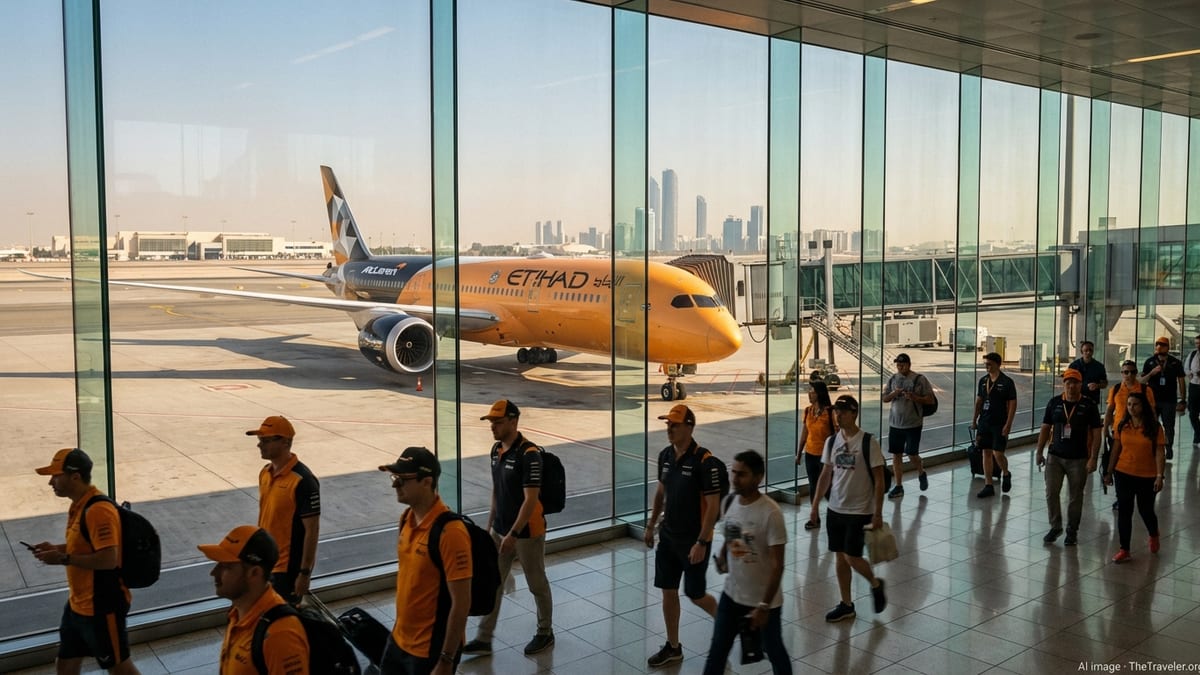
One of the most visible symbols of the partnership will come in the form of a special McLaren-themed livery on an Etihad Boeing 787 Dreamliner, due to enter service later this year. The long-haul aircraft, a flagship type in the carrier’s fleet, will carry McLaren Racing branding and the team’s signature papaya-inspired palette across high-profile routes linking Abu Dhabi with Europe, Asia, Australia and North America.
Special liveries have become a proven way for airlines to break out of industry circles and into mainstream conversation, and Etihad is betting that a McLaren-branded 787 will generate organic coverage well beyond race broadcasts. Seen at major hubs from London to Melbourne, the aircraft is expected to serve as a mobile advertisement for both the airline and the team, photographed by passengers and aviation enthusiasts each time it rotates through a new destination.
By aligning a long-haul workhorse with a global racing icon, the partners are effectively turning airport aprons and runways into additional stages for the sport. The aircraft joins on-car branding and helmet placements as a key visual asset, ensuring that McLaren’s competitive storylines are tied directly to the Etihad network that carries fans, sponsors and team personnel around the world.
Turning Fan Travel into a Growth Engine
Beyond branding, both Etihad and McLaren are framing the alliance as a bid to elevate the travel experience for motorsport fans and convert rising interest in Formula 1 and endurance racing into measurable tourism gains. Abu Dhabi’s Yas Marina Circuit has already proven its pulling power, with the 2025 Abu Dhabi Grand Prix drawing record crowds and pushing hotel occupancy and room rates on Yas Island to new highs. In that context, a dedicated airline partner with global reach becomes a central piece of the destination’s tourism strategy.
Etihad is expected to use its network of more than 100 destinations to funnel spectators to key races, with a focus on routes linking the United Arab Emirates to major source markets such as the United Kingdom, continental Europe, Australia, Japan, China and the United States. Industry observers anticipate tailored race travel packages, promotional fares and bundled hospitality offerings built around McLaren’s calendar in both Formula 1 and the World Endurance Championship.
Travel analysts argue that 2026 could mark a turning point in how fans plan race weekends, shifting from ad hoc bookings to curated end-to-end experiences tied to a single carrier and team identity. For destinations, the combination of predictable event dates, airline capacity and premium-branded experiences offers a way to smooth seasonality and capture higher-spending visitors who stay longer and explore beyond the circuit.
Abu Dhabi’s Ambitions and the Gulf’s Motorsport Play
The partnership also reflects a broader regional push to align aviation growth with top-tier sport and entertainment. Abu Dhabi has spent more than a decade positioning itself as a premium events hub, using the Abu Dhabi Grand Prix as a showcase for new cultural districts, waterfront developments and integrated resort offerings on Yas Island.
With McLaren now closely tied to Etihad, the emirate gains an additional narrative thread linking its national airline to one of the grid’s most followed teams. That connection is amplified by recent investment ties between Abu Dhabi interests and McLaren’s ownership structure, underscoring how sovereign wealth, aviation strategy and global sport are increasingly intertwined in the Gulf.
Competition among regional carriers is intensifying, with airlines across the Middle East leveraging motorsport, football and entertainment partnerships to capture market share on long-haul routes. In that context, attaching Etihad’s brand to McLaren’s resurgence on track is seen as a statement of intent, signalling that Abu Dhabi plans to compete aggressively for both transfer traffic and destination visitors in the run-up to the 2026 season.
What It Means for Global Aviation and Motorsport
For aviation, the Etihad–McLaren partnership offers a template for how airlines can move beyond logo placements to become integral to the fan journey. By synchronising schedules, capacity and marketing with the racing calendar, carriers can position themselves as the default choice for supporters following a team or championship across continents, while also winning high-value corporate and VIP traffic tied to race hospitality.
For motorsport, the tie-up reinforces a trend toward deeper collaborations with travel and tourism stakeholders, particularly as Formula 1 and WEC add or rotate events in markets eager to showcase new infrastructure and attract international visitors. As more races lean on destination branding and long-haul access, airline partners with global networks are poised to wield greater influence over how and where the sport expands.
If the strategy works, the 2026 Etihad–McLaren alliance could help reshape expectations around what a race weekend entails. Instead of a standalone sporting event, fans would encounter a stitched-together experience that begins when they book a flight and continues through airport check-in, in-flight branding, ground transfers, grandstand seating and curated city breaks. For both aviation and motorsport, that model promises higher engagement and new revenue streams, turning fandom into a fully fledged travel product.