

More news on this day
Etihad Airways has signed a multi-year deal to become an Official Partner of McLaren Racing from the 2026 season, linking the Abu Dhabi-based carrier’s growing global network with the team’s Formula 1 and World Endurance Championship campaigns in a move that could reshape how elite motorsport travels.
A Multi-Series Deal Built Around Global Mobility
The partnership will see Etihad designated as Official Partner of both the McLaren Mastercard Formula 1 Team and the McLaren United Autosports WEC Hypercar squad from 2026 onward, reflecting how top teams now race and test almost year-round across multiple series.
Etihad will support McLaren’s operations across a network of more than 100 destinations, including virtually every major Formula 1 and World Endurance Championship market, from the United Arab Emirates and Australia to China, Japan, the United Kingdom, Spain, Italy and the United States. For McLaren, that means a single, integrated airline partner underpinning much of its team and equipment movement as calendars become denser and more geographically diverse.
Brand visibility is central to the arrangement. Etihad’s logo will appear prominently on the 2026 McLaren MCL40 Formula 1 car, including the rear wing and halo, as well as on driver helmets. Similar branding will feature on McLaren’s Hypercar machinery in the endurance paddock, cementing Etihad’s presence wherever McLaren competes.
The deal deepens Etihad’s long-standing motorsport footprint. The carrier has been title sponsor of the Abu Dhabi Grand Prix since 2009, and the McLaren partnership marks a shift from event-led branding to embedding itself directly with a globally followed team.
From Cabin to Paddock: How Travel Could Change for Teams and Fans
At its core, the agreement is about more than logos on cars and aircraft. It positions Etihad as McLaren’s preferred global travel partner, with the airline expected to play a greater role in moving crew, partners and potentially hospitality guests around a crowded international schedule.
For Formula 1, where performance margins are fine and staff fatigue is a mounting concern, a closer integration with an airline could translate into better-coordinated charter flights, optimised connections and tailored onboard services for travelling team personnel. That may include adapted meal services, sleep-focused cabin configurations and streamlined ground handling to shorten transit times between races.
Fans are also in the frame. The partnership grants Etihad wide digital and experiential rights, opening the door to co-branded travel packages around key races. Supporters could see curated itineraries that combine Etihad flights into hubs such as Abu Dhabi, London or Milan with grandstand tickets, paddock experiences or McLaren-themed city breaks tied to race weekends.
In a sport where international spectatorship is growing rapidly, particularly from the Middle East and Asia-Pacific, the tie-up provides a platform to experiment with new forms of “track tourism” that blend premium air travel, motorsport hospitality and wider destination marketing.
A McLaren-Branded Dreamliner as Flying Billboard
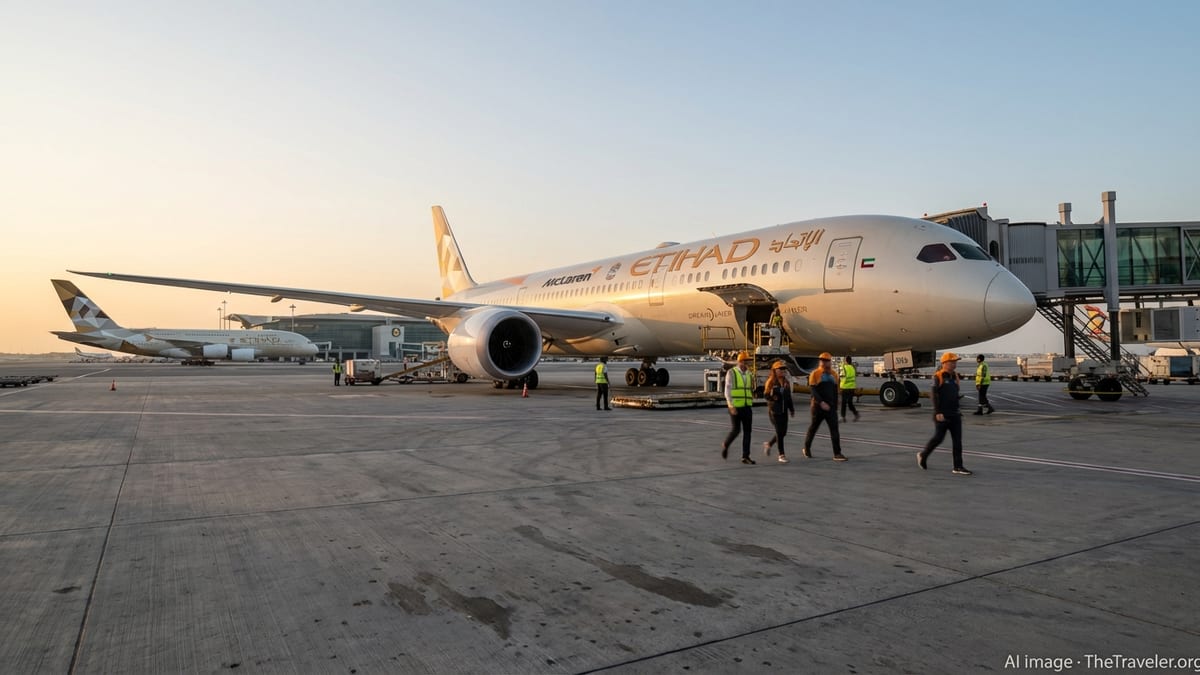
One of the most eye-catching elements of the partnership will be a special McLaren-themed livery on one of Etihad’s Boeing 787 Dreamliners, due to join the fleet later this year. The aircraft will serve as a flying billboard for both brands, operating across Etihad’s regular network rather than being confined to race charters.
For Etihad, the Dreamliner is a flagship for next-generation cabins and improved fuel efficiency, making it a logical canvas for a motorsport collaboration built around innovation, speed and technology. The livery is expected to incorporate McLaren’s distinctive papaya tones along with Etihad’s own design language, creating an instantly recognisable presence at airports worldwide.
The aircraft will likely become a focal point for fan engagement, with both companies hinting at further activations. These could include special onboard content, branded amenity kits on select routes, or social media campaigns that track the aircraft as it hops between key racing markets throughout the year.
Visually, the Dreamliner will also strengthen the connection between the grid and the gate. Seeing a McLaren-branded Etihad jet on the tarmac at a race host city will underline how closely travel and competition are now intertwined at the top level of motorsport.
Implications for Formula 1’s Commercial Landscape
The Etihad–McLaren alliance underscores how Formula 1 is becoming a proving ground for end-to-end mobility partnerships, not just sponsorship logos. As calendars expand and new races come online, airlines and transport providers are increasingly positioning themselves as strategic enablers of the spectacle.
For teams, a close relationship with a global carrier offers potential cost efficiencies and operational predictability at a time when logistics remain one of the biggest line items outside car development. For the sport’s commercial ecosystem, it signals that travel brands see long-term value in embedding with teams across multiple series and seasons.
The move also reflects the intensifying competition between Gulf carriers and regional hubs to capture the fast-growing traffic generated by F1, endurance racing and associated tourism. With Etihad deepening its ties to McLaren, and rival airlines courting other teams and events, Formula 1’s skies are becoming as contested as its circuits.
Looking ahead to 2026 and beyond, the partnership is likely to influence how other teams structure their own travel and sponsorship arrangements, and could encourage race promoters and tourism boards to develop more integrated offers that connect air travel, accommodation and trackside experiences in a single package.
Beyond F1: A Template for Cross-Series Sports Travel
By spanning both Formula 1 and the World Endurance Championship, the Etihad–McLaren deal points to a future where travel partnerships are built around a team’s entire competitive ecosystem rather than a single series. For McLaren, which is increasingly active in multiple categories, a unified airline partner simplifies planning while reinforcing its brand consistency from sprint races to long-distance classics.
Endurance racing in particular places unique demands on travel, with lengthy events, large technical crews and complex freight requirements. Having a global airline closely aligned with those needs offers scope for more tailored transport solutions that could ultimately improve reliability and performance at the track.
The partnership may also serve as a blueprint for other global sports organisations, from football clubs with international pre-season tours to racing outfits competing across electric and traditional categories. As fans chase their teams across continents, the lines between carrier, sponsor and travel facilitator are blurring, creating opportunities for more holistic, experience-focused offerings.
For travellers, that could mean a future in which booking a long-haul flight to a marquee sporting event automatically unlocks a suite of integrated benefits, from ticketing and transfers to behind-the-scenes access, all underpinned by a single, visible alliance between airline and team.