

More news on this day
Etihad Airways is on track for another landmark year as the Abu Dhabi-based carrier approached the two-million passenger mark in February 2026, reinforcing its position as one of the fastest-growing full-service airlines and highlighting sustained demand across its expanding global network.
Get the latest news straight to your inbox!
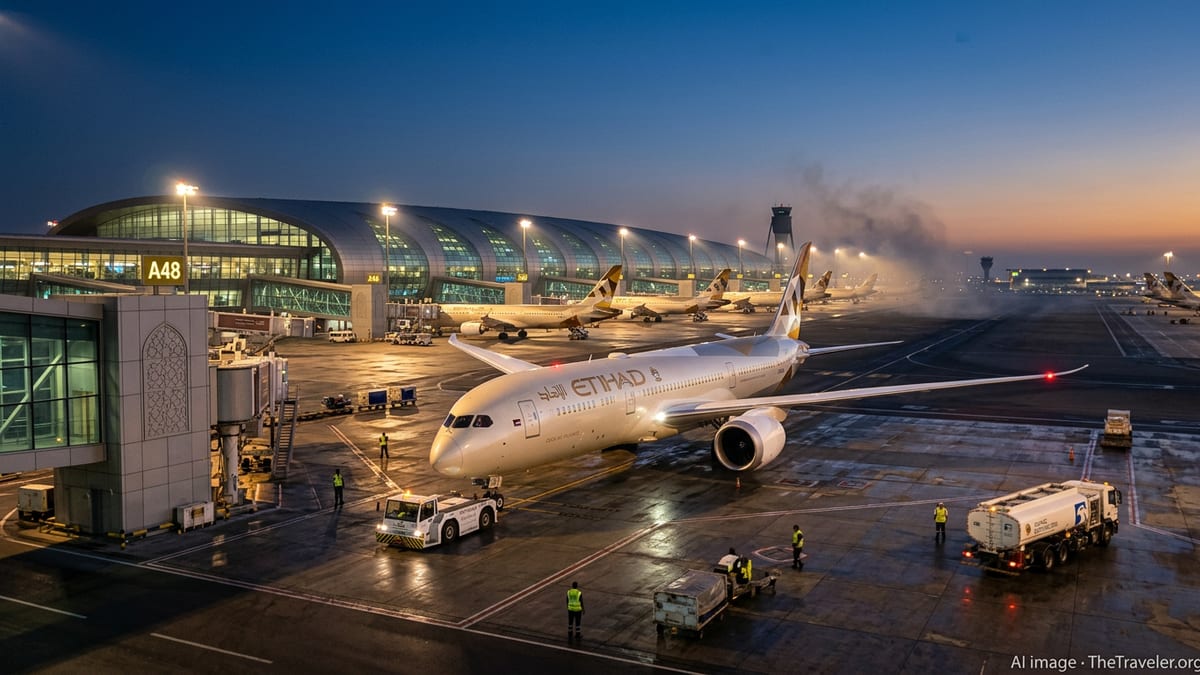
February 2026 Sets a New Benchmark for Etihad
Publicly available traffic data and industry analyses indicate that Etihad carried close to two million passengers in February 2026, building on strong momentum from late 2025. The figure represents a clear step up from February 2025, when multiple reports placed the airline at around 1.6 million passengers for the month, and follows a record December 2025 in which Etihad transported approximately 2.2 million travellers.
While the airline has not yet published its detailed monthly breakdown for February 2026, the near-two-million estimate aligns with Etihad’s reported 22.4 million passengers for full-year 2025 and a capacity increase of more than 20 percent year on year. Recent disclosures show that passenger load factors across the network remained close to the high-80 percent range, suggesting that added seats and new routes are being met by robust demand.
February’s strong result comes despite it being a shorter month with fewer peak-holiday travel days, indicating that underlying demand for Abu Dhabi as a hub and for Etihad’s network is no longer purely seasonal. The performance also reflects the airline’s recovery from earlier disruptions in regional airspace, with schedules stabilising and frequencies rebuilt on many trunk routes.
Network Growth and Fleet Expansion Underpin Demand
Etihad’s ability to approach two million passengers in February 2026 is closely tied to the rapid expansion of its network and fleet over the past two years. By the start of 2026, reports show the airline operating around 127 aircraft, the largest fleet in its history, after adding nearly 30 aircraft during 2025 across both widebody and narrowbody types.
This additional capacity has allowed Etihad to launch or restore services to multiple destinations across Europe, Asia and Africa, while also increasing frequencies on high-demand routes such as London, Mumbai and key Southeast Asian gateways. Industry coverage notes that the carrier has been targeting markets with strong point-to-point demand to Abu Dhabi as well as strategic connecting flows to and from Europe, the Indian subcontinent and Australasia.
At the same time, Abu Dhabi’s Zayed International Airport has recorded record-breaking passenger numbers, creating a virtuous cycle for the hub-and-spoke model that Etihad relies on. Airport data for 2025 points to more than 33 million passengers passing through the emirate’s airports, with Etihad accounting for a substantial share of that traffic and acting as the anchor carrier for many newly announced routes.
Operational Performance: High Utilisation and Punctuality
Operational statistics for February 2026 reinforce the picture of an airline scaling up efficiently. A recent analysis of flight operations showed that Etihad operated close to 8,800 arriving flights during the month, representing more than 20 percent growth compared with February a year earlier. This level of activity corresponds with the higher passenger volumes and confirms that the airline is making intensive use of its expanded fleet.
On-time performance remained strong in February, with tracking data indicating punctuality rates above 97 percent for departures and arrivals. For travellers, this translates into shorter connection times, fewer missed onward flights and a more predictable journey experience, particularly important at a transfer-focused hub like Abu Dhabi.
Cancellation rates also stayed relatively low, according to independent monitoring platforms, even as the airline navigated pockets of regional airspace disruption and weather-related challenges on some long-haul sectors. The combination of high utilisation, punctual operations and controlled irregularities has been a key factor in sustaining passenger confidence and supporting load factors across the network.
Financial Context: Building on Record 2025 Results
Etihad’s February 2026 performance comes on the heels of the airline’s strongest-ever financial year. Public financial disclosures for 2025 show a profit after tax of roughly 2.6 billion dirhams, with passenger numbers up 21 percent to 22.4 million and revenue increasing by a similar margin. Analysts note that this marked the fourth consecutive year of profitability and positioned Etihad among the industry’s better-performing network carriers.
The near-two-million figure for February 2026 suggests that the airline has so far maintained, and in some markets accelerated, the growth trajectory that underpinned those results. Industry commentary points to firm premium-cabin demand on core business routes, resilient leisure traffic into Abu Dhabi and improving yields on connecting itineraries, all supported by a disciplined approach to capacity deployment.
The carrier’s cargo division has also benefited indirectly from the passenger-side expansion. Additional belly-hold capacity on new and upgauged routes has enabled Etihad to increase freight volumes, particularly on corridors linking Asia, the Middle East and Europe. This diversified revenue mix provides some buffer against seasonal swings in passenger demand and helps sustain investment in fleet renewal and product upgrades.
What the Numbers Mean for Travelers Planning 2026 Trips
For travellers, Etihad’s near-record February 2026 performance translates into broader choice, more frequencies and generally smoother connections through Abu Dhabi. A growing fleet and expanding route map mean that passengers from major source markets in Europe, the Middle East, Africa and Asia are increasingly able to find one-stop itineraries to destinations that previously required two or more connections.
High on-time performance in February indicates that the carrier is currently operating a relatively resilient schedule. This is particularly relevant for long-haul itineraries with tight connection windows, where delays can have a cascading impact. While pockets of disruption and baggage issues have been reported in recent weeks, overall operational data for February points to a network that is largely running to plan.
Looking ahead to the remainder of 2026, analysts expect Etihad to continue targeting measured growth rather than aggressive overexpansion, focusing on consolidating its position on key trunk routes and adding capacity where demand has clearly outpaced supply. For passengers planning future trips, the February 2026 numbers suggest that Etihad will remain a competitive option on a growing list of city pairs, with Abu Dhabi strengthening its role as a major crossroads for global air travel.