

More news on this day
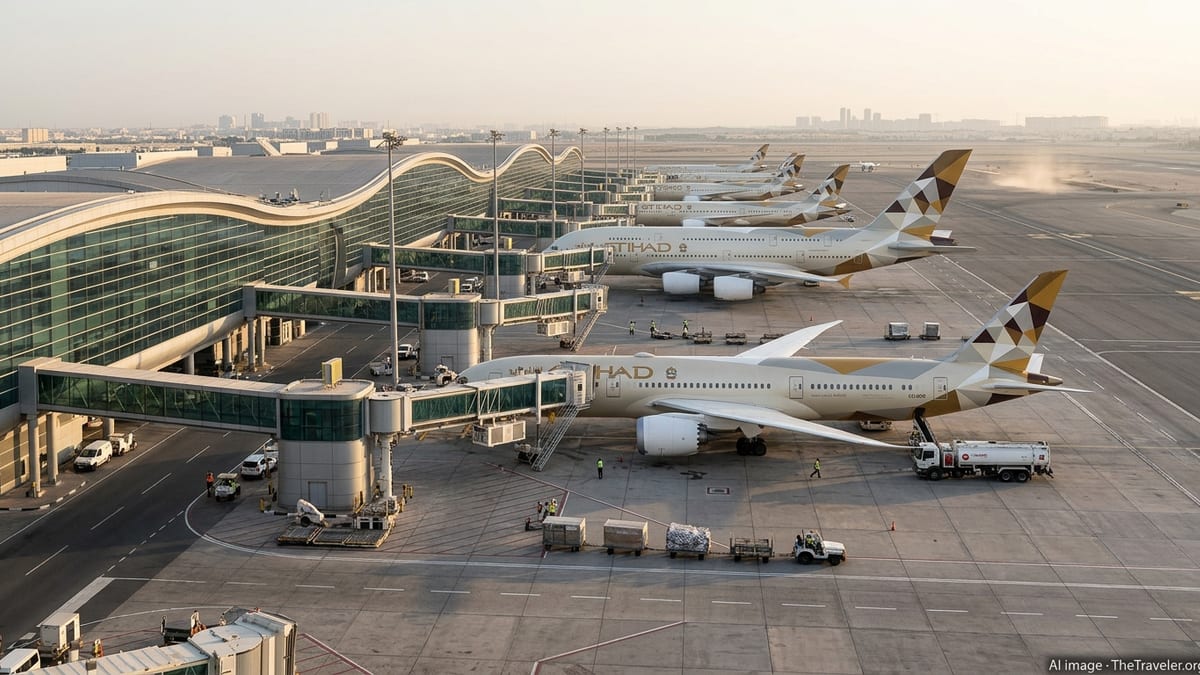
Etihad Airways is preparing to operate 62 flights out of Abu Dhabi on Wednesday, March 25, 2026, marking a sharp increase in departures as the carrier accelerates its phased recovery from recent regional airspace disruptions.
Get the latest news straight to your inbox!
Rapid Ramp-Up After Severe Regional Disruptions
The plan to operate 62 outbound flights from Abu Dhabi comes less than a month after Etihad’s hub was effectively shut down by widespread airspace closures across the Gulf, which forced the airline to halt or sharply curtail regular scheduled services. Publicly available advisories and news coverage describe how, from March 1, Etihad suspended most departures while authorities evaluated the security environment and airspace conditions around the United Arab Emirates.
In the days that followed, reports from aviation trackers and international media indicated that only a limited number of Etihad flights were moving through Abu Dhabi, often focused on essential travel and repatriation. These early operations were concentrated into narrow time windows and a small set of destinations, reflecting a cautious approach to rebuilding the schedule while regional tensions remained elevated.
Against that backdrop, a schedule featuring 62 ex-Abu Dhabi flights on a single weekday represents a significant step toward normalizing operations. While still below the airline’s pre-crisis peak traffic, the figure suggests that Etihad is now able to connect a much broader portion of its network through its Zayed International Airport hub.
Industry observers note that the ramp-up aligns with a wider pattern across Gulf carriers, where airlines are rapidly restoring long-haul links as soon as airspace and operational risk assessments allow. The March 25 plan indicates that Etihad intends to reassert Abu Dhabi’s role as a central transfer point between Europe, Asia, Africa, North America and Australia as quickly as conditions permit.
Rebuilding the Abu Dhabi Hub on a Limited Schedule
Etihad had already signaled a gradual rebound earlier in March by publishing a restricted timetable from Abu Dhabi, with flights clustered into daytime operating bands and focused on core markets. Airline updates and traveler reports pointed to a phased reopening strategy that initially covered a few dozen city pairs and then expanded as more routes cleared internal risk reviews.
The move to operate 62 departures on March 25 appears to be the next phase in that strategy. Instead of a skeleton network of mainly repatriation and essential flights, the pattern now resembles a trimmed, but recognizably global, hub schedule. The departures are expected to include high-demand long-haul services as well as flights to regional capitals that support labour traffic, family visits and business travel.
Scheduling specialists note that rebuilding a complex hub after a near-total shutdown requires careful balancing of aircraft rotations, crew availability and connection banks. A 62-flight outbound day suggests that Etihad has restored enough fleet and crew flexibility to support multiple waves of connections through Abu Dhabi, even if some frequencies and destinations remain below historical norms.
Airline statements in recent weeks have also emphasized that all services remain subject to change at short notice, underlining the possibility of tactical adjustments right up to departure time. Travelers are being encouraged, through public-facing channels, to check their flight status repeatedly in the days and hours before travel, reflecting the still-fluid operating environment.
Long-Haul Connectivity and the Role of Widebody Aircraft
As Etihad builds back to 62 departures in a day, widebody aircraft are expected to do much of the heavy lifting on key long-haul corridors. The carrier has been progressively restoring flagship services using Boeing 787s and Airbus A350s, and 2026 network plans highlighted in industry analysis show an expanded role for the Airbus A380 on select trunk routes out of Abu Dhabi.
Network-focused publications covering Etihad’s 2026 strategy describe how the airline intends to deploy the A380 on multiple high-demand routes from its hub, reaching a level of daily superjumbo departures not seen since before the pandemic. That approach is designed to consolidate premium traffic and increase seat capacity on routes where demand is expected to rebound quickly once airspace constraints ease.
Within a 62-departure day, a mix of A380s, 787s and A350s would allow Etihad to restore non-stop links to major markets in Europe, North America and Asia while maintaining efficient connections for passengers traveling between secondary cities. Medium-haul narrowbody flights to regional destinations then feed and distribute this long-haul traffic, recreating the “banked” hub structure that underpins Abu Dhabi’s role in global aviation.
Aviation analysts point out that the March 25 schedule will also serve as a live test of how quickly demand is returning across different geographies. Strong load factors on widebody routes could encourage Etihad to accelerate further frequency increases and additional aircraft deployments into the northern summer season.
Passenger Impact: More Options, Ongoing Uncertainty
For passengers, 62 outbound flights from Abu Dhabi in a single day translates into a noticeably broader menu of options compared with the heavily restricted services seen earlier in March. Travelers connecting from Asia to Europe or from the Indian subcontinent to North America, for example, are more likely to find same-day itineraries through Abu Dhabi rather than being routed via alternative hubs or rebooked on later dates.
However, recent weeks have shown that schedule listings do not always guarantee that a particular flight will operate as planned. Information shared through public forums and airport displays in early March highlighted discrepancies between airline timetables and airport departure boards, as carriers adjusted services in response to evolving conditions. That experience has reinforced the need for travelers to treat any schedule, including the March 25 plan, as indicative rather than absolute.
Travel insurers and corporate travel managers are advising customers to build additional flexibility into their itineraries, allowing extra time for potential rebooking and avoiding tightly timed onward connections that cannot be easily modified. With Etihad still describing its operation as limited and contingent on ongoing assessments, passengers may face rolling changes even as the overall number of flights increases.
The shift from a handful of flights to 62 departures nonetheless marks an important psychological turning point for many travelers who have been stranded or forced to postpone journeys. The sight of a busier departure board at Abu Dhabi’s terminal, with a more diverse set of destinations, is likely to signal that the worst of the immediate disruption has passed, even if full normality remains some way off.
Strategic Positioning Ahead of the Summer Travel Peak
Industry coverage of Etihad’s medium-term plans shows that the airline entered 2026 with an ambitious growth agenda, including new routes from Abu Dhabi to additional cities in Europe, Asia and North America, as well as frequency increases on several existing sectors. Some of those plans have had to be adjusted to account for the recent airspace crisis, but the broader strategy of strengthening Abu Dhabi as a competitive global hub remains intact.
Operating 62 outbound flights on March 25 fits into that wider context. By rebuilding scale before the main northern summer peak, Etihad is positioning itself to capture returning demand from both leisure and corporate segments. The day’s schedule is expected to include a mix of long-established routes and newer additions that reflect shifting traffic flows and competitive dynamics in the Gulf.
Aviation analysts following the region suggest that the airline’s performance around dates such as March 25 will be closely watched by investors, airports and tourism authorities. Strong operational reliability and healthy booking patterns would support further capacity restoration and could accelerate the introduction of additional destinations later in 2026.
While the operating environment across the Middle East remains sensitive, the planned 62 ex-Abu Dhabi flights underline Etihad’s determination to move from emergency response back to measured expansion. For Abu Dhabi, a busier departure schedule is also a key ingredient in supporting inbound tourism, trade links and the broader economic role of the emirate’s aviation sector.