

More news on this day
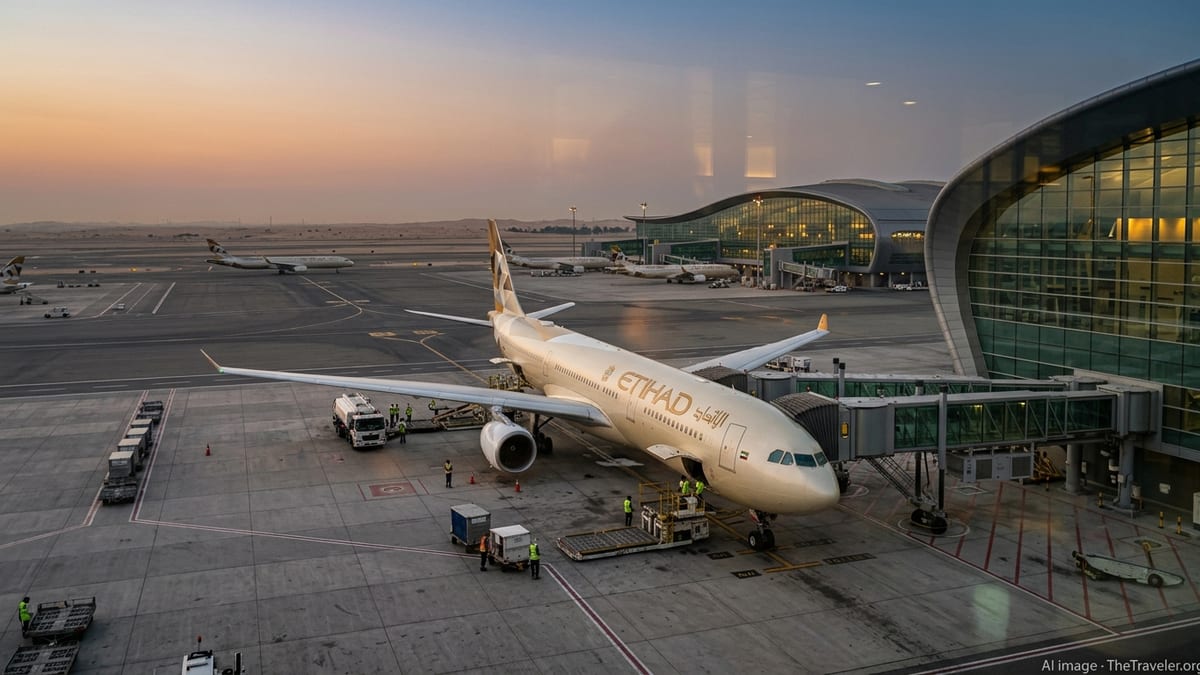
Etihad Airways is preparing to operate 70 outbound flights from Abu Dhabi on Wednesday, March 26, 2026, a concentrated schedule that reflects both the airline’s post-disruption recovery and the UAE capital’s wider ambitions as a global aviation hub.
Get the latest news straight to your inbox!
Focused Flight Programme After Regional Disruptions
The planned 70 departures come less than a month after serious regional tensions and airspace restrictions forced Etihad and other Gulf carriers to temporarily halt or sharply curtail operations from Abu Dhabi on March 1, 2026. Publicly available news coverage from early March described widespread suspensions and rolling schedule changes as airlines reacted to evolving security assessments and airspace closures affecting the wider region.
In the weeks since, Etihad has moved from full suspension to a carefully managed, limited schedule that gradually reintroduces destinations while keeping total movements below pre-crisis levels. Industry commentary and passenger reports indicate that the carrier initially focused on essential trunk routes and repatriation-style services before expanding to a more structured commercial timetable for mid-March.
Against this backdrop, the decision to stage 70 outbound flights from Abu Dhabi on a single weekday at the end of March is being viewed by aviation analysts as a notable step in the airline’s stabilisation phase. It signals that Etihad sees enough operational and demand visibility to consolidate a sizeable bank of departures while still staying within conservative constraints.
The number is also being interpreted as a calibrated target rather than a full return to the airline’s unconstrained daily capacity. Prior to the latest crisis, independent aviation analysis suggested Etihad was regularly operating around 300 passenger flights per day across its network, anchored by its Abu Dhabi base, meaning the March 26 schedule represents a selective slice of its broader potential.
Rebuilding Connectivity Across a 70-Destination Matrix
The 70 outbound flights planned from Abu Dhabi on March 26 are expected to map closely onto Etihad’s streamlined list of active destinations for the month. Recent schedule information and travel-industry reporting indicate that between early and mid-March the airline progressively expanded a restricted list of routes to reach roughly 70 cities served from Abu Dhabi during the March 6 to March 19 window.
Those routes span key markets in Europe, Asia, Africa and North America, reflecting Etihad’s long-standing strategy of using Abu Dhabi as a connecting hub between east and west. While individual frequencies on some city pairs remain lower than they were before the latest wave of geopolitical disruption, the breadth of the network allows the airline to restore a significant share of its long-haul and regional connectivity.
For passengers, the concentration of 70 departures in a single day increases the chances of securing workable one-stop itineraries through Abu Dhabi, particularly for journeys linking South and Southeast Asia with Europe or North America. Travel-agency briefings and booking data for late March suggest that many travellers who accepted rebookings earlier in the month are being moved onto these consolidated services, which are timed to connect within traditional bank structures at Zayed International Airport.
From a planning standpoint, aviation observers note that a 70-flight outbound day provides a test of how the hub can manage higher volumes under enhanced security and operational oversight. It gives airport operators and ground-handling teams an opportunity to scale up from the skeleton schedules seen in early March, while still preserving buffers to handle further regional developments if needed.
Hub Ambitions at Zayed International Airport
The March 26 schedule also highlights the central role of Abu Dhabi’s Zayed International Airport in Etihad’s growth plans. In 2025, airport operators reported record passenger volumes across the emirate, with Zayed International handling the overwhelming majority of traffic after the full move of operations to the new terminal complex. That performance was driven in part by Etihad’s route additions and frequency increases across multiple regions.
Abu Dhabi’s broader aviation strategy positions the airport as a high-efficiency connecting hub, with emphasis on quick transfers, modern facilities and close integration between airlines, tourism authorities and economic planners. The ability to support 70 Etihad departures in a single day, even within a constrained operating environment, underscores the hub’s underlying capacity and resilience.
Industry analysis published over the past year has pointed to Etihad’s growing fleet and improved financial results as key enablers of this hub strategy. The airline reported record profits for 2025 and has been inducting new aircraft to support both new destinations and additional frequencies on existing routes. These investments, made before the latest bout of regional instability, now provide the flexibility to re-time and reassign aircraft as demand patterns shift.
Aviation commentators also note that Abu Dhabi’s expanding roster of partner and visiting airlines enhances the overall connectivity picture. While the March 26 figure of 70 ex-Abu Dhabi flights refers specifically to Etihad’s own operations, the day’s total movements at Zayed International are expected to be significantly higher once other carriers’ schedules are included, reinforcing the airport’s status as a multi-carrier gateway.
Passenger Experience Under a Tightened Schedule
For travellers, the return to a 70-departure day offers more choice than was available earlier in March, but it still comes with caveats. Publicly available advisories and passenger testimonies throughout the month stress that timetables remain subject to short-notice adjustments, with some flights brought forward, retimed or consolidated as traffic is concentrated onto fewer services.
Air-travel experts recommend that passengers flying on or around March 26 allow additional time at the airport and remain flexible regarding final timings and routings. With the regional security environment still fluid, schedule planners are likely to keep contingency margins in place for airspace re-routings, slot changes and extended ground checks, all of which can ripple through daily departure banks.
At the same time, Etihad has been working to restore key elements of its premium and transit experience in Abu Dhabi as volumes rebuild. Travel reports highlight that core lounge and transfer services at Zayed International remain operational, with a focus on supporting passengers facing disrupted itineraries or extended layovers. The concentration of 70 outbound flights is expected to increase footfall in these areas, providing another test of how quickly service standards can be normalised.
For stopover visitors, the limited but growing number of departures means that short stays in Abu Dhabi are again becoming a practical option, although some travellers report that available stopover durations and hotel choices can be more constrained than in previous peak seasons. Late-March booking patterns will indicate how quickly high-yield transit and stopover segments are returning to the network.
What the March 26 Schedule Signals for the Months Ahead
Looking beyond March 26, analysts view the 70-flight day as an early indicator of how Etihad may shape its schedule into April and the northern summer season. If operational conditions allow, the airline is expected to continue adding frequencies on core routes and bringing more destinations back to full pre-crisis patterns, particularly where aircraft and crew resources are already in place.
The carrier’s existing pipeline of announced expansions for 2025 and 2026, including additional services to Europe, Africa and the Indian subcontinent, suggests that the current cap on daily departures is a temporary measure rather than a structural retreat. However, industry observers caution that the pace of growth will depend on how the regional security situation evolves and how quickly passenger confidence fully recovers.
For Abu Dhabi as a destination, the ability to sustain a meaningful outbound schedule while managing external shocks will be critical to maintaining momentum in tourism and business travel. Hotels, attractions and conference venues rely heavily on consistent air access, and a structured 70-departure day provides a degree of predictability for event planners and tour operators working on itineraries for the second quarter of 2026.
In that sense, Wednesday, March 26, 2026, is shaping up as more than just a busy operational day for Etihad. It serves as a barometer of how the airline and its home hub are navigating one of the most complex operating environments in recent years, balancing resilience, safety and growth as they rebuild towards a fuller schedule.