

More news on this day
Etihad Airways has reported a near 50 percent jump in annual net profit to $698 million, capping a record year of fleet and network expansion driven by robust demand across Asia, the Americas and Europe.
Record Financial Performance and Passenger Growth
The Abu Dhabi based carrier said profit after tax for 2025 rose about 47 percent year on year to 2.6 billion dirhams, equivalent to $698 million, marking the strongest financial performance in its two decade history. The result underscores the airline’s emergence as one of the fastest growing full service carriers in the post pandemic recovery cycle and reflects tighter cost control alongside higher yields.
Total revenue climbed 21 percent to 30.7 billion dirhams as both passenger and cargo businesses expanded. Passenger revenue increased 24 percent, supported by capacity growth and firm pricing, while cargo sales rose 8 percent on the back of higher volumes and additional belly hold space.
Etihad carried 22.4 million travelers in 2025, a 21 percent increase compared with the previous year, as it scaled up operations from its Abu Dhabi hub. Available seat kilometres reached 111.5 billion and the airline’s load factor edged up to 88.3 percent, indicating that new capacity was absorbed efficiently across the network.
Operational profitability also strengthened, with earnings before interest, tax, depreciation and amortisation rising 37 percent to 6.3 billion dirhams. Management said the 20 percent EBITDA margin and an 8.4 percent net margin placed Etihad well above the global airline industry average.
Rapid Fleet Expansion and A380 Comeback
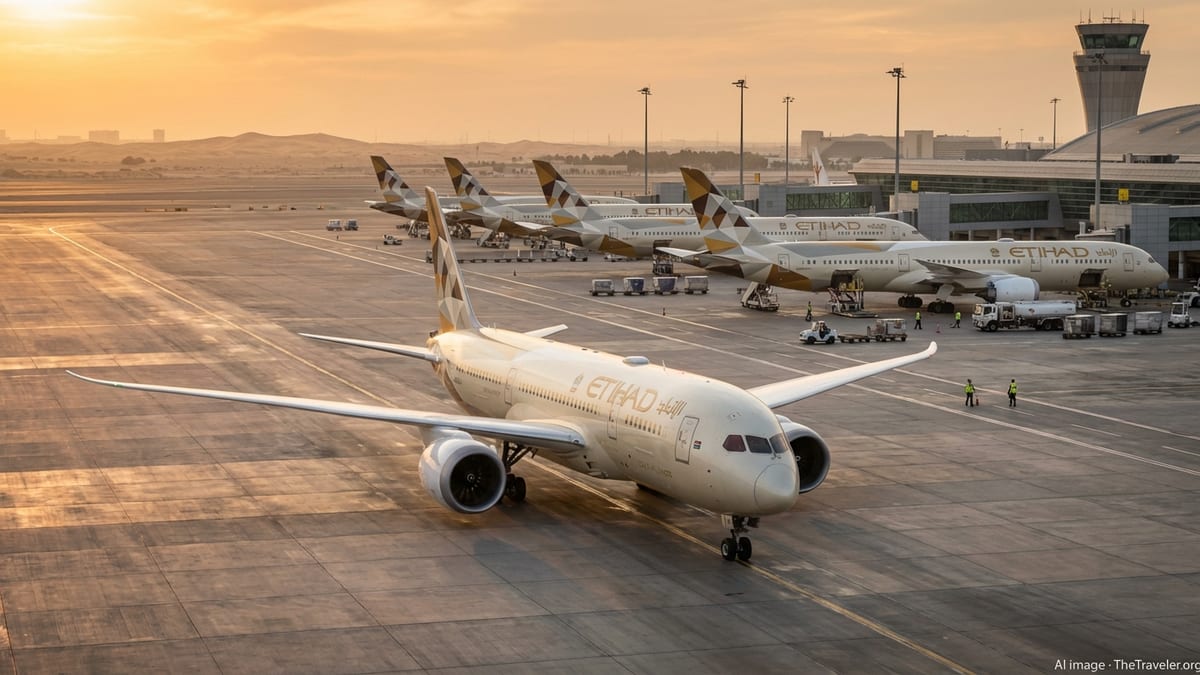
The earnings surge has been underpinned by a rapid build out of Etihad’s fleet. The carrier ended 2025 with 127 aircraft in service, the largest fleet in its history, after adding 29 jets during the year through new deliveries from Boeing and Airbus and the return of additional widebodies from storage.
The airline has focused on a mix of fuel efficient new generation narrowbodies for regional growth and long haul widebodies deployed on trunk routes linking Abu Dhabi with major cities in Europe, Asia and North America. The reintroduction of the Airbus A380 on selected high demand routes has allowed Etihad to add premium capacity efficiently where demand for first and business class remains strong.
Executives acknowledge that global supply chain disruptions and delivery delays have complicated fleet planning, but say coordination with manufacturers is improving. The carrier expects around 20 more aircraft to arrive in 2026, largely from Airbus, which will support further network growth and cabin retrofits designed to standardise the onboard product.
The enlarged fleet has also boosted cargo capability. Expanded belly freight space and dedicated freighters helped Etihad become one of the leading operators on lanes between mainland China and the Middle East, with more than 100 monthly cargo services on that corridor supporting e commerce and manufacturing supply chains.
Network Growth Across Asia, Europe and the Americas
Etihad’s financial rebound has been closely linked to an aggressive but targeted network strategy. Over the past two years the carrier has opened more than 20 new destinations and increased frequencies on numerous existing routes, using Abu Dhabi’s Zayed International Airport as a connecting hub between Asia, Europe, Africa and North America.
In 2025, the airline introduced services to cities including Prague, Hanoi, Hong Kong, Chiang Mai, Tunis and Medina, broadening its footprint in Central and Eastern Europe, Southeast Asia and North Africa. These additions complemented earlier launches to leisure and secondary markets such as Bali, Antalya and Santorini, as well as new long haul links like Boston that strengthened its presence in the United States.
The expansion has been particularly focused on Asia and Europe, where Etihad sees sustained appetite for one stop connections via the Gulf. The carrier plans further growth in mainland China and Southeast Asia this year, alongside extra capacity into key European capitals and secondary cities. In the Americas, new Canadian services and additional U.S. frequencies are designed to funnel more traffic between North America and emerging markets in South and Southeast Asia.
Executives say the performance of these new markets is exceeding internal forecasts, with routes maturing more quickly than expected and contributing incremental premium demand, especially from business travelers and high spending leisure passengers.
Premium Demand, Customer Experience and Hub Strategy
Etihad’s leadership attributes the latest profit surge to more than just geographic expansion. The airline has been investing heavily in cabin upgrades, lounges and digital services, seeking to differentiate itself in an intensely competitive Gulf market. Management reports record customer satisfaction scores in 2025, supported by a suite of new products in business and economy cabins and a renewed emphasis on service consistency.
The carrier has leaned into a strategy of pursuing “quality growth,” prioritising yields and premium demand rather than simply chasing volume. Executives say they are seeing more high value bookings across long haul cabins, with many flights departing at or near 90 percent load factors during peak periods. Strong performance in corporate and connecting traffic is helping to support the economics of newly launched routes.
Abu Dhabi’s upgraded airport infrastructure is central to this approach. The expanded hub allows Etihad to timetable more tightly banked connections and to market the UAE capital as an efficient gateway between Asia and the West. Additional lounges, streamlined transfers and an enlarged duty free and hospitality offering aim to keep the hub competitive with larger rivals in the region.
At the same time, the airline continues to emphasise fleet modernisation and fuel efficiency as part of its sustainability agenda. A younger average fleet age, combined with operational initiatives such as optimised flight paths and weight reduction programmes, is intended to reduce emissions per passenger while also lowering operating costs.
Outlook: Capacity Growth and Delivery Challenges
Looking ahead, Etihad sees little sign of demand softening across its main markets. Early traffic data for 2026 points to another strong year, with January passenger numbers rising sharply compared with the previous year and average load factors approaching 90 percent even as capacity increases.
The airline plans to continue growing both fleet and network, with around 20 additional aircraft expected to join this year and more routes under evaluation in Asia, Europe and North America. Priority will be given to city pairs that feed connecting flows through Abu Dhabi while diversifying the network beyond traditional metropolitan centres.
Industry wide bottlenecks remain a risk. Aircraft manufacturers are still grappling with supply chain constraints and certification issues, raising the possibility of delivery delays that could slow capacity expansion. Etihad says it is working closely with its suppliers and adjusting retrofit schedules to mitigate these pressures, but acknowledges that the operating environment remains fluid.
For now, the combination of strong global travel demand, an enlarged and more efficient fleet and a deeper route map has positioned Etihad Airways for another year of above industry growth, reinforcing the UAE carrier’s status as a rising heavyweight in international aviation.