

More news on this day
Etihad Rail is moving into the final stretch before launching its first passenger services, a high-speed, comfort-focused rail network that will dramatically cut travel times between Dubai, Abu Dhabi, Sharjah and Fujairah and redefine how residents and visitors move across the UAE.
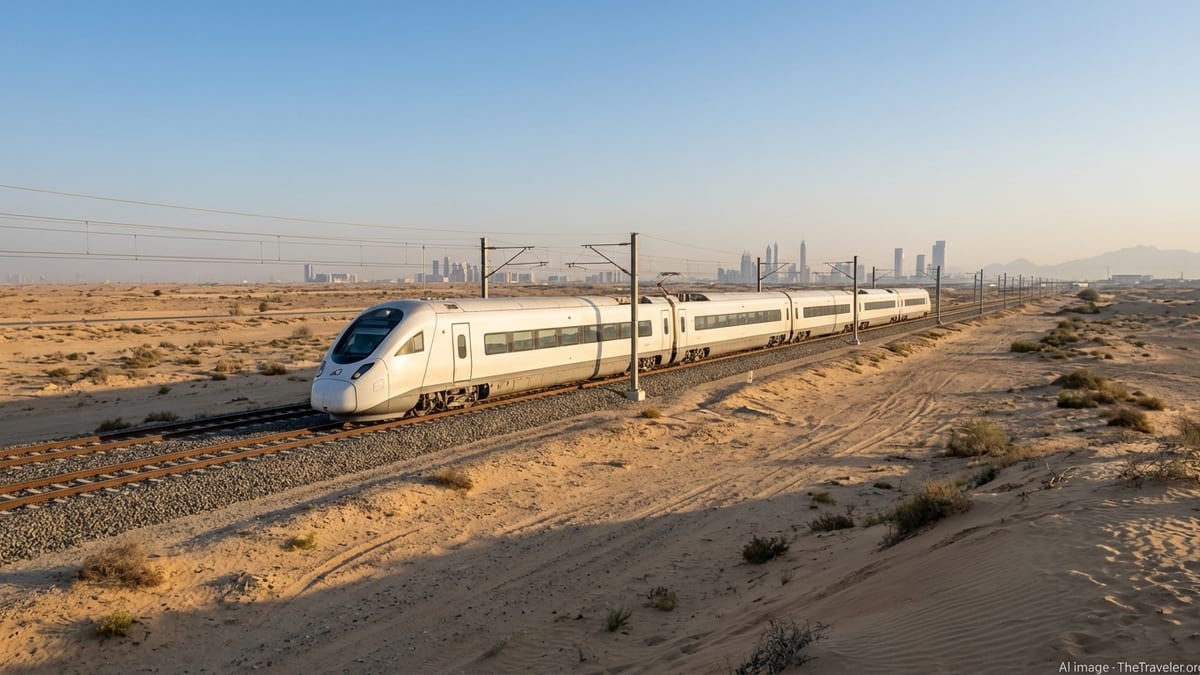
High-Speed Network Linking Key UAE Cities
Etihad Rail’s upcoming passenger service will form the backbone of a national rail network designed to connect major urban centers and coastal hubs, including Dubai, Abu Dhabi, Sharjah and Fujairah. The first phase of the passenger rollout will see trains serving 11 cities and regions, with stations in central locations such as Mohammed Bin Zayed City in Abu Dhabi, Jumeirah Golf Estates in Dubai, University City in Sharjah and the Al Hilal area in Fujairah.
Trains on the core passenger network are expected to operate at speeds of up to 200 kilometers per hour, carrying around 400 passengers per train. The service is being introduced alongside the UAE’s existing 1,200 kilometer freight network, signaling a shift from a purely logistics-focused railway to one that also serves daily commuters, business travelers and tourists.
Officials have indicated that services will come online in phases throughout 2026, with testing already complete on most of the fleet and the majority of trainsets delivered. When fully operational, Etihad Rail aims to accommodate up to 36 million passengers annually by the end of the decade, positioning rail as a mainstream alternative to driving between the country’s biggest population centers.
Comfort, Convenience and a New Standard of Onboard Experience
Beyond speed, Etihad Rail is pitching its passenger trains as a new benchmark for comfort and convenience in regional travel. Carriages are being fitted with spacious seating layouts, generous legroom and modern interiors to encourage passengers to work, relax or socialize during their journeys. Large windows will offer views of the UAE’s changing landscapes, from desert interiors to coastal approaches.
Business travelers are a clear focus, with onboard Wi Fi, power outlets at every seat and quiet, professionally designed spaces for work and meetings. The operator expects the trains to become a viable mobile office between key economic hubs, particularly along the Abu Dhabi to Dubai and Dubai to Sharjah corridors, where road congestion can be unpredictable and time consuming.
Timetables are being designed around fast, predictable connections, with a strong emphasis on punctuality and frequency. By offering a reliable service and guaranteed seating, Etihad Rail aims to give passengers back productive or restorative time that would otherwise be lost to traffic, parking and road fatigue.
Family-Friendly Travel From Coast to Desert
The new passenger service is also being framed as a family friendly alternative to long car journeys across the Emirates. Train interiors will feature dedicated family seating zones, allowing parents and children to sit together comfortably, along with abundant luggage space to support weekend trips, beach breaks and visits to relatives across different emirates.
By taking driving, navigation and traffic stress out of the equation, planners say journeys will become part of the shared experience rather than a chore. With no need to focus on the road, families will be free to talk, read, play games and enjoy the scenery, turning what was once a tiring drive into quality time together.
The stations themselves are being positioned as welcoming community gateways, connecting urban districts, desert communities, coastal towns and educational hubs. With stops stretching from Al Sila and Al Dhannah in Abu Dhabi’s western region to Al Dhaid in Sharjah and the Al Hilal area in Fujairah, the network is set to open up lesser visited parts of the country to domestic tourism and short breaks.
Strategic Vision: Cutting Emissions and Easing Congestion
Etihad Rail’s passenger project forms a central pillar of the UAE’s long term development agenda, including the national Projects of the 50 framework that prioritizes sustainable growth and economic integration. Rail travel is expected to significantly reduce carbon emissions compared with private cars and intercity buses, with estimates suggesting a cut of around 70 to 80 percent in emissions per passenger kilometer versus road transport.
Officials also view the rail network as a powerful tool for easing congestion on some of the country’s busiest highways, particularly between Dubai and Abu Dhabi. By offering journey times of under an hour between major cities, with fast connections onward to Sharjah and Fujairah, the service is designed to encourage a shift away from single occupancy car travel and to support more balanced regional development.
The network’s alignment with major residential areas, business districts and university hubs reflects a broader push to integrate transport planning with urban growth. Stations at locations such as Mohammed Bin Zayed City and University City are expected to act as catalysts for new mixed use development, enhancing access to jobs, education and leisure without reinforcing car dependency.
What This Means for Travelers and Tourism
For everyday travelers, the arrival of Etihad Rail’s passenger services will mark a step change in how they think about moving around the UAE. Commuters who currently rely on long car journeys between emirates will gain a consistent, weather independent and comfortable alternative that allows them to reclaim time for work or rest. For students and young professionals, the network promises more flexible access to universities, workplaces and events across city boundaries.
The tourism sector also stands to benefit as iconic city skylines, desert landscapes and east coast beaches become more easily linked by rail. Visitors based in Dubai or Abu Dhabi will be able to reach Sharjah’s cultural districts or Fujairah’s mountain and seaside resorts quickly and comfortably, encouraging multi stop itineraries that spread tourism spending across the country.
As Etihad Rail finalizes preparations for launch, expectations are building that the new service will do more than simply move people between cities. By combining high speed, comfort and convenience with a strong focus on safety and national identity, the rail network is poised to reshape daily life and travel habits across the UAE in the years ahead.