

More news on this day
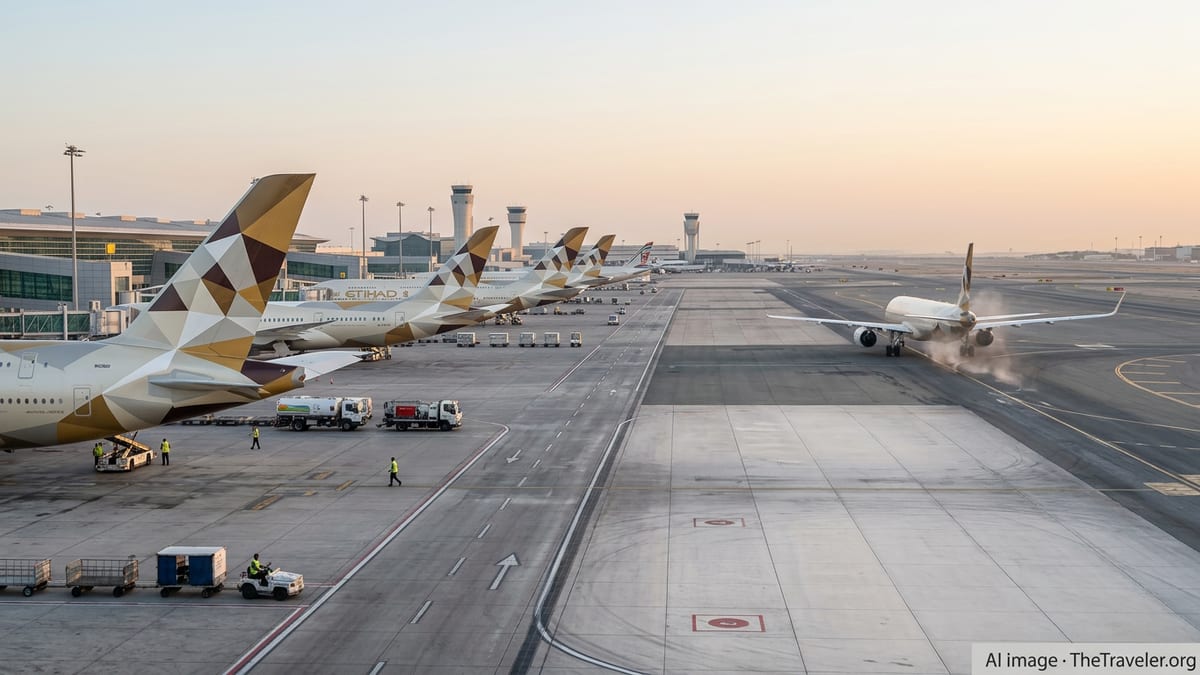
Etihad Airways has begun restoring flights from Abu Dhabi to dozens of global destinations after days of unprecedented airspace closures across the Middle East, marking a cautious step toward reconnecting key travel corridors between Europe, Asia and Africa.
Limited Schedules Return After Widespread Shutdown
Etihad Airways confirmed that a limited flight schedule is now operating from Abu Dhabi, following a partial reopening of United Arab Emirates airspace after regional conflict forced authorities to halt most commercial traffic. The restart, which began earlier this week, comes after days of grounded aircraft and diverted routes that rippled through global aviation networks.
According to operational updates from aviation data providers and regional travel advisories, Etihad is currently flying a reduced network focused on high-demand trunk routes and key partner hubs. Capacity remains significantly below normal levels, with the airline prioritising services that reconnect major cities in Europe, Asia, North America and the Indian subcontinent via Abu Dhabi.
The move mirrors similar steps by fellow Gulf carrier Emirates, which has also resumed a limited schedule from Dubai. Together, the UAE’s two largest airlines are cautiously reopening some of the world’s most important long-haul transfer hubs, even as surrounding airspace remains heavily restricted and flight paths continue to be reworked on a daily basis.
Regional authorities and carriers stress that the situation remains fluid, with schedules subject to late changes as risk assessments evolve. Travellers are being urged to treat early services as part of a gradual restart rather than a full return to business as usual.
Reconnecting a Global Network via Abu Dhabi
Industry trackers report that Etihad is now serving dozens of international destinations from Abu Dhabi, including key cities in Western Europe, South and Southeast Asia, Australia and North America. While the precise network is being adjusted day by day, flights are operating on many of the airline’s flagship routes, helping to clear a backlog of stranded passengers and restore long-haul connectivity.
Priority has been given to routes with large numbers of transfer passengers who were caught mid-journey when airspace closures took effect. Additional services and upgauged aircraft have been deployed on select sectors where demand is strongest, particularly between Abu Dhabi and major South Asian, European and Gulf gateways.
Abu Dhabi’s role as a connecting hub is central to the restart strategy. By re-establishing a core bank of arrivals and departures, Etihad is attempting to rebuild the complex wave structure that underpins its long-haul network, even if some spokes remain temporarily offline. Airport operators in the UAE report that terminal operations are stabilising, but emphasise that volumes remain well below normal peak-season levels.
Travel analysts note that the pace at which Etihad can restore its wider network will depend not only on demand and aircraft availability but also on how quickly neighbouring states relax route restrictions. Until more air corridors reopen, the carrier will continue to concentrate on markets that can be reliably reached using currently approved routings.
Complex Rerouting and Longer Flight Times
The resumption of flights has not meant a return to traditional routings. Large sections of airspace across parts of the Middle East remain closed or heavily constrained, forcing Etihad and other carriers to design complex detours that add hours to some journeys and increase operating costs.
Europe to Asia and Australia services, which normally rely on efficient overflight rights across Iran, Iraq and parts of the Gulf, are among the most affected. Many flights are now skirting restricted zones via alternative corridors over the eastern Mediterranean, the Caucasus, Saudi Arabia and the Arabian Sea. These diversions reduce the number of usable air routes and concentrate traffic into narrow aerial corridors.
Passengers on some long-haul sectors are experiencing extended flight times and, in certain cases, technical fuel stops where aircraft must land en route to refuel due to the longer distance. Airlines have warned that these operational constraints could temporarily limit available seats and push fares higher on specific routes, particularly where alternative carriers face the same geographic bottlenecks.
Despite the disruption, safety regulators and airline safety teams continue to stress that no flight is operating through airspace that has not been subject to rigorous risk assessment. The preference, experts note, has been to cancel or reroute services rather than attempt marginal operations in areas where security assessments remain uncertain.
Passenger Priorities, Flexibility and Guidance
With demand outstripping the number of available seats on many restarted routes, Etihad is prioritising travellers whose flights were cancelled during the shutdown period, as well as those on essential journeys. The airline has issued repeated guidance advising customers not to travel to the airport unless they have been directly notified that their flight is confirmed to operate.
Flexible rebooking and refund policies, initially introduced at the height of the disruption, remain in place for many affected itineraries. Travellers whose flights are still suspended are generally being offered the option to move to alternative dates, reroute via different gateways when operationally possible, or request refunds in line with the carrier’s disruption policy.
Airports in the UAE report a gradual easing of congestion as clearer schedules emerge and more passengers receive updated itineraries. However, check in, security and boarding processes can still take longer than usual, particularly where additional document checks or last minute gate changes are required due to evolving airspace conditions.
Travel advisers are recommending that passengers maintain close contact with airlines and booking agents, monitor flight status frequently, and allow additional time for formalities. Those with non-urgent travel are being encouraged to delay trips until schedules normalise and capacity returns, freeing seats for travellers attempting to complete disrupted journeys.
Strategic Test for UAE’s Global Hub Ambitions
The latest airspace crisis represents another major test of resilience for the UAE’s aviation sector, which has spent years positioning itself as a vital connector between continents. Etihad’s ability to rapidly restart a meaningful portion of its global network, even under constrained conditions, is being closely watched by governments, investors and competitors.
Analysts point out that the dual hub system centred on Abu Dhabi and Dubai gives the UAE an advantage when recovering from shocks, allowing airlines to share operational intelligence, coordinate air traffic flows and, where necessary, shift capacity between networks. The current restart underscores how quickly carriers and regulators in the country can move from shutdown to phased reopening once safety thresholds are met.
At the same time, the episode highlights the structural vulnerability of long-haul models that depend on stable access to neighbouring airspace. Even short term closures can strand tens of thousands of passengers and disrupt global supply chains, particularly when they coincide with peak travel seasons.
For now, Etihad is signaling cautious optimism, framing the resumption of flights as an important step toward restoring normal connectivity while acknowledging that further adjustments are likely. As airspace restrictions gradually ease and more corridors reopen, the airline expects to add frequencies and bring additional destinations back online, inching the wider international network closer to its pre-disruption shape.