

More news on this day
Etihad Airways has begun operating a small number of departures from Abu Dhabi ahead of a wider reopening of UAE skies, threading flights through a narrow band of safe airspace as regional conflict continues to disrupt travel across the Middle East.
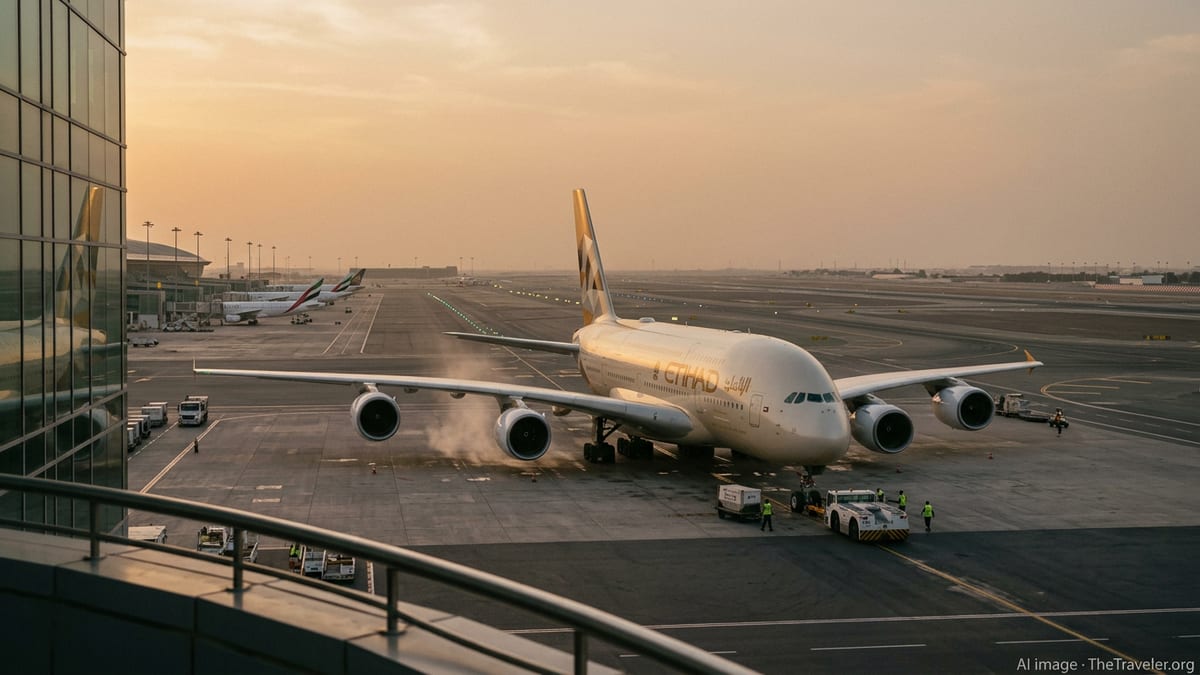
First Departures Take Off Through Limited Corridor
After several days of blanket suspension, Etihad moved earlier than expected to restart select services on March 2, as Emirati authorities lifted a full closure of national airspace and replaced it with tightly controlled access routes into and out of Abu Dhabi. Flight-tracking data showed one of the first departures routing to London Heathrow, marking a symbolic step toward restoring the hub’s global connectivity even as routine schedules remain largely frozen.
The partial reopening followed a Notice to Air Missions that allows a restricted number of arrivals and departures from Abu Dhabi and a handful of secondary airports through designated corridors. These routes are designed to keep commercial aircraft away from areas of heightened military activity, while still enabling limited long-haul and regional operations. Widebody overflights have also been cleared on specific tracks, giving airlines a narrow but crucial passage between Europe and Asia.
For Etihad, the early departures are framed as operationally necessary flights rather than a full return to business as usual. The airline has emphasised that each movement is subject to individual safety and security assessments, with aircraft, crews and destinations chosen to align with the new routing options and evolving risk maps across the region.
The move nonetheless signals that Abu Dhabi, unlike the still-closed hubs in Dubai and parts of northern Emirates, is beginning to reassert itself as a workable, if constrained, transit point. For stranded travellers and cargo customers, the sight of Etihad aircraft leaving Zayed International Airport again is an early sign that the total standstill of recent days is easing, even if only for carefully controlled services.
Repatriation, Cargo and Repositioning Drive Initial Schedule
Etihad’s first wave of flights is concentrated on what executives describe as “essential operations,” including repatriation services, cargo movements and repositioning of aircraft and crew. Recent statements from the airline stress that scheduled commercial services for the general public remain suspended, and that only passengers directly contacted by Etihad should proceed to the airport.
Destinations reached in the initial restart include a mix of key European capitals, South Asian gateways and regional cities, reflecting both demand patterns and the feasibility of routing via the newly available corridors. These flights are being coordinated closely with the UAE’s General Civil Aviation Authority and foreign regulators, with approvals granted on a case-by-case basis.
The focus on cargo highlights the strategic importance of Abu Dhabi’s role in global supply chains. With much of the Middle East airspace effectively off limits or heavily restricted, shippers have scrambled to reroute time-sensitive goods ranging from pharmaceuticals to electronic components. Carefully planned Etihad freighter and bellyhold operations through the reopened corridors are intended to keep critical trade moving while minimising exposure to risk.
At the same time, repatriation flights are providing a limited lifeline for residents and visitors who found themselves stranded after abrupt airspace closures rippled through the network. Governments in Europe, Asia and North America have been urging citizens to leave the region where possible, amplifying demand for any available seats on outbound services from the Gulf.
Regional Conflict Keeps Airspace Tense and Fragmented
The cautious restart is taking place against the backdrop of an escalating conflict that has seen the United States and Israel launch strikes on Iran, followed by Iranian missile and drone attacks on targets in the Gulf. In response, a swathe of countries across the region, including Iran, Iraq, Israel, Bahrain, Qatar, Kuwait, Saudi Arabia and the UAE, have instituted full or partial closures of their airspace, effectively redrawing the map for international aviation overnight.
With Russian skies already off limits to many Western airlines, carriers have been forced to squeeze long-haul flights between Europe and Asia through a handful of remaining corridors. One of the most critical lies over the Caucasus, where traffic density has surged as airlines attempt to remain clear of both Russian territory and the conflict-affected zones of the Middle East. The result is longer flight times, higher fuel burn and increased operational complexity for routes that once relied on efficient Gulf overflights.
Industry analysts note that the current disruptions rank among the most severe in the modern jet age, not only because of the scale of the closures but also because they affect major connecting hubs that underpin global travel. Abu Dhabi and Dubai, together with Doha, typically host thousands of daily transit passengers; with these hubs constrained or closed, airlines from Europe to Australasia are cancelling or rerouting services in unprecedented numbers.
Aviation authorities across the region continue to stress that the protection of civilian aircraft is paramount. Regulators and air navigation service providers are working with military planners to keep commercial routes physically separated from potential conflict zones, but they warn that changes to restrictions can occur at very short notice, leaving airlines and passengers facing ongoing uncertainty.
Passengers Urged to Wait for Confirmation Before Heading to Airport
Despite the high-profile first departures, Etihad has been explicit that the vast majority of its customers should not attempt to travel to the airport unless they have been contacted directly. The airline has extended the suspension of regular commercial flights to and from Abu Dhabi until at least the afternoon of March 4, citing the continuing volatility of regional airspace and the need for strict safety margins.
Travellers holding tickets for the disrupted period are being offered free rebooking within defined travel windows, as well as the option of full refunds. However, contact centres and digital channels remain under intense pressure as thousands of passengers seek clarity on their itineraries. Etihad has urged customers to rely on official communications about their specific bookings rather than general reports of flights departing Abu Dhabi.
Airport operators are also preparing for a protracted period of irregular operations. With only a fraction of normal movements authorised, terminals are notably quieter than usual, yet still host clusters of passengers awaiting updates on repatriation or onward travel. Airport authorities have warned that some flights may be retimed, rerouted or cancelled at very short notice if security assessments change.
Travel advisers recommend that passengers with flexible plans delay non-essential trips through the region until a more stable pattern of operations emerges, and that those who must travel build in generous buffers for potential disruption. Insurance providers are revisiting policy wording around war and airspace-related cancellations, an area that had already come under scrutiny during previous geopolitical crises.
Etihad Balances Safety Priorities With Hub Recovery
For Etihad’s management, the early resumption of select flights is part of a delicate balancing act between upholding the airline’s safety-first stance and beginning the long process of rebuilding its schedule. Executives have repeatedly stated that services will only operate when all safety criteria are met, and that any further expansion of flying will be contingent on both regulatory clearances and a sustained reduction in military risk.
The carrier’s strategy appears to prioritise rebuilding key trunk routes that support Abu Dhabi’s position as an intercontinental hub, while maintaining flexibility to scale back quickly if conditions deteriorate. Fleet deployment plans are being reassessed in real time, with widebody aircraft assigned to markets where demand for essential travel and repatriation is highest and routing remains viable.
In the medium term, the current crisis may accelerate discussions between Gulf carriers, regional regulators and global aviation bodies over how to manage conflict-related airspace closures more predictably. Airlines have long called for clearer frameworks on risk sharing, compensation and information sharing when skies are suddenly shut, arguing that they bear disproportionate operational and financial burdens.
For now, however, Etihad’s tentative departures from Abu Dhabi stand as an example of how carriers are trying to move ahead of formal reopening timelines without compromising on safety. Each successfully completed rotation through the narrow corridors available to civil aviation offers both practical relief to travellers and a cautiously optimistic sign that the Gulf’s critical role in global air travel may gradually reassert itself, even amid ongoing tension in the skies.