

More news on this day
Etihad Airways is rapidly rebuilding Abu Dhabi’s role as a global hub, restoring long-haul links, adding new destinations and tightening passenger protocols as demand for international travel rebounds across key markets.
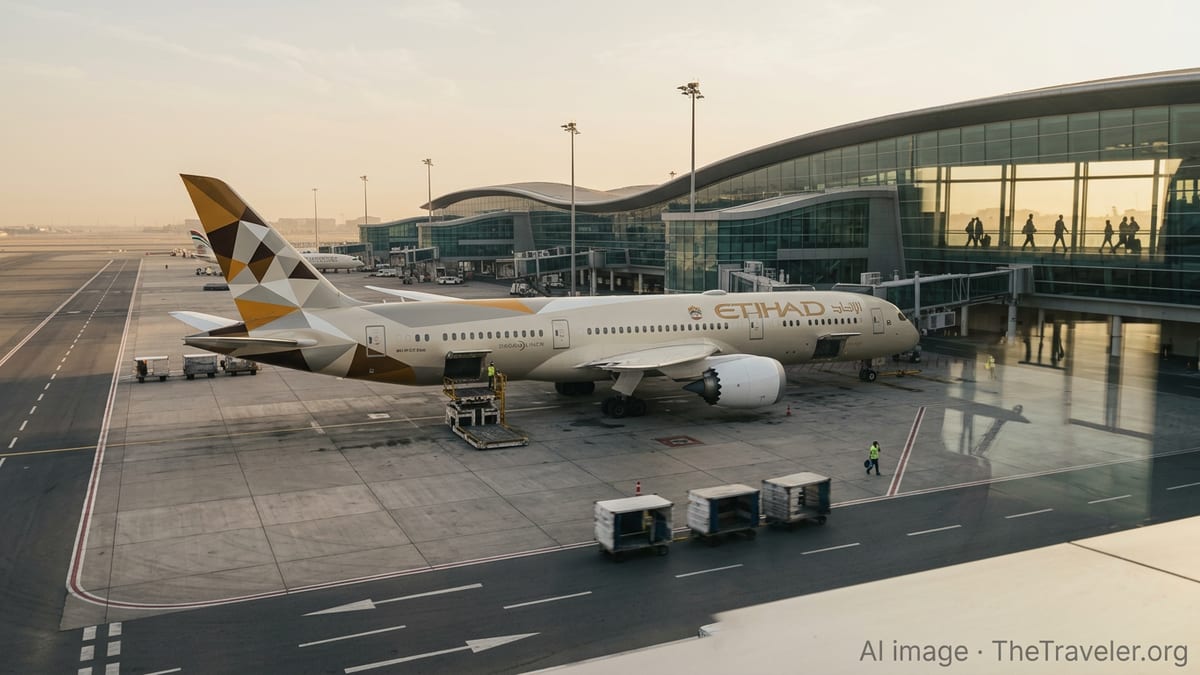
New Routes Cement Abu Dhabi as a Rebounding Global Hub
From North America to Asia and the Middle East, Etihad is methodically stitching Abu Dhabi back into the center of world air travel. The carrier’s current growth phase focuses on reactivating suspended routes and opening new ones that funnel traffic through the UAE capital, supporting both point-to-point demand and one-stop connectivity between major regions.
Among the most visible moves is the planned launch of nonstop flights between Abu Dhabi and Charlotte in the United States in 2026, creating a new bridge between the fast‑growing U.S. Southeast and Etihad’s expanding network across the Gulf, Indian subcontinent and Southeast Asia. The route will be Charlotte’s first direct link to the Middle East and its longest flight, underlining Abu Dhabi’s rising profile as an alternative gateway for transatlantic and transpacific itineraries.
Across Asia, Etihad has been rolling out new services to cities such as Hanoi, Chiang Mai, Hong Kong and other growth markets, using a mix of Boeing 787s and Airbus A321LRs to match capacity with demand while restoring pre‑crisis levels of connectivity. These additions are designed to attract new visitors to Abu Dhabi and to provide more options for business and leisure travelers using the city as a connection point.
On regional routes, the airline is also resuming or inaugurating flights to markets including Kabul and, from 2026, Damascus, reconnecting communities and commercial flows that rely heavily on Gulf hubs. Together, the new and restored services support Abu Dhabi’s strategy to diversify its economy through tourism and trade while reinforcing Etihad’s position in a highly competitive long‑haul landscape.
Tighter Minimum Connection Times and Smarter Hub Operations
Alongside its route expansion, Etihad is reshaping how passengers move through Abu Dhabi’s Zayed International Airport, aiming to make the hub both faster and more intuitive. A key step is the recent reduction of the minimum connection time on Etihad‑to‑Etihad itineraries from 60 to 45 minutes for most destinations, a change that enables more efficient scheduling and opens up additional same‑day connection options.
The shorter connection window reflects both operational confidence and a series of behind‑the‑scenes improvements, including more streamlined gate allocations, better alignment between arrival and departure banks, and enhanced coordination between ground handling, security and immigration processes. For travelers, the impact is felt in tighter itineraries with less downtime in transit and a higher likelihood of making preferred onward flights.
US‑bound passengers remain subject to longer connection requirements because of additional security and processing standards, especially for those using the airport’s U.S. preclearance facilities. Even here, however, Etihad and airport authorities are working to smooth the experience through clearer communication of cut‑off times, dedicated transfer support staff and updated digital tools that help passengers navigate formalities.
These hub‑level adjustments are central to Etihad’s effort to position Abu Dhabi as a convenient alternative to larger Gulf competitors. By pairing a growing network with more agile operations, the airline aims to win over time‑sensitive travelers, particularly those connecting between secondary cities in Europe, Asia and the Americas that historically required longer layovers.
Enhanced Health, Security and Service Protocols for Travelers
As long‑haul traffic climbs back toward and beyond pre‑pandemic volumes, Etihad is maintaining a heightened focus on health, safety and security across its operations. Cleaning and disinfection standards introduced during the crisis have been institutionalized, with high‑touch cabin surfaces treated regularly, air filtration systems continuously monitored and aircraft turnaround routines adjusted to preserve both hygiene and efficiency.
On the ground in Abu Dhabi, passenger flows are being managed through redesigned queuing systems, expanded use of e‑gates and biometric touchpoints, and clearer wayfinding that reduces congestion at security and immigration. These measures support a more predictable journey while responding to the enduring expectations of travelers who remain attentive to crowding and cleanliness.
Security protocols have also been updated in line with evolving regional risk assessments, particularly for flights to and from conflict‑adjacent markets. Etihad is coordinating closely with regulators and international partners on screening, airspace management and crew training to ensure that restored connectivity does not come at the expense of safety or operational resilience.
At the same time, the airline is trying to balance stricter protocols with service enhancements, including upgraded onboard connectivity via next‑generation satellite systems and refreshed cabin products on new‑generation aircraft such as the A321LR. The objective is to offer a travel experience that feels both reassuring and comfortable, especially on multi‑segment journeys routed through Abu Dhabi.
Strategic Growth Underpins Abu Dhabi’s Wider Economic Ambitions
Etihad’s network restoration is unfolding against the backdrop of an ambitious long‑term blueprint to grow Abu Dhabi as a tourism, trade and investment hub. The airline has outlined plans to double its fleet and significantly increase passenger numbers over the remainder of the decade, using a mix of fuel‑efficient widebodies for intercontinental routes and new‑generation narrowbodies for regional and mid‑haul services.
This growth is tightly aligned with the emirate’s push to attract more visitors, expand meetings and events traffic, and deepen commercial ties with markets across Africa, Asia, Europe and North America. New and restored routes are being coordinated with tourism campaigns, cultural programming and major sporting partnerships that raise Abu Dhabi’s profile on the global stage.
Financially, Etihad has emerged from years of restructuring to report robust profits and stronger balance‑sheet fundamentals, giving it more room to invest in network expansion, digital tools and customer‑facing upgrades. The carrier’s leadership has framed this phase as one of disciplined, sustainable growth focused on routes and frequencies that reinforce Abu Dhabi’s connectivity rather than chasing scale for its own sake.
For travelers, the result is a steadily widening map of one‑stop options through the UAE capital, supported by more efficient transfers and a clear emphasis on safety and service. For Abu Dhabi, Etihad’s restored global flight connectivity and enhanced passenger protocols translate into a renewed opportunity to position the city as one of the world’s most connected and competitive aviation hubs.